Monday, February 13, 2006

The Rolling Gospel of Thomas

If April DeConick is right about the gospel of Thomas, it belongs in the New Testament canon. Defying scholars who posit a late gnostic gospel, and liberals who identify an early source of wisdom sayings, DeConick proposes something radically new: that the earliest form of Thomas was thoroughly apocalyptic, and only later, in the face of failed expectations, did the gospel sayings become pressed into a mystical (though not gnostic) service, in an attempt to make the kingdom realized on earth.

DeConick sees the compositional history of Thomas as a "rolling corpus," in the same way William McKane has described that of the book of Jeremiah. A rolling corpus is based on the original words of a prophet received through oral tradition, with new oral material added over time to interpret, explain, and (most importantly) update the meaning of the sayings (p 61). She finds four layers in the rolling corpus of Thomas (see pp 97-98):
1. The Kernel gospel (30-50 CE) consisting of Jesus' apocalyptic warnings and his advice about preparing for the day of fiery judgment (80 passages)

2. Accretions (50-60 CE) dealing with relocation and a leadership crisis (2 passages)

3. Accretions (60-100 CE) accommodating Gentiles, and addressing the early eschatological crisis which resulted in a shift to the mystical dimension of apocalyptic thought (23 passages)

4. Accretions (80-120 CE) addressing new Christological developments and the continued eschatological crisis which resulted in incorporating primordial traditions pointing to paradise regained (41 passages)
The Thomasine Christians are thus seen to evolve from an apocalyptic community to an Edenic one, and by the second century, "their church was Paradise; they were Adam and Eve before the Fall" (p 240). The complete gospel dates no later than 120 CE, roughly contemporary with John's gospel and letters, and the Pastoral epistles. This "grounds Thomas' theology inside early orthodoxy rather than outside... Thomas represents a current in the stream of Christian traditions that ultimately became Eastern orthodoxy" (pp 240-242).

In an interesting anecdote, the author mentions the thanks she has received from a Greek Orthodox hieromonk for "discovering the origins of his religion" (see p 241). Neither a gnostic heresy, nor countercultural wisdom sayings, Thomas points to paradise regained after a failed apocalypse, readily conducive to Eastern Orthodoxy, which (unlike Western Catholicism) teaches the divine image still recoverable on earth. But is she right about all this?

Much of her analysis of the "Kernel" is fine on its own right. In these isolated passages Jesus comes across as a prophet of doom and judgment who is already casting fire on the earth. Jewish apocalyptic portrays the boundary between earth and heaven starting to collapse -- the "rolling up of the skies" (p 133) -- just like in Thom 111, where it's said that the heavens and earth will be rolled up in the very presence of believers (p 137).

Likewise, Jesus is identified with the fire of the heavenly realm: he promises that believers who draw near to him will experience a fiery epiphany (Thom 82); in apocalyptic literature fire is often associated with theophanies (p 137). Other sayings presuppose a time of apocalyptic chaos during which the powers of good and evil are battling for control of the world; calamity -- and key words like "sword, famine, fire, war" -- are common motifs in apocalyptic literature, just as in a saying like Thom 16 (pp 138-139). Jesus offers advice to prepare oneself for the end in various sayings (like Thom 98 and 103) (p 139). He offers the advice of I Enoch 62-63, telling kings to renounce their worldly power (Thom 46) as God's judgment draws near (p 140). A reversal of world order is expected (Thom 63 and 78) (pp 140-141).

All fine and well: from wherever these sayings come, they were surely apocalyptic in origin. But that the gospel of Thomas preserves their original grouping in a collection traceable to 30-50 CE probably amounts to wishful thinking.

For many of the sayings of this so-called Kernel gospel make just as much sense (if not more) as late reinterpretations of those found in the synoptic gospels. Nowhere is this more evident than in Jesus' pronouncement against the temple: "I will destroy this house and no one will be able to rebuild it" (Thom 71). DeConick offers a peculiar commentary on this passage:
"Unlike Mark, which is promoting the tradition that a divinely rebuilt temple will take its place, a temple 'not made with hands', this Thomas saying suggests that the temple will not be raised again. It is likely that this tradition is older than the synoptic variants, which tone down the harsh oracle by suggesting that there is hope, the temple will be rebuilt." (p 142)
This seems backwards. Originally, Jesus probably made a prediction about God destroying the temple and rebuilding it. When the temple was actually destroyed by the Romans (forty years later), there was less and less hope for its rebuilding as time went on; Jesus' prophecy became embarrassing. Mark and Matthew dealt with the embarrassment by placing the prophecy on the lips of false witnesses:
The chief priests were looking for testimony against Jesus to put him to death, but they found none. For many gave false testimony against him, saying, "We heard him say, 'I will destroy this temple that is made with hands, and in three days I will build another, not made with hands.'" (Mk 14:55-58/Mt 26:59-61)

They crucified Jesus... Those who passed by derided him, shaking their heads and saying, "You who would destroy the temple and rebuild it in three days, save yourself and come down from the cross!" (Mk 15:29-30/Mt 27:39-40)
Luke simply censored the prophecy. John spiritualized it:
Jesus said, "Destroy this temple, and in three days I will raise it up." The Judeans said, "This temple has been under construction for forty-six years, and you will raise it up in three days?" But he was speaking of the temple of his body. After he was raised from the dead, his disciples remembered that he had said this. (Jn 2:19-22)
Thomas -- evidently as embarrassed as the above four -- revised the prophecy, by insisting that no one would be able to rebuild the temple after its destruction:
"I will destroy this house, and no one will be able to rebuild it." (Thom 71)
So whether by falsification, censorship, spiritualization, or revision, Jesus' original prediction was controlled so that it squared with what actually happened forty years later. But DeConick wants us to believe that Thomas' version is original and predates 70 CE. This is problematic for two reasons. First, how did the "wrong" idea of the temple's rebuilding enter the Christian tradition, thereby necessitating the damage-control in Mark, Matthew, and John?

Second, there is little if any precedent in Jewish apocalyptic for the destruction of the temple without being rebuilt. DeConick herself acknowledges the many passages in which the temple is expected to be rebuilt (Jub 1:29, 23:21; I En 14:8-25, 71:5-6, 89:73, 91:13; II Bar 4:2-6, T Levi 5:1, 18:1-14; 4Q266 3:20-4:3), and only one where it is not (T Moses 5-10) (p 142). In the last, moreover, the temple's actual destruction isn't made plain (any more than it usually is, even in cases envisioning rebuilding, save perhaps I En 90). The point is that no matter how we tackle it, Thom 71 reads like a glaring post-70 revision rather than the original prophesy itself.

But more general: How does one even attempt to stratify a gospel and determine its earliest layer (the "Kernel")? Sometimes DeConick's strategy appears to be as circular as those she criticizes (Patterson, Koester, Arnal, and others who identify non-apocalyptic wisdom sayings at the base). She says we can do this in the case of Thomas "because it wasn't rewritten into a narrative or theological discourse like the synoptics and John" (p 36). This is an argument we've heard repeatedly from those who love this gospel (and the phantom Q): it lacks narrative. Why are narratives precluded from "earliest tradition"?

Her best answer seems to be that this is just the way oral traditions unfold. Brief, conservative, and redundant speeches mark the earliest stage (p 27), with questions/answer units coming later as they clarify and update the meaning of these speeches. This, she says (following Vernon Robbins), is the typical pattern seen in orally transmitted "speech" sources (p 55). How verifiable this is remains unclear.

She ties this to what is described in the Pseudo-Clementine corpus: sayings of Jesus first collected into speeches used by the early Jerusalem church for proselytizing purposes, with James himself commissioning their use (pp 34-35). "Thus, the first written speech gospels must predate James' death and probably reflect Christian traditions prior to 50 CE" (p 35). But that the gospel of Thomas happens to preserve one of these mysterious "speech gospels" may owe to a fertile imagination more than actual history.

I doubt that DeConick has recovered the original gospel of Thomas, much I would love her theory to be true. Like her, I find it impossible that the gospel is based on an early collection of wisdom sayings (p 46). Like her, I believe that earliest Christianity was apocalyptic to the core, and if she were right, then Thomas would go a long way to proving this with an apocalyptic kernel traceable to 30-50 CE -- predating even Paul's letters. But I don't have confidence in this method of stratifying the gospel (the rolling corpus model), and I'm eternally suspicious of what Donald Akenson calls "downward dating creep":
"The scholarly work on the Gospel of Thomas is illuminating, for it illustrates a particularly invasive phenomenon among biblical scholars -- namely, downward-dating-creep. When one observes this pattern with any Christian document, it is a warning light to the observer: watch carefully and count the spoons... Within the scholarly community there is an almost magical belief in low numbers..." (Saint Saul: A Skeleton Key to the Historical Jesus, p 92)
... and particularly with this gospel! DeConick's methodology impresses only slightly more than those of Patterson, Koester, and Arnal. It's nice that she focuses on oral developments more than redactional ones; that's long overdue. But can oral history go so far as to unlock a priceless layer of this gospel anymore than literary criticism can?

At the end of the day, the traditional view of Thomas as a late gnostic document (derived and reinterpreted from various apocalyptic passages in the synoptics) commends itself as the most likely theory, as unexciting as that may be. I don't think scholars like Meier and Ehrman have been mistaking early Jewish esotericism for gnosticism, as DeConick claims (p 54). I think they've spotted an implied gnostic thought pattern where it's been all along. It would be conveniently nice if Thomas did the two things DeConick wants it to do -- show the apocalyptic character of earliest Christianity and the orthodox nature of the end result -- and that may be why I really don't trust her theory: it's just too damn convenient. But despite its failure to convince, the book is important for the way it forces crucial questions about the evolution of oral traditions, and for its proof that sappiential wisdom sayings neither inevitably, nor likely, lie at the core of the gospel of Thomas.

UPDATE: See Stephen Carlson's review of the book.

Saturday, October 06, 2012

Retrospective/Review: Q, Thomas, and Killjoy Scholarship

Spring 2002: "If we were to dispense with Q, it would not be without tears. For Q has been all over the world, loved by everyone, feminists and liberation theologians, the sober and the sensational, the scholar and the layperson, a document with universal appeal. Indeed one of the keys to its success has been its ability to woo both conservatives and radicals alike. While conservatives, for example, are drawn by its early witness to the sayings of Jesus, others have seen its lack of a Passion Narrative as witnessing to an alternative stream of early Christianity, one not based on the proclamation of a crucified Christ. For those at one end of the theological spectrum, Q can give us a document of Jesus material from before 70, written within a generation of the death of Jesus. For those at the other end of the spectrum, Q aligns itself with the Gospel of Thomas to form a 'trajectory' in early Christianity that contrasted radically with emerging orthodoxy." (The Case Against Q, pp 16-17)

Fall 2012: "The idea that Thomas is familiar with the Gospels can seem unwelcome. If Thomas derives much of the material it shares with the Synoptics from the Synoptics themselves, then... no longer would Thomas be an early, independent witness to primitive Jesus tradition or to early, variant Christian ideologies. It is easy, in such circumstances, for a case in favour of Thomas's knowledge of the Synoptics to be seen as something of a recalcitrant, spoil-sport attempt to hark-back to a position that is now passé. Unless there are new arguments, and new perspectives, the case for an autonomous Thomas remains a highly attractive one to anyone interested in exploring the diversity of early Christianity. Given the difficulty in making progress in scholarship, some might feel that the last thing we want is to undo the fine work of the last generation and to set back the clock to a bland, monochrome view of Christian origins." (Thomas and the Gospels, p 3)

Mark Goodacre has become something of a killjoy in biblical scholarship, and that's cause for rejoicing. If historical criticism is supposed to be about scientific inquiry, or where evidence leads, then its results shouldn't necessarily please us. Yet it would seem that the field is often a playground for those who don't move beyond conjectures and deductions in efforts to paint things more complicated or arousingly different than they really were. The work done on Q and Thomas falls in a particularly unflattering spotlight, as the existence of one and early dating of the other enjoy remarkable followings, even by those who can only vaguely explain why they even believe such things.

I'm not exempt from this charge. I once believed in Q, for over a decade in fact, despite fleeting initial misgivings. As an undergrad in '91 I remember being taught the way Luke faithfully preserved Q as contrasted with Matthew's spiritualizing agenda, the classic point being "blessed are the poor" (Lk 6:20) which became "blessed are the poor in spirit" (Mt 5:3). Yet I had also just been taught that Luke had a social agenda for the poor and outcasts. Doesn't it make better sense, I asked, that the agenda worked in the opposite direction? That Luke socialized a spiritual saying? Well, came the answer, Q was concerned about the poor too.

And that was that. On the strength of scholarly consensus, assurances from a professor I held (and still hold) in high regard -- and because my introduction to the New Testament didn't even seriously entertain the idea that Luke could have known Matthew -- I accepted the phantom Q: a mysterious lost source which Matthew and Luke used independently of each other. I bought into this business with ease, and wouldn't seriously confront the Farrer theory1 until Goodacre's user-friendly defense of it in 2002.

I was not, however, on fast friendly terms with The Case Against Q. I was nonplussed by it at first, admiring its aesthetic (Goodacre is a good writer) while hating its content. It was an irritation and meant the great historical-Jesus scholars of the '90s -- and I mean the mighty ones like Meier and Allison as much as fantasists like Crossan and Borg -- were speaking the wrong language. It meant that so much scholarly labor on early Christian origins relied on a mirage. True, there was always Sanders, and yes, many a thesis would have pressed home the same with or without Q to lean on, but for purposes of academic dialogue, Q had been (and I think still is) a major common denominator. And I liked Q, or the idea of it: a tantalizing "gospel behind the gospels", which hinted at more primitive ideas.

Thomas is a different matter. I never bought into ideas about its early dating and literary independence, and so Goodacre's sequel is an immediate validation of what I always knew: that Thomas was familiar with the Synoptics, he used Matthew and Luke quite clearly, and his gospel is significantly gnostic (though Goodacre avoids the term: see further below) and can be comfortably dated to around the 140s. Lest I wax too smug, Goodacre does include a chapter on orality that gives me pause, as I've been somewhat guilty of caricatures he complains about when contrasting oral and print cultures. But more on that in a later post.

Back to Q: On second reading of Goodacre's book (in 2004), it emerged for me as what it is, becoming -- not to sound too dramatic -- a summons. What would happen, I asked myself, staring dully at the blue-and-white cover with its overbloated "Q", if I did not skim the uncongenial arguments this time, but gave myself to them, if I truly lowered the plow through the surface crust? Chapter seven's "How blessed are the poor?", in particular, pointed an accusing finger; it voiced my own nagging objection from way back in '91. But it wasn't just the specific point about Luke's social agenda that began turning me. The Case Against Q is one of those books that compels on every page with its even-handed candor and muscled interdisciplinary approach. Like the hot-off-the-press Thomas and the Gospels, it shows how the science of historical criticism can truly be at one with the humanities, when employed by aesthetic writers and shrewd thinkers.

Today, in retrospect, it actually stuns me how flimsy the basis for Q is. Its defenders have manufactured problems where none exist. That Luke doesn't reproduce Matthean elements within the triple tradition is unsurprising, as Goodacre notes, since those elements conflict with Luke's interests;2 we don't suddenly pretend we've never heard of redactional criticism in trying to prove a case for Q (p 51). More importantly, this claim isn't even true; there are very clear cases in the triple tradition where Luke looks more Matthean than Mark does. Yet when this happens, the Q advocates appeal to "Mark-Q overlaps", an astounding heads-I-win-tails-you-lose argument (p 54). Even worse is the "argument" that Luke doesn't reproduce Matthean elements only found in Matthew (M material), silly at the most basic level, since that's the way M material is defined, but even on a more detailed level doesn't hold up to scrutiny (p 55). As for the so-called "distinctive character of Q", which favors issues of poverty, the Gentiles, debates about the law, Jesus' relationship to wisdom, and the spirit, these are (of course) precisely the sorts of "Luke-pleasing" issues we would expect to see co-opted from Matthew on the assumption that Luke copied him (p 68). It's the same reason that M material, by definition, was ignored on grounds of it being "Luke-displeasing" (p 70).

A better argument is the one of alternating primitivity: that if Luke were copying Matthew, we'd expect Matthew more often to preserve the more original form of the saying. But this only spotlights how Q advocates have gone about assessing original forms (p 60), based in no small part on the assumption that Matthean expressions are typically not primitive, nor distinctive of "Q", which Goulder long ago showed to be false. Assuming its existence, Q's style is in fact quite Matthean at times (p 61). But more generally, the whole befuddlement over alternating primitivity ignores the oral dimension to the way texts are handed down and received. No reasonable scholar denies that Luke was aware of oral Jesus-traditions -- he tells us himself that he was working with both oral and literary sources in Lk 1:1-4 -- and we should obviously "distinguish properly between direct use of a prior text and knowledge of oral traditions, both of which are key in the composition of Luke's Gospel" (p 66). "Alternating primitivity" is one of those hands that seem monster but show air when the cards are flipped over.

Goodacre is at his best, however, in demolishing assumptions about order and rearrangement. Three whole chapters of The Case Against Q are devoted to the question of Matthew's implied aesthetic. Far from the disorderly scattering charged by Q-advocates, Luke's reworking of Matthew is a huge improvement. The reason Luke's gospel has the biographical verisimilitude appreciated by all scholars owes precisely to his "unscrambling" of Matthew which makes the material flow more smoothly. For those who have any doubts about what is obvious -- or what should be obvious when we look at the gospels literarily as much as theologically -- Goodacre's "bonus" chapter on the celluloid Christ pays dividends. Modern filmmakers evidently agree with Luke that Matthew's Sermon on the Mount is too long and unwieldy -- too much to keep the audience interested, compromising the narrative flow, and weakening the literary impact of the gospel narrative (p 126). Even Pasolini's slavishly faithful Gospel According to St. Matthew abbreviates, truncates, and rearranges the sermon with a vengeance (pp 125, 130). It doesn't take a literary genius to see that Matthew's discourses interrupt his narrative all around, while Luke cleans him up so that the sayings complement and grow out of the narrative (p 129). Put bluntly, Matthew's sermon is not the masterpiece implied by some Q-enthusiasts, and indeed his literary skills are a liability -- the clever five-block infrastructure notwithstanding.

Fast-forwarding to today, Goodacre is still on target about ordering. Thomas' rearrangement of the Synoptic sayings are no more a problem than Luke's rearrangment of Matthew. This is especially true in view of his agenda aiming at shock, surprise, even disorder. "It is not just the sayings themselves that shock and surprise, but also the bizarre juxtaposition of apparently contrasting ideas, side by side... Thomas' Gospel is aiming at enigma, and this is why it announces itself as an enigma from the beginning (Incipit, 1), and why it orders sayings in this apparently incomprehensible way. If there is one thing that is clear about Thomas, it is that it is not clear. Modern interpreters with their bright ideas about Thomas's arrangement run the risk of attempting to explain what the author wishes to leave unexplained." (Thomas, p 16) There are bizarre ideas that take on near axiomatic status in biblical scholarship, and the one which assumes gospel writers are so unlikely to scramble and reorder their source material is among the most bizarre.

But you could almost throw all of this out. The most imperative point relates to realistic expectations about verbatim agreement. In the case of Q, Goodacre echoes Goulder: the minor agreements between Matthew and Luke against Mark (which are at least acknowledged by Q advocates, unlike the major ones which are circularly attributed to Mark-Q overlaps) remove the very reason to postulate Q (Case, p 168). After all, Q's existence is predicated on the assumption that Luke didn't know Matthew at all. All that is needed to demonstrate Luke's knowledge of Matthew is exactly that. The minor agreements aren't so "minor" when you stop and think about what constitutes evidence for familiarity, and to ignore this point is to also ignore Occam's Razor.

In the case of Thomas, Goodacre invokes the "plagiarist's charter" against those who similarly demand unreasonably large amounts of verbatim agreement. Stephen Patterson's standards would excuse a lot of unethical behavior:
"When students are accused of plagiarism, it is no excuse for them to point to the amount of material that they have not taken over. No reasonable disciplinary body would accept the lack of copying in parts of the paper as an excuse for the copying in other parts of the paper, or as evidence that the copied parts are not copied. Nor is this just the case in relation to student plagiarism. The relevant legal judgement on the topic is clear: 'No plagiarist can excuse the wrong by showing how much of his work he did not pirate.'" (Thomas and the Gospels, p 55)
Again, all that is needed to establish Thomas' use of Matthew and Luke is exactly that. Goodacre establishes this beyond a reasonable doubt. The Greek fragment of Thomas shows the same kind of verbatim agreement with the Synoptics (as between P. Oxy. 1:1-4 (Thom 26) and Lk 6:42/Mt 7:5), as the Synoptics do with each other; and no one seriously thinks that agreement between synoptic texts like Lk 6:42 and Mt 7:5 are due to oral tradition (pp 30-33). That Thomas knew both Matthew and Luke is pretty clear.

His dependence on Matthew is seen most clearly by the phrase "kingdom of heaven" (Thom 20, 54, 114), which is not, as has been claimed, an avoidance of the term "kingdom of God" -- for that phrase is found in the early Greek fragments of Thomas if not the complete Coptic version (pp 66-69). Then there is the "out of the mouth" phrase (Thom 14), in which Thomas follows Matthew's redaction of Mark about what truly defiles a person (pp 70-73). There is also the curious case of Thomas' reworking of the Tares (Thom 57), which in turn is probably a redactional expansion of Mark's Seed Growing Secretly, which Thomas also knows (Thom 21). Goodacre underscores the missing antecedent in the missing middle of the parable, as well as the glaring apocalyptic allegorical Mattthean residue which opposes Thomas vision; indeed, the only reason Thomas seems to have used this parable at all owes to his love affair with everything in Mt 13 for the agricultural imagery (pp 73-80).

His dependence on Luke is also evident. In the "nothing that is hidden that won't be made manifest" saying (Thom 5), he parallels the Lukan rephrasing of Mark (pp 82-84). And the saying about a prophet in his home country (Thom 31) follows Luke's theme of acceptability in place of Mark's theme of honor (pp 84-86). There is also special Lukan material: the Rich Fool (Thom 63) and the "womb and breasts" passage (Thom 79), rather glaring instances of dependence, even if it's not as easy to see redactional work when there are no parallels in Matthew and/or Mark; we don't suddenly suspend redactional-criticism when we run into Sondergut material (pp 87-96).

Then there is the classic "blessed are the poor" saying (Mt 5:3/ Lk 6:20/Thom 54). What we have -- and what I glimpsed immediately in '91 but wouldn't see until a second reading of Goodacre's Q book in 2004 -- is a spiritualized saying in Matthew, which got truncated to a social one in Luke, and then both of them co-opted by Thomas. The common wisdom that Q (preserved in Luke) and Thomas both preserved the early form of the saying independently of each other, and that Matthew, knowing Q, spiritualized it, is not only an unnecessary complication invoking phantoms and unwarranted downward dating, but embarrassingly ignores both Thomas' use of the distinctly Matthean "heaven", and Luke's glaring agenda for the poor and outcasts. "Perhaps," says Goodacre, "we are all too eager to discover a message more palatable in a secularized society, in which 'spiritualizing' represents a secondary, negative development of material originally more conducive to a social gospel." (Case, p 147; cf. Thomas, p 51) There is simply no solid objection to the idea that Luke used Matthew, and that Thomas used both of them in turn; these schemes offer the most plausible and economical solutions; they are completely believable.

Unlike Q, Thomas existed; it is real. But it doesn't testify to some primitive variant of Christianity grounded in wisdom. If some of us can't whiff its gnostic fragrance (I can), the nose isn't necessarily at fault:
"That some insist on Thomas' Gnosticism while others vigorously deny it illustrates the success of Thomas' project. Thomas reinvents Jesus as the mysterious, enigmatic Living One who sometimes sounds suspiciously like the Synoptic Jesus but who, in the end, is not the same man. He preaches but he does not heal; he speaks in parables but he is not the Son of Man. He uses familiar metaphors but he does not quote Scriptures; he speaks of the kingdom but he does not expect the end. Thomas' Jesus does not speak about the passion, and his disciples do not witness the resurrection. The Gospel of Thomas' genius is that it conveys its radical difference from the Synoptic Gospels by hiding its theology in words and images it derives from them." (Thomas and the Gospels, pp 191-192)
But eschewing the term gnosticism altogether (see p 176) is perhaps overly cautious on Goodacre's part. Everything he demonstrates in his last chapter confirms essentially what scholars like Meier and Ehrman have been saying all along. Thomas uses Synoptic sayings to invest his new esoteric material with an older authenticity (p 172), and that esotericism certainly reads as gnostic, and is confirmed as such by Goodacre's own dating of the gospel to around the 140s.

That dating is based on secure data -- the witness to the temple's destruction (Thom 71) and presupposition of the Bar Kochba revolt (Thom 68) (see pp 166-171) -- and makes perfect sense of not only a strategy that relies on co-opting the Synoptics rather than audaciously replacing them, but the striking mention of Judas Thomas. Goodacre underscores a trajectory in the gospel traditions which moves from no authorial self-representation (Mark and Matthew), to hints of authorial self-representation (Luke and Acts), to a definite but unnamed authorial presence (John), to finally an explicit self-representation (Thomas) (p 176). It's a trajectory which reflects increased claim of apostolic authority in a world of unusual gospels. A world, in other words, where the likes of Irenaeus and Valentinus warred on each other through their own writings.

It's also a trajectory which results in a fairly traditional, even boring, picture of early Christianity. But scholarship demands a bit of the killjoy, and we should be thankful for those like Goodacre who don't fear a "spoilsport" branding. I think there's a tendency to expect too much out of historical criticism, that our biblical experts can somehow unlock arsenals that will arm us against the orthodox and open progressive paradigms. The New Perspective on Paul is exhibit A in this regard, for having turned Paul into a modern anti-apartheidist. There's no denying that Judaism has been woefully misrepresented, and the Gentile issue underappreciated (if not ignored), by the Lutheran scholars of old, but the specter of nationalism can be just as intrusive as legalism. Paul's Christology was a radical and complex and harshly alien one that isn't done justice by simply praising ancient Judaism, criticizing Luther, and emphasizing the apostle's concern for Gentile rights.

The scholarly love affair with phantoms (Q) and late heresies made early (Thomas), not to mention hoaxes (Secret Mark), owes to the same kind of romance. It's exciting to tunnel into the past and find countercultural surprises. Sometimes this even genuinely happens. But it requires more than loosing our imaginations and concocting scenarios. Part of me would enjoy setting Calvin on the devotees of Q and early-Thomas, with his famous diatribes against "vain speculation". The other part of me -- the wiser part, I hope -- prefers light over heat, or the radiance of a cold uncaring scientific method which simply takes us where the evidence leads. And as Goodacre has demonstrated, there is no good evidence for Q or an early Thomas.


Endnotes

1. For complete details on the Two-Source Theory (which depends on Q) and the Farrer Theory (which dispenses with Q), see Stephen Carlson's website on the Synoptic puzzle.

2. John Kloppenborg ("On Dispensing with Q?: Goodacre on the Relation of Luke to Matthew", New Testament Studies 49, pp 210-236), unfortunately, doesn't always have the best handle on Luke's interests. He objects to Goodacre's treatment of Matthew's additions to Mark in Mt 3:15 and Mt 16:16-19 as follows: (a) Regarding Mt 3:15, he says that Luke would have had no reason to alter Matthew by putting John in prison at the time of Jesus' baptism, since Matthew solved the problem implied by Mark, by having John call Jesus his superior and by having Jesus describe his baptism as fulfilling righteousness rather than eliminating sin. I can't believe this objection, for Matthew has not in fact solved these embarrassing problems. Jesus is still being baptized by John, as in Mark, and everyone knows what that implies, declarations and appeasements notwithstanding. This is precisely why Luke (like John after him) came up with a better solution. It's very easy to see why Luke altered Matthew in this case, and that's the whole point behind the criterion of embarrassment: there is a trajectory from Mark->Matthew->Luke->John, each of whom controls the damage better than the one before. (b) Regarding Mt 16:16-19, Kloppenborg provides an arsenal of passages which show that Luke holds Peter in higher esteem than Goodacre allows; Peter is sanitized in Luke's gospel and a key preacher and apologist in the first half of Acts, and only recedes in the second half because of the shift of focus to Paul, not out of any low regard for Peter; so had Luke used Matthew and seen Mt 16:16b-19, we would expect to him to have rephrased some of it. It is perhaps true that Goodacre has underestimated Luke's esteem for Peter, but that esteem is a complicated point. The most obvious response is that in Acts the leadership of the church passes from Peter to James, so that no matter how high Luke's esteem is for Peter, Mt 16:16b-19 simply goes too far. But there's more. Luke's esteem is for a fantasy Peter: he has co-opted the historical Peter (who is no friend to Luke) against those like Matthew who were (correctly) invoking him as an authority against certain law-free practices. That Luke felt compelled to claim the support of Peter by reversing his historical role says a lot about this opposition (see Philip Esler, Community and Gospel in Luke-Acts). Given the ugly tension between the two images of Peter, it's not at all surprising to see Luke claiming Peter's glory on his own terms rather than on the terms of the source who holds him in high regard for the wrong reasons. Luke's censorship of Mt 16:16-19 is thus not only again understandable, but wise.

Saturday, February 11, 2006

The Orthodox Gospel of Thomas

"The scholarly consensus that [the Gospel of Thomas] exemplifies an early Christian non-apocalyptic gospel preserving the message of a philosophical Jesus is highly suspect. In fact, the opposite appears to be the case. The earliest version of the gospel of Thomas was an apocalyptic speech gospel emphasizing the imminent end and its demands. It is only in the face of a communal memory crisis, which also was experienced by other Christian communities in the late first century and early second century, that the text's emphasis was shifted away from the eschatological interpretation of Jesus' sayings to the mystical... This places the complete Gospel of Thomas at a date no later than 120 CE, making the accretions contemporary to the compositions of the Johannine literature and the Pastoral Epistles. It also grounds Thomas' theology inside early orthodoxy rather than outside." (April DeConick, Recovering the Original Gospel of Thomas, p 240)

I have finished reading April DeConick's stimulating new book on Thomas. I can't remember the last time I encountered a theory I wanted so much to be true but knew in my gut to be false. Stay tuned next week for a full review.

Thursday, May 11, 2006

Meier's Unpapal Conclave: An Experiment (II)

As mentioned previously, the following people were willing to serve on an "unpapal conclave" like the one envisioned by John Meier in A Marginal Jew: Rethinking the Historical Jesus:


Atheist/Non-theist: Mike Grondin (a) Jeffrey Gibson (n)
Jewish: Mark Nanos Chris Weimer
Agnostic: Zeba Crook James Crossley
Protestant: Stephen Carlson Robert Schacht
Catholic: Brian Trafford Michael Barber
Evangelical: Tim Gallant
Unitarian: Loren Rosson


[Jeffrey Gibson, Robert Schacht, and Brian Trafford don't have personal homepages or blogs. Gibson is the owner of the Crosstalk mailing list (and other list-serves), for which Schacht is also one of the moderators. Trafford has been a contributor to that list for many years now.]

Each conclave member is either a professional in the field, independent scholar, or amateur who has studied the subject matter over a long period of time. The point of this experiment is to find out if Meier's idea has merit, and whether or not common ground can be found in a group like this. Reason being, any points of consensus reached among people this diverse would stand a good chance of being objectively true.

The members were given a survey of 100 questions, examples of which I mentioned in the previous post. Our initial plan had been to discuss and debate our answers (in an online "conclave" somewhere), but not everyone had time for this.

Because our group may have been able to find more common ground had we further debated and discussed issues of contention (as Meier envisions when he speaks of locking the group in the "jury room" of Harvard Divinity and not allowing them to emerge until consensus has been hammered out), I will take a "consensus" answer to refer to a question answered the same way by all but one or two members of the conclave. In other words, if at least ten of the twelve members voted the same way, I'm calling that a reasonable consensus.

I won't go through every question on the survey, but here are the highlights.

Criteria for Determining Authenticity

There was no consensus about the value of the criteria traditionally used to determine what Jesus said and did (embarrassment, dissimilarity to Judaism, dissimilarity to the early church, multiple attestation, rejection/execution). One person's bedrock was another's sand. The group members seemed most dubious about "dissimilarity to Judaism", but again, there was no consensus as to the degree.

The Value of Sources

The survey asked:

Rate the following sources in order of value for recovering the historical Jesus:

-- synoptic gospels
-- gospel of John
-- gospel of Thomas
-- letters of Paul
-- letter of James


Few members rated these in the exact same order, though the most common ranking (shared by three members: myself, Gibson, Crossley) may be worth mentioning:

1. synoptic gospels
2. letter of James
3. letters of Paul
4. gospel of John
5. gospel of Thomas

But what about consensus? Only two things stood out: (1) the synoptic gospels always came in first or second place; (2) aside from one exception, the letters of Paul fell somewhere in the top three. So the group agreed that the synoptic gospels and Paul's letters provide good windows onto the historical Jesus. But consensus stopped there.

The gospel of Thomas rated curiously. Half the conclave ranked it at rock bottom. The other half placed it anywhere between (2) - (4). But even the two members who awarded it second place didn't put much stock in the historical value of sayings unique to Thomas mentioned elsewhere in the survey. (The survey later asked about the historical value of sayings 82 and 97, for instance, and there was a landslide consensus that Jesus didn't say them -- even by the two members who rated Thomas second priority.) So the conclave seems to share a distrust of the gospel of Thomas when it comes to sayings unique to Thomas, even if a few members see value in this gospel overall.

Sayings and Deeds

There was no consensus about whether Jesus' sayings or deeds are more important when considering him as an historical figure. Only two members favored sayings, but three members were unwilling to commit to one over the other. So there was a slight preference for deeds, but not enough to call consensus.

What was the Jesus movement?

The survey asked:

The historical Jesus and his followers are best described as:

a. a reform movement
b. a renewal/restoration movement
c. a sect
d. a philosophical group
e. other_____________


No one took (d) seriously, but there was no agreement otherwise. Most favored the renewal/restoration movement option (b), but two voted for (a) and three voted for (c). So there was no consensus here.

Jesus' Mission

The survey asked:

Jesus saw the purpose of his ministry as primarily (choose the main purpose, even if you think more than one is correct):

a. a battle with Satan and his minions (through exorcising the mad/possessed)
b. a venue for teaching subversive or alternative wisdom
c. announcing and preparing the way for a new age
d. to engage in public challenges with representatives of various factions (Pharisees, priests, etc)
e. other______________


There was no consensus here, though most agreed on (c) -- that Jesus was preparing for a new age in some way. One member favored (a), while another said (b). Two members offered a similar alternative in (e): that Jesus' aim was, above all else, to uphold Jewish values in the face of Greco-Roman pressures and/or to prevent the destruction of Israel. (None of these options are exclusive, of course.)

Regarding predecessors and followers in his mission: Everyone (without exception) agreed that Jesus was baptized by John in the Jordan. Everyone (save one member) agreed that Jesus called a group of twelve special disciples. But there was no consensus about John's precise role, nor the role of the twelve disciples.

The Kingdom of God

The survey asked:

Jesus' kingdom of God was about (choose the best answer):

a. the apocalypse (end of the world, or "heaven come to earth")
b. the climax of Israel's history, resulting in a new historical phase
c. major events about to happen, resulting in a new socio-political order
d. a countercultural philosophy
e. a better spiritual existence
f. an insurrectionist takeover
g. other__________


There was no consensus here, though no one voted for (e) or (f), and only one member voted for (d). The votes were spread out over (a), (b), and (c). So if we loosely group together these three options, we can say there was consensus that the kingdom Jesus expected involved something momentous and dramatic, which would happen on a large scale.

The survey also asked about Jesus' view of the temporal dimension of the kingdom. There was consensus that the kingdom was understood to be both future and present, but how that present/future tension works out remained unclear.

Miracles

There was a landslide consensus with regard to Jesus' healings and exorcisms. Everyone in the group (no exceptions) agreed that Jesus performed exorcisms, and everyone (save one member) agreed that he performed healings. These results are remarkable given the conclave's diversity. John Meier wasn't kidding when he said that "Nothing is more certain about Jesus than he was viewed by his contemporaries as an exorcist and a healer." ("Jesus" in the Jerome Biblical Commentary (Revised), p 1321)

On the other hand -- and not surprisingly -- there was no consensus about the nature miracles and resurrections. For instance, we were evenly divided as to whether or not the account of the loaves and fish goes back to Jesus, and most of us (except four members) denied that the raising of Lazarus happened.

The survey asked about distinctions between miracles and magic:

Miracle and magic, for historical purposes, are best understood (choose one):

a. as essentially the same thing: a way of using divine/superhuman power to achieve desired ends in the material world
b. as opposites: miracles involving faith in a deity, and the use of terse words along with symbolic gestures; magic involving spiritual manipulation or coercion of a deity, and the use of incantations, spells, and/or recipes of foodstuffs
c. on a sliding scale: the opposites in (b.) being valid, though on a spectrum (magical traits occasionally appearing in miracle-working activity, or the miraculous entering into magical manipulation)


Everyone in the group (except one member) agreed on the necessity of distinguishing between miracles and magic, but we were almost evenly divided between (b) and (c).

In response to another question, about half the group said that "miracle-worker" is the proper title for Jesus, while the other half allowed that either "magician" or "miracle-worker" suffices. So there was really no consensus on the subject of magic vs. miracle.

So on the whole, regarding miracles, there was consensus about Jesus being an exorcist-healer, but not much else.

Ascetism

The survey asked:

During his ministry, Jesus was ascetic in matters of:

-- sex
-- money
-- food

(assign a value of 0-2 for each, where 2 = always ascetic, 1 = sometimes ascetic, and 0 = never ascetic)


There was consensus about sex. Everyone (except one member) agreed that Jesus was thoroughly sexually ascetic during his prophetic career. (Take that, Dan Brown.)

There was no consensus, however, about money and food. Most of us said that Jesus sometimes fasted and sometimes feasted (but not enough to call consensus), and we were evenly divided between "always" and "sometimes" on the question of money (i.e. half of us said he shunned money like the plague, the other half allowed that he dealt with money if he had to).

The Pagan Nations

There was no consensus about how Jesus felt about Gentiles. Our opinions ranged between Jesus foretelling and endorsing a future programmatic mission to the Gentiles, more modestly prophesying that Gentiles would inherit the kingdom of God, allowing Gentiles in his movement with no specific provisions for them, and having no use for Gentiles at all.

Miscellaneous

Sometimes there was consensus that Jesus said or did something, but no consensus about what he meant by what he said or did. For instance:

Everyone (save one member) agreed that Jesus spoke the Lord's Prayer, but there was no consensus as to the prayer's focus. Some said it was about apocalyptic blessings being realized on earth; others said it was a prayer of protection against unfaithfulness; and others had a variety of interpretations.

Everyone (save one member) agreed that Jesus told people to "turn the other cheek", but there was no agreement as to what he was getting at. Some thought it reflected general pacifism; some thought it was a practical survival strategy for itinerant travelers; others said it was designed to curtail blood feuds; still others said it was a way of shaming one's oppressors.

Everyone (save one member) agreed that Jesus required people to hate their families in order to be his disciple. But the group was divided over whether or not this related to the demands of itinerant missionary work or a strategy of replacing biological kin with fictive kin.

Everyone (save one member) agreed that Jesus feasted with outcasts and sinners, but there was no consensus about why he did so. Half the conclave said it was Jesus' way of enacting on the fact that these people were forgiven and would inherit the kingdom of God. But others had different interpretations.

Everyone (without exception) agreed that Jesus said, "Render to Caesar that which is Caesar's and to God that which is God's." But there was no consensus at all as to what he meant by it. Some thought he advocated paying taxes; others thought he meant to rid the Jewish land of idolatrous coins; and others thought he opposed paying Caesar's taxes.

The Parables

The topic generating the least amount of consensus was the parables. This isn't surprising, given that parables are open-ended and malleable enough to be interpreted in almost any way. One member said that Jesus' parables were allegories; another thought they were metaphors; some said they were artistic/literary devices; others said they were Hebraic mashals; still others said they were peasant folk tales.

In addition to general questions about the parables, the survey asked about nine specific ones: the prodigal son, the talents, the sower, the mustard seed, the laborers in the vineyard, the dishonest steward, the rich man and Lazarus, the broken jar, and the leased vineyard. (This is a cross-section of parables unique to Matthew, Luke, Thomas, as well as multiply attested parables.)

The only consensus was that Jesus spoke four of the above parables, and that he didn't speak one of them. We agree he spoke the prodigal son (save two members), the sower (save one member), the mustard seed (without exception), and the leased vineyard (without exception). We deny that he spoke the broken jar (save one member), which again confirms the group's distrust of things unique to the gospel of Thomas.

But there was no consensus as to the original meaning of the four parables agreed to go back to Jesus. The closest area of agreement involved the leased vineyard: eight members thought Jesus was portraying God's judgment on the priesthood and rich, derived from classical prophetic condemnations of aristocrats who "ruin/devour" the vineyard of Israel (Isa. 3:14, Amos 5:11, etc); but others had different interpretations.

So all things considered, regarding the parables, there was really not much consensus to speak of.

The Torah

There was overwhelming consensus that Jesus engaged in the Torah-disputes reported in the gospels, but infrequent consensus as to why he did so. For instance:

Everyone (save one member) agreed that Jesus condoned plucking grain on the sabbath, but there was no consensus as to why. Some thought it was in the interest of competing moral imperatives, while others thought it was in Christological interests (Jesus deliberately modeling himself on David).

Everyone (save two members) agreed that Jesus disputed handwashing in conjunction with food laws. Among those who agreed, there was reasonable consensus that he did so in order to maintain a conservative view of the Torah over against Pharisaic innovations and/or inapplicable priestly codes.

Everyone (without exception) agreed that Jesus prohibited divorce, but there was no consensus as to why. Some said it was to protect the honor of families in village settings. One said it was a relative prohibition assuming divorce only in certain circumstances. Another thought Jesus had eschatology in view here. One believed it was out of concern for the unity of man and woman expressed in the Torah. Another said it was a critique of Herod. Still another thought it was to protect the vulnerable.

The Temple

Everyone (without exception) agreed that Jesus spoke and/or acted against the Judean temple. The survey then asked:

If he did, his speech/act against the temple is best understood as (choose the best answer):

a. a cleansing of its commercial activities
b. a prelude to establishing alternative religious ritual (the eucharist) in place of sacrifice
c. a protest against systematic injustice
d. a pointer to its imminent (apocalyptic) destruction
e. a pointer to its future decimation by Rome
f. an act symbolizing its replacement by his own body
g. a violent attempt to take it over
h. other ____________


To which there was no consensus at all. Some voted for (a) (I was surprised anyone voted for this option), some for (c), one for (d) (surprisingly, only one), two for (e), and two offered alternative answers (h) -- the first a demonstration saying that the temple could never be pure as long as the Romans were around, and the second a prophetic critique not against the temple but the way it was being run.

The Eucharist

Everyone (without exception) agreed that Jesus shared a last supper with his closest followers in Jerusalem. The survey then asked:

If he did, then the last supper is best understood as (choose the best answer):

a. a meal with no attached significance to it
b. the last of a series of meals pointing to the great feast in God’s coming kingdom
c. a converted passover meal by which Jesus symbolically offered himself as a paschal lamb so that his "blood" would protect the faithful when God came in judgment
d. a ritual supplanting the temple's sacrificial system in which bread became one's "flesh" of sacrifice to God, wine one's "blood" of sacrifice
e. a Hellenistic mystery rite
f. a rite by which the bread and wine were changed into Jesus’ physical body and blood, retaining only the appearance of bread and wine
g. other____________


No one voted for (d) or (e), but there was at least one vote for every other option. The most popular was (c) (Scot McKnight's view, incidentally, argued recently in Jesus and His Death) which had five votes. So there was no consensus.

Passion

Everyone (without exception) agreed that Jesus was arrested and crucified in Jerusalem during passover festival. There was a loose consensus that he was killed for being perceived as some kind of political troublemaker.

Everyone (save two members) agreed that the Jewish elite helped engineer Jesus' arrest and crucifixion, but we couldn't agree as to the reason(s) why.

There was no consensus at all about how Jesus thought about his death (assuming he thought about it at all).

Resurrection

Here's a surprise: everyone (save two members) agreed that the resurrection belief came from early sightings of apparitions and/or an empty tomb, rather than later legends of such. Needless to say, this leaves open the question of how to understand the apparitions and/or empty tomb (and there will never be consensus on that point).

Conclusions

The upshot is that there was little consensus on what we can say about Jesus. We agree that he was baptized by John; that he was an exorcist-healer; that he was sexually ascetic; that he was a prophet (whether apocalyptic, messianic, social, or some combination thereof) who expected something rather dramatic to happen soon (i.e. the coming kingdom of God); that he called twelve special disciples; that he said a lot of memorable things which continue lending themselves to a variety of interpretations (especially the parables); that he engaged in disputes over the Torah, temple, and taxes; that he was killed by the Romans (in collaboration with the Judean elite) in Jerusalem during passover as a political troublemaker; that the synoptic gospels and Paul's letters are good ways of getting to Jesus. We could perhaps call these basic facts which stand a good chance of being objectively true, since they are agreed to by people from Christian, Jewish, and secular backgrounds. But these modest results are somewhat disappointing: they simply confirm what most books about the historical Jesus say anyway.

It's possible that our group would have found more common ground had we further debated and discussed issues of contention (hence my provision for up to two dissenters from a majority opinion), but even so, these results call into question the vision which John Meier has been using in his Marginal Jew series. If our group is modestly representative of the various faith positions (or lack thereof), then an unpapal conclave would obviously not reach or endorse many of Meier's conclusions. This is not to undermine Meier's Marginal Jew series per se -- speaking for myself, I think it's one of the best works to date. But our results do show that Meier's work is more autonomous than he seems to believe, and that his muse -- the hypothetical "unpapal conclave" -- reaches consensus about a lot more things than an actual conclave does in the real world.

Thanks to everyone who served on this board! Any comments (from anyone) to this experiment are welcome.

Saturday, February 24, 2007

To Rebuild the Temple or Not (Thom 71)

There's been a lot of interesting discussion over at April DeConick's blog, in comments under posts about meta-narratives, sexism, and the temple saying of Thom 71. Regarding the last, in response to April's claim that "the Gospel of Thomas is preserving the oldest, harshest, and least popular remembrance of this saying, that the temple would be destroyed unconditionally [without being rebuilt]," I responded as follows:

April wrote:
"Since the Temple did indeed fall, the account that Jesus predicted its fall certainly would not have been embarrassing, but it very well could have been unpopular."
It's the part about rebuilding which was embarassing/unpopular, since it never happened. If Thomas' version -- which lacks any reference to the rebuilding -- were original, how did the embarassing idea of rebuilding enter the tradition to begin with, necessitating the damage control in Mark/Matthew (where it's denied) and John (where it's spiritualized to refer to Jesus' resurrection)? Doesn't it make more sense that Jesus predicted the temple's destruction and rebuilding, and that Thomas' version controls the damage as much as Mark/Matthew and John?
"Bear in mind how Matthew, Mark, and John labor to revise it in light of Jesus' death, suggesting that the saying referred to Jesus' body, its entombment in the earth for three days, and its resurrection on the third day, NOT the actual destruction of the Temple."
As I understand it, Mark and Matthew do no such thing. They simply deny that Jesus predicted that he (God, more likely original) would "destroy the temple and rebuilt it in three days" by placing the prophecy on the lips of false witnesses. (Mk 14:55-58/Mt26:59-61; Mk 15:29-30/Mt 27:39-40). Only John revises the prophecy by applying Jesus' resurrection to it (Jn 2:19-22).
"The opinion that such a saying could only be explained in a post-Jewish war context is nonsense, and does not take into consideration the rich Jewish expectations about the Temple at the End of time - its destruction, either temporary or permanent."
There wasn't much precedent in Jesus' day for the temple's destruction without being rebuilt. You call attention to many passages involving rebuilding (Jub 1:29, 23:21; I En 14:8-25, 71:5-6, 89:73, 91:13; II Bar 4:2-6, T Levi 5:1, 18:1-14; 4Q266 3:20-4:3), but only one where it is not (T Moses 5-10), in Recovering the Original Gospel of Thomas (p 142). But even in the last, the temple's actual destruction isn't made plain.
"So it may be that the Gospel of Thomas is preserving the oldest, harshest, and least popular remembrance of this saying, that the Temple would be destroyed unconditionally."
I don't mean to imply that Jesus was slavishly unoriginal -- he was capable of manipulating his traditions in many cases. But in this case, for the above reasons, doesn't it seem rather likely that he predicted the temple’s destruction and its rebuilding, and the latter half was later denied (Mk/Mt), revised (Jn), and dropped (Thom) on account of post-70 embarrassment?

To rebuild or not, 'tis the question...

Monday, November 16, 2009

Looking Back: The Most Thought-Provoking Books of the Past Five Years

I started this blog five years ago and thought it was a good time to revisit the most thought provoking biblical studies books I've read since then. Note that I don't necessarily endorse the arguments of the following titles (though I happen to agree largely with many of them). I like them for the way they grab our attention and challenge us to see things we may not be inclined to see, for better or worse. So here they are, the most stimulating books of 2005-2009 -- a baker's dozen of them, so there's no chance of being shortchanged. I've reviewed all of them (see hyperlinks).
1. Resurrecting Jesus, Dale Allison (2005). For the best study of the resurrection, and brilliant essays about the relationship between the historical Jesus and modern needs.

2. Gospel Hoax, Stephen Carlson (2005) & The Secret Gospel of Mark Unveiled, Peter Jeffrey (2006). For putting Morton Smith's defenders in an embarrassing spotlight, and forcing unavoidable questions about academic integrity.

3. The Deliverance of God, Douglas Campbell (2009). For a massive appraisal of the New Perspective and opposing theories of salvation in Paul's writings.

4. New Testament Theology, Philip Esler (2005). For a powerful explanation as to why theology should be more about dialogue/communion (and disagreement) with the biblical authors than about liking what they have to say.

5. The Symbolic Jesus, William Arnal (2005). For underlining how agenda-driven the question of Jesus' Jewishness is, no matter what side of the fence we're on.

6. The Ethics of Obscene Speech in Early Christianity and its Environment, Jeremy Hultin (2008). For an incredibly fascinating survey of something I love to use: foul language.

7. The Background and Content of Paul's Cultic Atonement Metaphors, Stephen Finlan (2005). For a sharp assessment of Paul's different and contradictory death metaphors, which blend together and work despite themselves.

8. The End of Biblical Studies, Hector Avalos (2007). For arguing that the discipline of biblical studies is a waste of time. (But it's fun, Hector!)

9. Recovering the Original Gospel of Thomas, April DeConick (2006). For an oral approach to the layering of Thomas –- a breath of fresh air, and much needed alternative to Patterson, Koester, and Arnal.

10. A Marginal Jew (Vol IV): Law and Love, John Meier (2009). For putting the classic criteria into action big time, while showing they can only do so much for us, despite the author's confidence.

11. Jesus in an Age of Terror, James Crossley (2009). For showing how liberal scholars can unwittingly play into the hands of conservative pundits and culture critics when analyzing the Middle-East.

12. Paul, Judaism, and the Gentiles: Beyond the New Perspective, Francis Watson (2007). For taking the best of the New Perspective and pointing to a beacon that promises more and better.

13. Jesus and His Death, Scot McKnight (2005). For an amazing analysis of the historical Jesus' understanding of the way his death would atone –- you might be surprised this book was written by an evangelical for the way it banishes plenty of gospel testimony (ransom redemption, covenant ideas, etc.) to post-Easter developments.

Saturday, September 22, 2012

The Gospel of Jesus' Wife

Since the Tuesday news release, it didn't take long for at least one eminent scholar to show that the papyrus fragment alluding to a "Gospel of Jesus' Wife" may well be a fake. Mark Goodacre provided sound coverage on the issue Wednesday and Thursday; on Friday he posted the link to Francis Watson's article. It shows that most of the phrases on the fragment are taken directly from the Coptic version of the Gospel of Thomas, in a collage technique that would be expected of a modern forger with a limited understanding of Coptic.

No less important is the point about Zeitgeist made by Jim Davila:
"This fragment is exactly, exactly, what the Zeitgeist of 2012 would want us to find in an ancient gospel. To my mind that weighs heavily against its authenticity. Of course I hope I'm wrong and that it is genuine, and that is certainly a possibility, but this is equivalent to winning big in the lottery and that should make us nervous. It is too perfect. As Larry Schiffman put it, 'The most exciting things are the things most likely to be forged.'"
Indeed, it's starting to look like a repeat of Secret Mark's homoerotic Jesus in the '50s. Now we have a miniscule fragment that so happens to preserve words that play into contemporary feelings about Jesus being married, Mary Magdalene, and his family.

And speaking of Secret Mark, Stephen Carlson weighs in on the Boston Globe's naive assertion that it's hard to imagine who could have faked the papyrus fragment -- which as we've just seen isn't true at all, but underscores the problem which kept Morton Smith clean in the eyes of many for decades.
"The problem with many academics on the topic of forgery is frankly that they are too honest and find it difficult to place themselves in a forger's shoes -- unless they have specifically studied the topic."
I've stated repeatedly that it's no accident Morton Smith was exposed by two critics outside the biblical studies guild, a lawyer and a musicologist (the attorney, of course, has since become Dr. Carlson). Forgery is a wider phenomenon than many realize, and the presumption of integrity an understated pitfall in approaching the issue.

UPDATE: Not only does it look like the forger cribbed from the Coptic Gospel of Thomas, he/she seems to have copied a typo from Mike Grondin's interlinear, which is freely available on the web. (Good detective work, Andrew Bernhard.)

Thursday, December 01, 2005

An Apocalyptic Gospel of Thomas?

Jim Davila mentions coverage on Axcess News of April DeConick's new book, Recovering the Original Gospel of Thomas.

This caught my eye, regarding oral tradition:

"'I think previous problems with examining the Gospel of Thomas are based on misunderstanding the oral tradition,' said DeConick. 'Oral studies show that a singer, or somebody who is transmitting the tradition, does not remember things verbatim but will remember the key point and a few phrases or words. Then, they will use their own words, change the subject, even alter the meaning to meet the needs of the audience.'"

And then, of all things, this:

"In fact, the 'Kernel' sayings all have a clear apocalyptic message. These earliest preachers believed that the end was very near, and all of the sayings in the 'Kernel' underscore that belief, according to DeConick.

"'They were very certain that they were living in the very end times,' DeConick said. 'The ethic of how they were living was end-time living: don't worry about raising a family, don't worry about food and clothes, just get out and convert as many people as possible so that when God's judgment comes as many will be saved as can be. I think that was the mentality that is shown in these original sayings.'"

If her apocalyptic reading of Thomas ends up "supporting our traditional picture of Christianity," as suggested in the article, then this is going to be one interesting book. I've placed my order.

Tuesday, April 22, 2014

Facebook Discussion of Zeba Crook's Parallel Gospels

There's been some lively to-and-fro on Facebook over the utility of Zeba Crook's Parallel Gospels. Readers may recall Zeba's SBL Response to Mark Goodacre's session critique back in Novemeber 2012. Now he calls attention to Mark's official RBL review which reiterates many of the same points. With Zeb's permission I place below their Facebook interactions (Stephen Carlson also stepped in).

By way of preface, I own both Throckmorton's Gospel Parallels (4th ed.) and Crook's Parallel Gospels. While I enjoy both, my readers won't be terribly surprised that Throckmorton remains my favorite tool. Especially for the elegant word alignment, though also for Mark's objections about giving Q undue tangibility. But on this latter point, see the below discussion and decide for yourself.

Mark's third criticism -- Crook's "clunky" word-for-word renditions, as opposed to user-friendly translations per our English-speaking bibles -- is actually the one that doesn't faze me. Maybe it's because I already have so many English-bibles that I appreciate the grunt work Zeba has done here, and seeing the nuts and bolts of the Greek. Zeba's rendition approach actually fits the utility of a gospel-parallel quite well.

_________________________________________________________

Zeba Crook [Status Update]: I need to get better reading critical reviews (I admit, they sting), but I am disappointed to see Mark Goodacre still talking about the challenges of coloring (e.g., there are three primary colors so a synopsis should have three columns). My seven year old would have no problem using more colors as needed. I feel the complaint is beneath you, Mark.
Mark Goodacre: Thanks, Zeb. Hadn't realized that it had been published, so thanks for drawing attention to it. On the colouring, why not explain how you, or your daughter, would do it with the extra Q column? I think I know how I would answer the query, but I'd be interested to hear your take. It's the kind of discussion that might be able to get to the heart of our basic disagreement about the inclusion of Q in a Gospel Synopsis, which would I think be useful.

Zeba: When I teach from the synopsis, I tell my students NOT to colour Q at all because I don't want to prejudge their discovery of how much Q makes sense. I also tell them they cannot color Thomas since Thomas wasn't translated by the same principles as the rest of the synopsis. And nothing ever agrees with John, so colouring isn't a problem there either. But if one were inclined to colour Q, one could do so colours for: triple agreements, Mt/Mk against Luke, Lk/Mk against Mt, Mt/Q against Lk, and Lk/Q against Mt, and I'm not sure that doing so wouldn't do as much damage as help to the Q hypothesis. I just don't think that the colour issue is as worthy as your other comments (to which I responded two two years ago).

Mark: Thanks, Zeb. But the cases of triple tradition with major agreements (so-called Mark-Q overlap) have four columns, so you need a scheme that has quadruple agreements, several types of triple, several doubles etc. I don't know how one does that with a three-colour mixed scheme. I think that sounds very difficult to conceptualize, but I'd be happy to see it if you think you can illustrate how it's done. If you are able to illustrate that it can be done as simply and straightforwardly as the more intuitive colouring scheme that one can produce on the basis of three synoptics, I will happily publicly retract my comments.

Zeba: Mark, I never said it was more intuitive. And obviously 3 is simpler than 4, 5, 6 or 7. But perhaps having students use only 3 colours inscribes in their imaginations a gross over-simplification what is obviously an extremely complex problem.

Mark: I'd settle for as intuitive or even almost as intuitive -- just show me how it works. But I'm a little surprised by the idea that working with the three primary colours would lead to "a gross over-simplification". That's like saying that insisting on three synoptic gospels is a gross over-simplification. My point is that if you have three synoptics (fact) and you have three primary colours (fact), then we can work with that fortuitous and intuitive outcome. Adding a fourth column to reflect one solution to the problem is the thing generating the problem here; it has nothing to do with the intrinsic complications of studying the synopsis.

Zeba: Adding the fourth column for Q does not reflect one solution, any more than adding Thomas and John reflects solutions to whether either or both of those were reliant on the Synoptics. There are features of this synopsis that might just as easily undermine the Q solution in some people's eyes (such as the number of times that Matt and Luke agree in placement of Q material).

Mark: Of course adding the fourth column for Q reflects one solution, Zeb. It reflects the Two-Source Theory, according to which Q is the source for Matthew's and Luke's double tradition, from which the wording in that Q column is derived. And there is, of course, a material difference between Q on the one hand and Thomas and John on the other. They are extant works with textual witnesses and citations in early Christian literature; they are not hypothetical texts reconstructed on the basis of a Synoptic comparison that works with a specific solution to the Synoptic Problem.

Zeba: Yes, there are differences, but one need not be solely fixated on that difference (which is emphasized in the synopsis, no less). The fact is, scholars disagree about the questions of reliance, and one would just as easily (and just as wrongly) claim that putting Thomas/John there prejudices those debates.

Mark: I suspect that you may just be being cute here, or facetious; I think you know full well that there is a world of difference between including a hypothetical text that is a result of studying the Synopsis and including extant texts that are not. But the inclusion of Thomas & John parallels do not prejudice debates about source-usage; they facilitate those debates -- they set out the evidence in a graphic way in order that we can have the discussion. The inclusion of Q, on the other hand, takes one particular conclusion about the Synopsis and then integrates it into the presentation of the Synopsis.

Zeba: I respectfully disagree, and I'm not being cute. I maintain that the inclusion of Q is to facilitate the discussion, and that opposition to Q is just as feasible as support for it when studied in the context of his synopsis.

Stephen C. Carlson: If one is to include hypothetical documents that could be a solution, why privilege Q? Why not include Ur-Markus too? Why not Deutero-Mark? Why not Pierson Parker's Koine Gospel common to Matthew and Mark but not Luke? Why not any of Bosmard's multiple sources? Why not Q1, Q2, and Q3? And whose Q to include? Harnack's? The IQP's Q with the baptism of Jesus in it? Including Q just begs too many questions and biases the answers. I think students ought to understand that the reality of Q is contingent in a way that all the other sources are not, and by including Q as if it is on par with Mark, Thomas, etc. muddles the lesson.

Zeba: Stephen, if readers of my synopsis come away with a sense that Q is anything but contingent, then they aren't reading my synopsis. I think the only way you and Mark could have been pleased on this issue is I had not mentioned Q anywhere in the book. And why not infinite other sources? Like it or not, and rightly or wrongly, Q is relevant to current gospel research in a way those other issues are not. It's that simple.

Stephen: The point is not that Q (or even our text of Mark) is contingent or hypothetical--they both are, of course--but that Q is contingent in a way that other sources are not. It is here that the reification of Q in the synopsis sends a mixed and muddled message.

Zeba: I wasn't comparing Q's contingency with Mark's. I was saying straight out that Q is contingent and that if the reader of my synopsis doesn't get that, he's an idiot. As I said, the only way I think you and Mark wouldn't charge this project with sending out a mixed message is if there was no mention of Q anywhere in the book. But Q is part of the scholarly debate. Full stop.

Stephen: Kloppenborg and other members of the Toronto school compare the Q's hypothetical nature with that Mark's text all the time. In fact, it's a favorite argument of his. Now, if you've disavowed this argument or comparison, please accept my apologies for presuming that you agree with it. I don't have any problem with mentioning Q in the introduction, where the student can be told that Q is contingent on a number of things without being shown that it is not in the synopsis.

Zeba: I agree that the comparison isn't wholly persuasive. But that's not the point: I didn't make any such comparison in what I said.

Mark: "I think the only way you [Stephen] and Mark could have been pleased on this issue is I had not mentioned Q anywhere in the book." -- I think that might be a bit unfair, Zeb, given that I have always attempted in my published work to engage critically with current Q scholarship, and to make sure that I have understood it and represented it fairly. My issue with the Q column is stated without prejudice to the arguments pro or con the existence of Q. It is a straightforward question, to repeat: do we wish to incorporate one of the solutions to the problem into the presentation of the data? Tuckett's JTS review, which I came across today, makes a similar point from the perspective of one who accepts the Q hypothesis.

Zeba: I'm sure I've told you this before, Mark, but what really bugs me about getting hammered for the absence of line-by-line parallelization (Tuckett makes the same complaint) is that line-by-line parallelization is how I originally had it and wanted it, but OUP balked at the expense, because it really stretches out of the pericopae and leaves lots of white space (a benefit as far as I was concerned, but a waste of paper as far as OUP was concerned). Grrrr.

Mark: Yes, you mentioned this at the SBL session, Zeb, and I'm afraid I couldn't help facetiously suggesting that OUP could have saved some extra space by eliminating the Q column!

Mark: But more seriously, this is why reviews are helpful. Works like yours, at their best, improve in the light of repeated editions and revisions. OUP will hopefully see that there is a consensus in the reviews about this key element. I have found the same thing even in the synopsis excerpts that I have created -- publishers often have no clue what I am trying to do and eliminate all the hard work I have done and scrunch the text together. But for me, one of the things that is so striking about Parallel Gospels is that you go to such pains to render every word the same way, and then don't cash in the advantage of having them in word-aligned parallel.

Tuesday, November 02, 2010

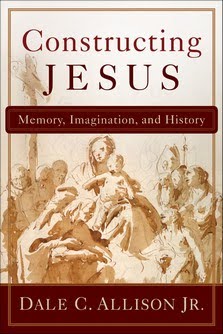
Constructing Jesus: Memory, Imagination, History

Outstanding sequels are rare, third sequels even rarer, but trust Dale Allison to deliver against the odds. Constructing Jesus: Memory, History, and Imagination caps off the author's work begun in the incisive Millenarian Prophet and the even more impressive Resurrecting Jesus, and is a powerhouse presentation of an apocalyptic Jesus who had exalted thoughts about himself, and saw death coming straight at him and didn't run away. Taken as a whole, the trilogy -- but especially this book -- puts to bed fantasies of a non-apocalyptic Jesus, and calls for new ways of assessing the Jesus traditions in place of the classic criteria.

The first part, "Memories of Jesus", covers the fallibility of memory, and is a healthy antidote to monographs which treat the gospels as robust eyewitness accounts. "Even where the gospels preserve memories, those memories cannot be pristine; they must often be dim or muddled or just plain wrong." At the same time, the Jesus tradition is saturated with certain themes, motifs, and rhetorical strategies, and it is in these places that the historian should expect to find at least some reliable memory. Frequently attested themes point to something more promising, albeit more generally, than multiply attested sayings & deeds (pp 19-20), about which no consensus can be reached regarding authenticity.

The second part, "The Eschatology of Jesus", revisits arguments from the previous two books, but with more muscle and finality. Again we see, beyond a reasonable doubt, that if we can't trust the massive traditions of apocalyptic eschatology, then we can't say anything about Jesus at all. Allison also revisits the hobgoblin of consistency -- this section would have someone like Douglas Campbell wailing like a banshee -- and underscores what, really, should be common sense: that even the best theologians are inconsistent, and the most effective charismatics are those who act strangely, unpredictably, and inconsistently. Apocalyptic eschatology, in particular, "has never incubated practical reason". These few pages alone (pp 88-97) should be required reading of every student of the New Testament, let alone the historical Jesus.

The third part, "The Christology of Jesus," is as strong as the eschatological part, and represents fresh material. Even if messianic complexes strike us as egocentric, they were not so in ancient Judaism, and in any case prophets could be reluctant about their divine callings even when accepting them. I think Allison's arguments would have been strengthened by the further observation that in dyadic cultures identity is provided by one's peers more than oneself; and that if certain roles were thrust on Jesus, he would have had to embrace them in some permutation to keep a strong core of followers.

The author proceeds by skewering the scholarly mantra that "Jesus preached not himself but the kingdom", one of the falsest dichotomies plaguing Jesus-scholarship. That Jesus thought he would rule on God's behalf in the future kingdom is more than likely: the Romans crucified him for being "King of the Jews" (and he doesn't seem to have distanced himself from the title any more than he explicitly accepted it), and only in four cases in Matthew's gospel is God himself portrayed as a king (which confirms, incidentally, my ongoing suspicions that if the parable of The Unmerciful Servant goes back to Jesus, it was originally about messianic kingship, not God). As for why Jesus accepted an "anointed" role, he had probably grounded his prophetic ministry in Isa 61:1-3. Allison also discusses the pros and cons of Jesus as Elijah or Elisha come again, finding the data rather murky, and then finds more promise in the idea that he saw himself as an eschatological Moses derived from Deut 18:15-18.

But by far the most intriguing contribution of the Christology section comes in the author's solution to the Son of Man enigma. Eschewing his earlier support for a collective understanding of the figure (see Millenarian Prophet, pp 65-66), Allison now affirms that Jesus believed the Son of Man to be an angelic figure after all -- indeed, his own heavenly twin or Doppelganger, with whom he was one, or would soon become one. Not only is there precedent for celestial doubles and heavenly alter-egos (see pp 296-300), this would resolve long standing puzzles:
(a) If Jesus and the Son of Man were two yet one, it would explain both the earthly human sayings and the heavenly angelic ones.

(b) Dan 7:14 is easily read as an angelic figure (whether or not the "one like a son of man" was originally intended it as a collective figure). The Book of Similitudes certainly read it this way, and, moreover, ultimately identified it with Enoch the seer: Enoch sees visions of the Son of Man (I En. 46, 48, 62, 69) and is eventually translated into him (I En. 71). Jesus may have correlated his own Son of Man identity with a heavenly counterpart.

(c) Hope for humanity's eschatological destiny is often angelic, which could have encouraged Jesus to imagine his future identification with an angelic savior.

(d) If Jesus believed he had a heavenly counterpart, then there is no mystery in the fact that he imagined himself coming on the clouds of heaven while having nothing to say about being removed from earth, and raised to heaven, before that could possibly occur -- he was already up there.

(e) There are traditions of Jesus having a twin (Acts of Thomas, Book of Thomas the Contender), which could possibly descend from a belief in his heavenly Doppelganger. (pp 301-303)
Like Allison, I've gone back and forth between collective and angelic interpretations of Daniel's "one like a son of man" and the synoptic Son of Man, but in recent years have been moving increasingly in the direction of the angelic. Allison's "Doppelganger" proposal (which he cautions is just that, a possibility rather than probability, p 303) reinforces my faith in this direction and invites more investigation.

The fourth part, "The Discourses of Jesus," is to me the least satisfying part of the book, no doubt for its reliance on Q, and its top-heavy focus on a single pericope. Here the author devotes over 75 pages to the Sermon on the Plain, arguing that Lk 6:27-42 points to a reliable recollection of discourses that Jesus uttered habitually, like a stock sermon, rather than on one occasion. It's not so much that I have a problem with the general conclusion. Allison is on solid ground about "stock sermons": as an itinerant, Jesus was surely "less like a modern pastor facing a single congregation and forced to come up with new ideas, and more like a seasoned professor teaching an introductory class for the umpteenth time" (p 24). I just see red whenever Luke's sermon is prioritized or held to be more historical than Matthew's, since there are powerful reasons to believe Luke truncated Matthew's unwieldy and unaesthetic version. The lesson of this section is nonetheless sound, that in addition to aphorisms and parables, at least one of Jesus' discourses owe to reliable memory derived from multiple episodes, implying that other discourses may too, though Allison is more reserved, for instance, about the eschatological discourse of Mk 13 and the instructions on mission in Mk 6:7-10/Mt 10:5-42/Lk 9:3-5; 10:2-16.

The fifth part, "The Passion of Jesus," argues powerfully that Paul was as much familiar with a passion narrative as the gospel writers were, and that it's a sure bet that Jesus was a martyr. "There is less evidence that Jesus cast out demons, yet who disputes that he was an exorcist?" (p 433) Paul spent enough time in Jerusalem not long after the crucifixion that he could have learned about the circumstances of Jesus's death from those who were with him, and like Donald Akenson (Saint Saul), I would go stronger than Allison on this point: it's incredible that he would not have learned about something like this. Regarding the passion narratives themselves, Allison upholds Mark Goodacre's contention that "history remembered" and "prophecy historicized" are not mutually exclusive, and that, contra Crossan, to biblicize is not necessarily to invent. The passion accounts are memories told in the language of scripture.

The sixth and final part, "How Much History?", addresses whether or not the gospel writers believed their own stories about Jesus, to which there is no tidy answer. On the one hand, the ancients didn't see history everywhere in the bible (in the Talmud one rabbi insisted that Job never existed and was just a "parable"; Origen was comfortable with spiritual truth being preserved in material falsehood in the gospels; and then there was Philo), on the other, they certainly believed things we deride as false (many miracles, the creations accounts of Genesis, apocalyptic prophecies of the end, etc.). Allison suggests an under-appreciated index that can help us gauge how literally an ancient author intended a story: humor. The hilarity and absurdity in (for instance) Judith, Jonah, The Acts of Peter and Andrew, The Infancy Gospel of Thomas, and The Testament of Abraham show these works to be products of authors who are declaring their nature up front, and advertising fiction. The canonical gospels, on the other hand, appear to do just the opposite. (Though as an aside, I must confess there's at least one synoptic text which makes me laugh uncontrollably when I try imagining the scenario: Jesus' cursing of the fig tree, which wasn't even supposed to be bearing fruit to begin with; I honestly find this as funny as Thomas' infancy report of him cursing & killing the boy who bumps into him.) The bottom line, says Allison, is that our critical sensibilities are deficient guides on this issue, and we shouldn't underestimate how literal minded people can be about stories that academics see as purely metaphorical.

Constructing Jesus beckons us to fields where memory patterns and themes supplant detailed sayings and deeds. I haven't given up on the classic criteria as much as Allison has -- and frankly, not even Allison has done so as much as he thinks. He half-acknowledges breaking his own rule in demonstrating the historicity of Pilate's sentence for the crime of being "King of the Jews" (pp 231, 233-240), basically wielding a version of both the criterion of discontinuity (with early Christianity) (p 235), and of course, execution. He thus implicitly acknowledges that there are at least some cases where the criteria work, and I'm again put in mind of Donald Akenson, who railroaded the criteria as almost completely useless, save in rare "glaring" cases where an eight-year old can see the process at work (i.e. the embarrassing account of Jesus' baptism by John).

More successfully -- in fact, completely so -- Constructing Jesus pounds the last nail in the coffin of minimalism. I've often said that it's better to be a mythicist than a minimalist -- the former at least don't pretend to be able to construct a historical Jesus on the assumption that our sources are so untrustworthy; the latter (read: Jesus Seminarians) cut their own throats. But it's even wiser to be a millenialist than a mythicist, because, as this book shows, our sources, while legendary, are more reliable than either mythicists or minimalists allow. It's Dale Allison's final say in a trilogy that stands as the definitive guide to what Jesus was about, and in many ways the best of the three.

Monday, April 27, 2009

Origen's Use of Thomas

Keep an eye on the GThomas mailing list, because next month Stephen Carlson will be posting excerpts from his SBL paper, "Origen's Use of the Gospel of Thomas". Stephen's abstract points to a conclusion that, "despite Origen’s recognition that the Gospel of Thomas did not rank with Matthew, Mark, Luke, and John and despite the presence of some content he must have found objectionable, Origen nonetheless thought that the Gospel of Thomas contained historically useful and homiletically edifying material." I'm looking forward to this list discussion, hosted of course by Mike Grondin.

Wednesday, September 28, 2005

Lying and Deception in Authorship

(Prologue to this series here. Part I here. Part II here.)

In discussing pseudepigraphy on Religions of the Ancient Mediterranean Phil Harland advises caution when using value-loaded terms, suggesting that we distinguish forgery (implying deceit) from pseudonymity (reflecting admiration), even if both may be found on a spectrum in varying degrees. He writes:
The fact that the practice of attributing a work to some respected figure of the past was widespread in the Jewish and Greco-Roman worlds, and that the ones doing this almost always liked or respected the figure whose identity they were 'borrowing', suggests that something other than deliberate deception and forgery was going on.
Other scholars have made similar distinctions. Bruce Metzger ("Literary Forgeries and Canonical Pseudepigrapha", JBL, 91 (1972): 3-24) argues that some pseudepigraphy intends to deceive while other such works do not. Wolfgang Speyer (Die Literarische Fälschung im Heidnischen und Christlichen Altertum, 1971) suggests three categories: "authentic pseudepigraphy", "forged pseudepigraphy", and "fictional pseudepigraphy".

I don't think we should be hiding behind double-speak like this. Those who wrote pseudonymously, even if "in admiration", were no less deceitful than those who engaged in other lies and deceptions for socially acceptable reasons. They forged, pure and simple. And they did so for any of the reasons Ehrman notes -- profit, malice (if II Thess is any indication), or admiration. Most often it was simply to gain a hearing for one's views and be taken seriously. In cultures like the ancient Mediterranean, only honorable people are taken seriously, and forgery becomes a way of acquiring that greatest form of wealth (reputation).

Indeed, against Metzger and Speyer, Jeremy Duff (A Reconstruction of Pseudepigraphy in Early Christianity, D. Phil. Thesis, University of Oxford, 1998, pp 134-135) and Lewis Donelson (Pseudepigraphy and Ethical Argument in the Pastoral Epistles, Tn: JCB Mohr, 1986) are, to me, convincing. Texts carried authority not on the basis of what they said but who wrote them; authorial identity was taken very seriously. Artificial (apologetic?) categories like "authentic pseudepigraphy" and "forged pseudepigraphy" miss the point. Pseudepigraphy is, by definition, forgery; by nature deceitful. It's just a question of whether or not the deceit can be pressed into an honorable goal, and if one can get away with it.

Harland later qualifies his remarks in the comments section of my first post in this series:
The duality of deceit and admiration is more a result of Ehrman's categorizations (rejecting ideas of admiration and emphasizing deceit). Motivations for writing in the name of another ranged between these two extremes and should not be described in blanket terms, and it may not be impossible that in a particular case admiration was accompanied by a little deceit.
I don't quite see Ehrman making this duality. He thinks admiration is one of four reasons for engaging in deceit/forgery (as noted above; see pp 30-31 of Lost Christianities). It would perhaps be more accurate to say, representing Ehrman, that deceit could be accompanied by admiration (or interest in profit, or malice, or a general interest to receive a hearing for one's views).
They forged for the love of Pythagoras, so to speak, and their intentions were focused on inspiring similar respect or honor for this philosopher on the part of their readers or hearers.
Just a side-note about Pythagoras. Duff has apparently argued that Iamblichus' statement about him doesn't necessarily provide evidence for a group of neo-Pythagoreans, only that a scholar three hundred years later thought this may have been the explanation. The passage cited (On the Pythagorean Life 198), according to Duff, may indicate that Iamblichus had contemporary disciples in mind. But however we adjudicate on the question of the "neo-Pythagoreans", we must again bear in mind that admiration and deceit can go readily hand-in-hand.
Ehrman's claim that forgery was clearly and almost unanimously rejected in classical times is precisely what I am contesting (and I don't think he provides evidence in support of that position -- rather assertions). A better way of putting this, I think, is that when someone disagreed with the views expressed or practices advocated in pseudonymous writing, they were likely to charge the author with the equivalent of forgery or being a fake. If someone agreed with the views or enjoyed the story, then this would not be an issue, and nothing close to "forgery" would be the charge...
Here I think Harland is on the right track. Forgery was clearly and unanimously rejected -- if it was called out as such. The honor-shame world is all about (1) public perception and (2) not getting caught. If the forged text was well received, and no one else exposed it as fraudulent, then, as Harland says, there would have been no issue. But this is regardless of the intentions of the author, whether sinister or positive.

It's like with lying. Being called a liar is a great public dishonor, for it (obviously) implies that one really is lying. But as we saw in the last post, many forms of lying and deception, both positive and negative, "don't count" as such. The public is the final arbiter here; one's audience decides whether or not the cause of honor has been served. (Imagine a modern courtroom where a verdict depends entirely on what the jury decides, without any official guidance from statutes or case law.) Intentions have nothing do with it. It's a matter of staying clean in the eyes of others, whoever those "others" happen to be.
My overall impression, from cases such as the Acts of Paul and Thecla, for instance (in Tertullian), is that the intentions of authors do not fit with terms such as deceit and forgery.
Perhaps Harland doesn't care for the way Ehrman aligns the case of Secret Mark with three others. In Lost Christianities he discusses (1) the Gospel of Peter, (2) the Acts of Paul and Thecla, (3) the Gospel of Thomas, and (4) the Secret Gospel of Mark, describing them, respectively, cleverly, as (1) "the ancient discovery of a forgery", (2) "the ancient forgery of a discovery", (3) "the discovery of an ancient forgery", and (4) "the forgery of an ancient discovery". (Chapters 1-4).

These are indeed all forgeries, irrespective of intentions. I agree with Harland that intentions matter -- an ancient presbyter who forged "for the love of Paul" is different from the modern scholar who expanded on Mark for other reasons -- but I don't believe they warrant narrowing definitions to make our view of the ancients more palatable. We need to resist romanticizing the ancients, in any case. For scientific and historical purposes, the term forgery should be used as neutrally as lying and deception themselves.

In next part of this series we will look at lying and deception in the postmodern age.

UPDATE: Stephen Carlson jumps into the fray with astute observations about "The Seriousness of Forgery in Antiquity". Nice presentation. I look forward to his sequel post, in which he plans on addressing the propriety of the term "forgery". What I'm pushing for in this series is that it's not only appropriate but necessary to become comfortable with the terms "lying", "deception", and "forgery", in order to understand double standards for what they are, and how they vary in application across time and culture.

UPDATE (II): See Phil Harland's further comments. Phil notes that "[Loren and Stephen] have every right in the world to find 'forgery' exciting." I hope it's clear that I haven't been condoning use of the term for sensational reasons.

UPDATE (III): Carlson's sequel post, "Toward an Understanding of 'Forgery': Metzger", steers somewhere between my position and Harland’s on the propriety of the term "forgery". He makes an interesting point about indirect authorship -- "the employment of ghostwriters, secretaries, amaneuenses, or other agents of the named authors" -- which no one considers forgery. But this is because the author consents to have someone write under his/her name. I agree that forgery becomes an inappropriate term for describing such cases of brokered authorship. (Though a graduate student is given less choice about the matter than a ghostwriter.) When authors authorize someone to write in their name, "forgery" loses its significance.

UPDATE (IV): Carlson's on a roll. See the next part of his series, "Toward an Understanding of 'Forgery': Speyer".

The complete series:

Prologue
Lying and Deception in Homo Sapiens
Lying and Deception in Honor-Shame Cultures
Lying and Deception in Authorship
Lying and Deception in the Postmodern Age
Epilogue