"Most of Bergman's films were about the plague of the modern soul — the demons and doubts, secrets and lies that men and woman evaded but were forced to confront. This agonized Swede was a surgeon who operated on himself. He cut into his own fears, analyzed his failings, perhaps sought forgiveness through art. When he died at 89 [July 2007], he left behind him a worldwide colony of devotees, and a collection of spare, severe dramas unique in their intensity and impact. He must have been surprised at the acclaim for works so personal, they seemed like primal screams, picking at the scabs of his psyche. His films spoke not just to the self-absorption of the therapy generation, but to the human quest to discover the worst and the strongest about ourselves, to make that journey into the darkness with no guide but our need to know." (Richard Corliss, Time, 7/30/07)
I'm not especially savvy when it comes to foreign film directors, but Ingmar Bergman is an exception with the highest honors. That he would be featured in this monthly
blogathon was a given. Even by arthouse standards he went places undreamed. Bleakness, sickness, eroticism, nihilism, madness, and death were his forte, and I wasn't surprised to learn that when he got old he couldn't watch his own films anymore because they were too damn depressing. But Bergman had a sense of humor too, and he knew tenderness at the right moments. No filmmaker, in my view, has more forcefully examined the human condition and interrogated the soul. I've seen 22 of his films, and here's how I rank them in descending order.
Update: See also
Carson Lund's rankings of Bergman.
1.
Cries and Whispers. 1973. 5+ stars. This is a harrowing meditation on the theme of pain, possibly Bergman's bleakest work (which says a lot), and a perfect exit point for Harriet Andersson who plays the dying Agnes. The hurt on display is relentless; facial contortions, gasps, and screams are so hideous I cringe. Most unforgettable is the use of red color, which permeates everything, and is so effective it's staggering.
Cries and Whispers is the world of women, where men are gluttonous oafs and blind to their wives' contempt. But it's not simple male-bashing; the women have complexly repulsive relationships with each other, bruising each other with enough emotional pain to match the physical assault of Agnes' cancer. The late Roger Ebert made a fascinating analogy: "The year 1973 began and ended with cries of pain. It began with Bergman's
Cries and Whispers, and it closed with Friedkin's
The Exorcist. Both films are about the weather of the human soul, and no two films could be more different. Yet each in its own way forces us to look inside, to experience horror, to confront the reality of suffering." How true: each left me terrified to exist as a human being. I could claim either one as my favorite film of all time.
2.
The Seventh Seal. 1957. 5 stars. Bergman's most famous film is richly rewarding, laced with gratifying, cutting-edge humor. It sounds a bit boring when described (a knight plays chess with Death), but it's the knight's journey around the game's intervals, through a land struck by plague and fanaticism, and his attempts to penetrate God's mysteries, that drive the story. His close-to-atheist squire is played hilariously by Gunnar Björnstrand, and he gets in great lines, a perfect counterpart to Max Von Sydow's glacial reserve and tormented anguish. There's so much grand entertainment here -- bar brawls, apocalyptic tirades, insult contests, self-mutilation, and a witch-burning to top it off -- that the theological side helpings make it one of the most balanced arthouse films I know.
The Seventh Seal is an ambitious work that somehow, almost effortlessly it seems, tackles death, existential horror, and spiritual uncertainty all at once. And if it's a nihilistic dance of death that awaits us all, then at least Bergman allows us to enjoy some comforts, and through a great cast of characters, before we get there.
3.
Fanny and Alexander. 1982. 5 stars. This masterpiece is diminished by accolades; it has to be experienced to feel the magic, and despite the three-hour length (or even five-hour, if you see the extended version), you won't want it to end. It's a Dickens-like wonder, populated by ghosts and magical surrealism, the stuff of rare epic, weaved around a boy's imagination that helps him deal with the death of his father and an abusive new one. There is the wild Christmas party of the first part, the tyranny and bloody lashings of the second, the dazzling dream-flight of the third. What stands out most is the optimistic ending, unique for Bergman. It was intended to be his last film, and I imagine him wanting to leave something more uplifting in his legacy.
Fanny and Alexander is pure enchantment, pure storytelling, and its triumphant conclusion is richly earned.
4.
Shame. 1968. 5 stars.
Shame shows the personal cost of war -- and without any political axe to grind -- by focusing on a simple married couple all the way through. We share their intimacies, then their hopelessness when they're uprooted from home, falsely accused of bad allegiances, then freed on the condition that Eva performs sexual favors for a government official (played by the flawless Gunnar Björnstrand). Things escalate to the point of such humiliation that Jan, clearly a pacifist by nature, snaps and becomes a moral monster. The exodus into a sea of corpses haunts me to this day. It's a miserable ending, but the only one that fits. Stanley Kubrick's
Paths of Glory showed us the politics of war, and Terrence Malick's
The Thin Red Line looked at war from a cosmic perspective; but Bergman's
Shame is all the close-up intimacy.
5.
Hour of the Wolf. 1968. 5 stars. Known for being Bergman's only horror film, and like
Shame (which was released the same year) it involves the actors Max Von Sydow and Liv Ullman as a married couple (Johan and Alma) on an island, with Johan's psyche crumbling under extreme pressure, only this time the pressure is interior rather than exterior. It's a film about inner demons, personal alienation, homosexual guilt, necrophilia, and the intensified blurring of reality and fantasy. We're never quite sure if we're seeing Johan's demons, or those shared by Johan and Alma together, or some combination with reality. The theme of contagious insanity is strangely compelling -- only William Friedkin's
Bug has come close to tapping this theme with results just as raw -- and Alma's "If I'd loved him less, would I have been able to protect him more?", shows the devastating liabilities of love in this context.
6.
The Silence. 1963. 5 stars. Here Bergman suggests that there's no solution to the riddle of God's existence, and yet the search for a solution remains important. This film is so unnerving, it holds you in a vise and never lets up. The setting is a foreign country that gets few visitors, and where tanks roll down the streets ready to fire; the hotel is a fantastic set piece and like something out of a paranoid dream state (even anticipating
The Shining), with the hyper-friendly old porter and the room of circus dwarves, all of whom speak gibberish. The theme of non-communication pervades on every level, carrying "silence" to its symbolic extreme. The visiting sisters resent each other and retreat into their own silences or dysfunctions: sexual promiscuity (Anna) and alcoholism (Ester); by contrast, the boy Johann almost represents unfallen humanity before being corrupted by the world -- he can interact with all of the hotel's grotesqueries with delightful naivete, even despite the language barriers. This is the third part of the so-called "faith trilogy" -- the most intelligent, subtle, and terrifying of the three.
7.
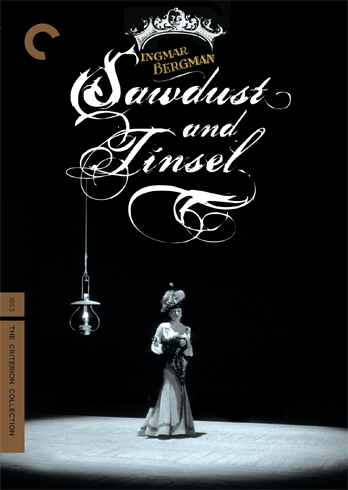
Sawdust and Tinsel. 1953. 5 stars. This clash of the sexes shows Bergman funneling his personal guilt, romantic betrayals, and artistic dissatisfaction into a cruel-cutting misanthropic parable. It's such a nasty piece of work, and so refreshingly honest, that it has to be the product of an artist going through his own hell. Albert and Anne are among my favorite cinematic couples, playing off each other with unpleasantries and suffering degradations, unable to escape their miserable relationship in a harsh career. Gunnar Björnstrand is also priceless as the theater director, dishing out insults wrapped in ironic wisdom: he publicly lambastes Albert while cheerfully admitting that his own world (tinsel, the theater) is as degrading as Albert's (sawdust, the circus).
Sawdust and Tinsel is one of Bergman's most underrated films, and an unflinching look at artistic humiliation. It's prefaced by a great homage to Christ's Golgotha, as a man struggles to carry his naked wife through crowds of harassing soldiers.
8.
Persona. 1966. 5 stars. Many consider this the ultimate masterpiece, and it's certainly been analyzed to death more than any other Bergman film. Oddly, it's not one of my top-notch choices, though there's no denying its excellence. I think its real significance lies in what it represents at a critical turning point in Bergman's career.
Persona was forged in the fires of his mental breakdown, and from here on out his strategies changed. He began treating bisexuality seriously. The pre-1966 films typically resigned heterosexual couples to bleak endings; now he felt free to engineer the utter destruction of these relationships (as in
Hour of the Wolf and
Shame) and veer off into homoeroticism. In the case of
Persona, the two women go beyond intimacy so that they merge metaphysically, signaled in the famous disturbing shot where the halves of their faces are combined. Alma craves Elizabeth's identity as much as her affection, and I think that's what makes
Persona the legendary experiment it is.
9.
The Magician. 1958. 4 ½ stars. A film based on the wisdom that "deception is so generally common that he who tells the truth as a rule is classed as the greatest liar" is a sure winner. All things considered, I don't think
The Magician intends the often-supposed clash between science and the supernatural, rather honesty and deception, and in this arena neither reason nor superstition wins. Vogler may be proven a charlatan, but he frankly doesn't come off bad for it, and he's even given royal approval at the end. The morbid climax had my skin crawling, and wondering if he had actually died and come back to life, but when the black show is done, Vogler admits to chicanery without any shame at all, telling Vergérus (whom he succeeded in terrifying out of his wits) that he should be pleased to have received the experience of a lifetime.
The Magician vindicates the evolutionary-psychological wisdom that humanity needs its self-deceptions to stay healthy. Besides that, it's a great showcasing of colorful characters, and like
Sawdust and Tinsel examines the demeaning lives of traveling artists.
10.
The Virgin Spring. 1960. 4 ½ stars. The same year Hitchcock served up the first slasher with
Psycho, Bergman gave us rape revenge. But unlike the modern formula that often glorifies retribution,
The Virgin Spring puts the screws to it. The father's revenge is portrayed as ugly and self-righteous, and this is what keeps this classic above American copycats like
The Last House on the Left. It refuses to allow us moral holidays. The father is almost an anti-Charles Bronson in this light, atoning for his revenge by dedicating a holy shrine on the spot his daughter was killed. Bergman uses the medieval setting to great effect, teasing out conflicts between paganism and Christianity, as in the way the foster-sister worships Odin and even wishes the harm on Karin right before she's attacked. The film's enduring power matches
Psycho's, and of course both Hitchcock and Bergman have been abused in imitations, spin-offs, and remakes of their artistry.
11.
Through a Glass Darkly. 1961. 4 ½ stars. This was my first Bergman film and will always be special for that reason alone. The isolated island setting and small cast of four makes for an intense character study, and it doesn't hurt that my favorite Harriet Andersson takes the lead, as a schizophrenic affecting her family in complex ways. The theme of spiritual doubt is the subtle undercurrent, always subordinate to the personal relationships, the most fascinating of which is the incestuous one between Karin and her brother Minus. Though the denouement has the father holding out hope for a loving God, that possibility seems disingenuous in the extreme, and raised precisely to call forth the audience's denial given Karin's grim fate. The concept of God as a spider is one of the most sinister and arresting metaphors for the deity I've come across in any film. This is the first part of the "faith trilogy", and the most intimate.
12.
Winter Light. 1962. 4 ½ stars. Before
The Silence interrogated God's existence,
Winter Light tested his benevolence. It does this through the spiritual struggle of a priest, and his relationship with a woman who loves him, but whom he can barely tolerate under his contempt. It's devastating to watch her poleaxed expression when he finally tells her how much he despises her -- fed up with her "loving care, clumsy hands, rashes, and frostbitten cheeks", among other things that don't bear mentioning.
Winter Light is essentially about a pastor so furious at God's silence, that he breaks his own "silence" towards the kindest woman with an avalanche of brutality that makes the Almighty's treatment of Job seem almost benign. It's the second part of the "faith trilogy", which most Bergman fans consider the best part; to me,
Through a Glass Darkly is slightly superior, and
The Silence is way ahead of both.
13.
Summer with Monika. 1953. 4 stars. This one is famous for two shots. First is Harriet Andersson's soft-porn sunbathing scene, which got heavily reedited in America, under the sensational retitle of
Monika, the Story of a Bad Girl! The second is her phallic drag on a cigarette as she stares out at the camera --
through the camera, it seems, right at the audience -- holding us in contempt for daring to judge her selfishness and infidelities.
Summer with Monika is that tale of youthful escapism everyone has fantasized about at some point: two lovers abandon their jobs and families, and run away in a motorboat to spend weeks on an isolated beach in the Stockholm archipelago. They dream the dreams of children, of a blissful married life ahead of them... and then return to the cold reality of poverty, dissatisfied adultery, and unwanted babies. Not especially profound as Bergman films go, but compelling for its modest ambitions.
14.
The Passion of Anna. 1969. 4 stars. I have a complicated relationship with
The Passion of Anna. On first viewing I didn't care for it. After watching the other Faro-Island pieces --
Persona, Shame, Hour of the Wolf, all excellent -- this one felt derivative and uninspired. Even worse, it shows Bergman's deconstructionism of the '60s getting well out of hand, with actual
interviews with the actors interrupting the film at various points. Character narrations and voice-overs (as in
Hour of the Wolf) are acceptable cinematic techniques, but here we have the equivalent of modern DVD extras and featurettes mixed throughout the film. However,
Anna has gotten much better on subsequent viewings. If you can make yourself forget about the other Faro-Island films, it stands as a remarkably innovative, unflinching look at the pain and meaninglessness of life, around a weird plot of an animal serial killer and the arrest and trauma of an innocent man.
15.
Wild Strawberries. 1957. 4 stars. This was Stanley Kubrick's favorite Bergman film, and most fans would consider it a blasphemy to rank below the top five. But I'm underwhelmed by
Wild Strawberries, probably because I'm so hopeless that I watch Bergman to get depressed, and this film has cushions of enough optimism to qualify it as "comfort Bergman". Grandpas reminiscing about teen sweethearts in strawberry patches, and where they went wrong in life, only speak so much (to me, anyway) about the human condition. The film, however, has a stunningly gorgeous aesthetic, especially in the shots of Isak's premonitions, daydreams, and nightmares. The empty streets with faceless clocks, and the faceless person who "dies" in front of him, is my favorite scene, and I also love his nightmare of failing graduate exams under the austere gaze of a younger professor. The birthday party from his childhood can't go unmentioned either: the whites here are incredible -- colorful, almost, if there was ever a time that white could be.
16.
Autumn Sonata. 1978. 4 stars. This is
Cries and Whispers lite -- a relative statement, as there's certainly nothing "lite" about the hurt and anger on display. Bergman was aiming for the same kind of thing but with results less supreme. Again we have a claustrophobic household setting, and again the color red is milked for all its worth. The drama is simple and direct, as a woman wages verbal war on her visiting mother. Ma's offenses are endless: she neglected Eva as a child, yet smothered her with domination; she was eternally angry with her daughter, but kept it under a facade of phony smiles and backhanded praise. This is a superb last role for Igrid Bergman (no relation to the director). Her character is one we end up feeling for despite the laundry list of offenses, primarily because Eva's screeds are so relentlessly self-righteous. They tear her mother to shreds and make her confess that she was always just as terrified and helpless as her daughter.
17.
Summer Interlude. 1951. 3 ½ stars. This is Bergman's breakaway from his efforts of the '40s (which were rather rigid cinematic essays), and the one which showed a true master on the horizon. It's not a great film by any means, but it points to greatness, and to a germinating directorial confidence. As Bergman described it: "This was my first film in which I felt I was functioning independently, with a style of my own, making a film all my own, with a particular appearance of its own, which no one could ape. It was like no other film. It was all my own work." It prefigures
Summer with Monika, which is also about youths falling in love, though this is a sunnier version, for Marie is sweet as Monika is feral. Bergman as we really know him would come two years later (in
Monika, and then the brilliant
Sawdust and Tinsel), but this is where the seeds were sown.
18.
Smiles of a Summer Night. 1955. 3 ½ stars. I'm hard to please with comedies, and this one has the added disadvantage of being associated with countless rip-offs, including one by (cough) Woody Allen.
Smiles is a clever film, and enjoyable enough if you want some light viewing, but it's not all that memorable. There are the characteristic manipulations and infidelities expected from Bergman, but the material becomes a victim of its silliness. The Count is the funnest character, humorless and driven by rigid honor codes, cheating on his wife with abandon, while railing against men who dare make advances on his mistress or wife (professing indifference towards those who hit on the other, depending on his mood). After jealousies and betrayals culminate in the Russian roulette duel, the film ends on perhaps the most touching scene with (my favorite) Harriet Andersson in the fields playfully accepting love without taking the concept, or herself, too seriously.
19.
Scenes from a Marriage. 1974. 3 ½ stars. Some consider this a masterpiece, but I wonder if that's over-evaluating a film which is renowned for causing an outbreak in divorce. (Divorce rates nearly doubled in Sweden the year after its release.) Bergman was clearly aiming for something new, and for that should be commended. Gone is his trademark introspection and existentialism, and in their place a direct tale of a married couple's relationship we observe like a fly on the wall for five long hours. As their marriage disintegrates, they run a gamut of emotions: they're content but unsatisfied, strong yet spineless, certain then confused, loving and mean-spirited at once -- childish, really, but in the end able to obtain a reconciliation without any illusions. It's as realistic a look at something like this I've ever watched, and since I love rapid-dialogue films filled with claustrophobic close-up shots, I'm surprised this film doesn't do more for me. Maybe there's something
too banal and mundane about this five-hour marathon; I'm not sure. But it's still an impressive work.
20.
From the Life of the Marionettes. 1980. 3 stars. This is another film that I feel I should like more, if for no other reason than its morbid premise. It reintroduces two characters briefly seen in
Scenes from a Marriage, Peter and Katarina (the dinner friends of Johann and Marianne), whose own relationship descends into something far more ghastly than everyday marital conflicts and separations. Katarina chases wantonly after other men, and Peter is driven to murder a prostitute (who has his wife's name) and then sodomize her corpse. There are no reconciliations to be found here -- Peter ends up in a mental asylum -- and this is admittedly superbly dark material, but it's never fleshed out in a way we can really understand. The idea of obsessing and possessing a loved one is quintessential Bergman, but
Life of the Marionettes isn't the artistry of
Persona. It's enjoyable enough, but falls a bit short.
21.
Face to Face. 1976. 2 stars. I'm shocked that Bergman made this film. It feels more like the work of an aspiring student, vainly evoking dreams and mental anguish without any of the Swede's finesse, depth, and subtlety. And while Liv Ullmann's acting is top-notch (as always), what she portrays doesn't add up to much. She's a psychiatrist who inexplicably grows depressed, attends a party full of gay stereotypes, meets a doctor who will serve as a convenient sounding board to her histrionics, is nearly raped and finds herself wishing she had been, and then rages about mommy-daddy issues on a purely cliche level. Her nightmares are astonishingly crude and blunt (a far cry from the brilliant sort we're used to in
Wild Strawberries, Hour of the Wolf, etc.), and in the end,
Face to Face feels not only less than the sum of its parts, but less than a fraction of Bergman's talents. Ullman's ferocious performance is all that's left to mesmerize.
22.
The Serpent's Egg. 1977. 1 star. Everyone hates this film, and it's fun to read reviews of it. They show that the greater the filmmaker, the more critics revel in tearing him to shreds when they have rare cause. And so, as I began my top slot with a Roger Ebert citation, so I'll finish with one: "
The Serpent's Egg is a cry of pain and protest, a loud and jarring assault, but it is not a statement and it is certainly not a whole and organic work of art. The movie attacks us, but in self-defense. There are loud, hurtful noises, shouts, and screams, self-destructive orgies and an overwhelmingly relentless decadence. But there is no form, no pattern, and when Bergman tries to impose one by artsy pseudo-newsreel footage and a solemn narration, he reminds us only of the times he has used both better. He strains for impact. He looks emptiness in the face, and it outstares him. He hurls himself at this material, using excesses of style and content we've never seen from him before, but the subject defeats him." It's the only film on this list I would never watch again.
Next month:
Stanley Kubrick.




7 Comments:
Nice to see someone who believes that Winter Light is the weakest of the faith trio and Silence the best. But I'd insist on Wild Strawberries making the top 10, and possibly even Summer with Monika. This is a wonderful post.
Although I agree with the vast majority of your judgements, I do think Wild Strawberries deserved a higher spot.
I knew I'd take a hit for Wild Strawberries, and adding to my guilt is that it was Kubrick's favorite from the pre-Persona era. Alas.
Great round-up Loren. These are some very well-written blurbs, and it's exciting to see where others stand on my favorite director.
The most interesting aspect of your coverage is the theological knowledge you bring to his body of work. I don't have much background in religion, so there are clearly allusions in Bergman that fly right by me that I'm sure would enrich the experience. Nonetheless, I find his consistent thematic involvement with God and faith to be fascinating, even if I don't share some of the quandaries of his characters. Bergman himself was always ambivalent towards the nature or existence of any form of God, so that's mostly the area where I connect.
Anyway, I didn't expect to see The Virgin Spring, Shame, and The Magician so high on your list, films I didn't have time to revisit before writing my list. I'm still working on it and will have it up in the next few days, but I doubt I'll be able to find a DVD of them in LA right now.
Out of curiosity, what are your issues with Wild Strawberries, or is it more just a matter of indifference?
Also, now that you have canonized your favorite actors and actresses in Bergman's films, it's inspired me to try to do the same, but I am having trouble; I love all of them in roughly equal measure! Bibi Andersson, to me, especially in her early roles, is extremely charming. I think of her blond hair glistening in the sun as she munches strawberries...
Just wanted to chime in to say that Same is also my favorite war film (with Cross of Iron and Paths of Glory a bit behind). I usually leave a Bergman film thinking, "I'm not sure I really go that", but I didn't have that feeling at all with Shame.
There's a street named after Ingmar Bergman right near Uppsala University. I'll see if I can get a photo of the street sign uploaded.
Post a Comment
<< Home