Sunday, May 11, 2014

Blog Moved

After nearly a decade on Blogger, The Busybody has moved to WordPress. I'll be keeping this blog up, so don’t fear: if you've linked to my posts over the years, they will be preserved. But the old posts are now on the new blog as well, and moving forward, I will only be posting at WordPress.

Tuesday, April 22, 2014

Facebook Discussion of Zeba Crook's Parallel Gospels

There's been some lively to-and-fro on Facebook over the utility of Zeba Crook's Parallel Gospels. Readers may recall Zeba's SBL Response to Mark Goodacre's session critique back in Novemeber 2012. Now he calls attention to Mark's official RBL review which reiterates many of the same points. With Zeb's permission I place below their Facebook interactions (Stephen Carlson also stepped in).

By way of preface, I own both Throckmorton's Gospel Parallels (4th ed.) and Crook's Parallel Gospels. While I enjoy both, my readers won't be terribly surprised that Throckmorton remains my favorite tool. Especially for the elegant word alignment, though also for Mark's objections about giving Q undue tangibility. But on this latter point, see the below discussion and decide for yourself.

Mark's third criticism -- Crook's "clunky" word-for-word renditions, as opposed to user-friendly translations per our English-speaking bibles -- is actually the one that doesn't faze me. Maybe it's because I already have so many English-bibles that I appreciate the grunt work Zeba has done here, and seeing the nuts and bolts of the Greek. Zeba's rendition approach actually fits the utility of a gospel-parallel quite well.

_________________________________________________________

Zeba Crook [Status Update]: I need to get better reading critical reviews (I admit, they sting), but I am disappointed to see Mark Goodacre still talking about the challenges of coloring (e.g., there are three primary colors so a synopsis should have three columns). My seven year old would have no problem using more colors as needed. I feel the complaint is beneath you, Mark.
Mark Goodacre: Thanks, Zeb. Hadn't realized that it had been published, so thanks for drawing attention to it. On the colouring, why not explain how you, or your daughter, would do it with the extra Q column? I think I know how I would answer the query, but I'd be interested to hear your take. It's the kind of discussion that might be able to get to the heart of our basic disagreement about the inclusion of Q in a Gospel Synopsis, which would I think be useful.

Zeba: When I teach from the synopsis, I tell my students NOT to colour Q at all because I don't want to prejudge their discovery of how much Q makes sense. I also tell them they cannot color Thomas since Thomas wasn't translated by the same principles as the rest of the synopsis. And nothing ever agrees with John, so colouring isn't a problem there either. But if one were inclined to colour Q, one could do so colours for: triple agreements, Mt/Mk against Luke, Lk/Mk against Mt, Mt/Q against Lk, and Lk/Q against Mt, and I'm not sure that doing so wouldn't do as much damage as help to the Q hypothesis. I just don't think that the colour issue is as worthy as your other comments (to which I responded two two years ago).

Mark: Thanks, Zeb. But the cases of triple tradition with major agreements (so-called Mark-Q overlap) have four columns, so you need a scheme that has quadruple agreements, several types of triple, several doubles etc. I don't know how one does that with a three-colour mixed scheme. I think that sounds very difficult to conceptualize, but I'd be happy to see it if you think you can illustrate how it's done. If you are able to illustrate that it can be done as simply and straightforwardly as the more intuitive colouring scheme that one can produce on the basis of three synoptics, I will happily publicly retract my comments.

Zeba: Mark, I never said it was more intuitive. And obviously 3 is simpler than 4, 5, 6 or 7. But perhaps having students use only 3 colours inscribes in their imaginations a gross over-simplification what is obviously an extremely complex problem.

Mark: I'd settle for as intuitive or even almost as intuitive -- just show me how it works. But I'm a little surprised by the idea that working with the three primary colours would lead to "a gross over-simplification". That's like saying that insisting on three synoptic gospels is a gross over-simplification. My point is that if you have three synoptics (fact) and you have three primary colours (fact), then we can work with that fortuitous and intuitive outcome. Adding a fourth column to reflect one solution to the problem is the thing generating the problem here; it has nothing to do with the intrinsic complications of studying the synopsis.

Zeba: Adding the fourth column for Q does not reflect one solution, any more than adding Thomas and John reflects solutions to whether either or both of those were reliant on the Synoptics. There are features of this synopsis that might just as easily undermine the Q solution in some people's eyes (such as the number of times that Matt and Luke agree in placement of Q material).

Mark: Of course adding the fourth column for Q reflects one solution, Zeb. It reflects the Two-Source Theory, according to which Q is the source for Matthew's and Luke's double tradition, from which the wording in that Q column is derived. And there is, of course, a material difference between Q on the one hand and Thomas and John on the other. They are extant works with textual witnesses and citations in early Christian literature; they are not hypothetical texts reconstructed on the basis of a Synoptic comparison that works with a specific solution to the Synoptic Problem.

Zeba: Yes, there are differences, but one need not be solely fixated on that difference (which is emphasized in the synopsis, no less). The fact is, scholars disagree about the questions of reliance, and one would just as easily (and just as wrongly) claim that putting Thomas/John there prejudices those debates.

Mark: I suspect that you may just be being cute here, or facetious; I think you know full well that there is a world of difference between including a hypothetical text that is a result of studying the Synopsis and including extant texts that are not. But the inclusion of Thomas & John parallels do not prejudice debates about source-usage; they facilitate those debates -- they set out the evidence in a graphic way in order that we can have the discussion. The inclusion of Q, on the other hand, takes one particular conclusion about the Synopsis and then integrates it into the presentation of the Synopsis.

Zeba: I respectfully disagree, and I'm not being cute. I maintain that the inclusion of Q is to facilitate the discussion, and that opposition to Q is just as feasible as support for it when studied in the context of his synopsis.

Stephen C. Carlson: If one is to include hypothetical documents that could be a solution, why privilege Q? Why not include Ur-Markus too? Why not Deutero-Mark? Why not Pierson Parker's Koine Gospel common to Matthew and Mark but not Luke? Why not any of Bosmard's multiple sources? Why not Q1, Q2, and Q3? And whose Q to include? Harnack's? The IQP's Q with the baptism of Jesus in it? Including Q just begs too many questions and biases the answers. I think students ought to understand that the reality of Q is contingent in a way that all the other sources are not, and by including Q as if it is on par with Mark, Thomas, etc. muddles the lesson.

Zeba: Stephen, if readers of my synopsis come away with a sense that Q is anything but contingent, then they aren't reading my synopsis. I think the only way you and Mark could have been pleased on this issue is I had not mentioned Q anywhere in the book. And why not infinite other sources? Like it or not, and rightly or wrongly, Q is relevant to current gospel research in a way those other issues are not. It's that simple.

Stephen: The point is not that Q (or even our text of Mark) is contingent or hypothetical--they both are, of course--but that Q is contingent in a way that other sources are not. It is here that the reification of Q in the synopsis sends a mixed and muddled message.

Zeba: I wasn't comparing Q's contingency with Mark's. I was saying straight out that Q is contingent and that if the reader of my synopsis doesn't get that, he's an idiot. As I said, the only way I think you and Mark wouldn't charge this project with sending out a mixed message is if there was no mention of Q anywhere in the book. But Q is part of the scholarly debate. Full stop.

Stephen: Kloppenborg and other members of the Toronto school compare the Q's hypothetical nature with that Mark's text all the time. In fact, it's a favorite argument of his. Now, if you've disavowed this argument or comparison, please accept my apologies for presuming that you agree with it. I don't have any problem with mentioning Q in the introduction, where the student can be told that Q is contingent on a number of things without being shown that it is not in the synopsis.

Zeba: I agree that the comparison isn't wholly persuasive. But that's not the point: I didn't make any such comparison in what I said.

Mark: "I think the only way you [Stephen] and Mark could have been pleased on this issue is I had not mentioned Q anywhere in the book." -- I think that might be a bit unfair, Zeb, given that I have always attempted in my published work to engage critically with current Q scholarship, and to make sure that I have understood it and represented it fairly. My issue with the Q column is stated without prejudice to the arguments pro or con the existence of Q. It is a straightforward question, to repeat: do we wish to incorporate one of the solutions to the problem into the presentation of the data? Tuckett's JTS review, which I came across today, makes a similar point from the perspective of one who accepts the Q hypothesis.

Zeba: I'm sure I've told you this before, Mark, but what really bugs me about getting hammered for the absence of line-by-line parallelization (Tuckett makes the same complaint) is that line-by-line parallelization is how I originally had it and wanted it, but OUP balked at the expense, because it really stretches out of the pericopae and leaves lots of white space (a benefit as far as I was concerned, but a waste of paper as far as OUP was concerned). Grrrr.

Mark: Yes, you mentioned this at the SBL session, Zeb, and I'm afraid I couldn't help facetiously suggesting that OUP could have saved some extra space by eliminating the Q column!

Mark: But more seriously, this is why reviews are helpful. Works like yours, at their best, improve in the light of repeated editions and revisions. OUP will hopefully see that there is a consensus in the reviews about this key element. I have found the same thing even in the synopsis excerpts that I have created -- publishers often have no clue what I am trying to do and eliminate all the hard work I have done and scrunch the text together. But for me, one of the things that is so striking about Parallel Gospels is that you go to such pains to render every word the same way, and then don't cash in the advantage of having them in word-aligned parallel.

Saturday, April 12, 2014

Tribulation, Rapture, and Wrath (In That Order)

For years I've been fascinated by Pre-tribulationists: Christians who believe they will be raptured (taken bodily up to heaven) before the onset of the apocalyptic tribulation. It's a belief that emerged only in the 19th century, but has been popularized by the Left Behind series to the extent of The DaVinci Code. There are technical problems with this view and the more general: early Christians not only expected to suffer the tribulation before they were raptured; they saw it as their holy mandate. Let's examine.

Paul is the place to start on the subject. His description of the rapture is justly famous, being the most detailed and earliest (50s AD) version preserved in the NT:
"For the Lord himself, with a cry of command, with the archangel's call and with the sound of God's trumpet, will descend from heaven, and the dead in Christ will rise first. Then we who are alive, who are left, will be caught up in the clouds together with them to meet the Lord in the air; and so we will be with the Lord forever. Therefore comfort one another with these words." (I Thess 4:16-18)

"We will not all die, but we will all be changed, in a moment, in the twinkling of an eye, at the last trumpet. For the trumpet will sound, and the dead will be raised imperishable, and we will be changed. When this perishable body puts on imperishability, and this mortal body puts on immortality, then the saying that is written will be fulfilled: 'Death has been swallowed up in victory.'" (I Cor 15:51-55)
Obviously neither of these passages says anything to the effect of "comforting one another because you won't have to go through tribulation". The passage of I Thess 4 simply advises comfort because believers can count on seeing their loved ones again. Paul was addressing a concern about the bodies of Christians who died before the second coming (his answer: they will be resurrected from their sleep-state). In the passage of I Cor 15, he was addressing an opposite concern, about the bodies of Christians who were still living (his answer: they won't need to die first before being resurrected; their mortal bodies will be instantly clothed with immortality). Paul wasn't implying anything at all about the time of the rapture, only about the logistics of dead and alive bodies.

He provided a vivid description of the rapture in any case, which impacted the gospel writers and the author of Revelation. The image of Jesus descending in the clouds and harvesting the faithful is present in the Markan Apocalypse (early 70s AD), followed by Matthew (80s) and Luke (90s), and these writers clearly state that the rapture takes place after the tribulation.
"But in those days, after the tribulation, the sun will be darkened, and the moon will not give its light, and the stars will be falling from heaven, and the powers in the heavens will be shaken. Then they will see the Son of Man coming in clouds with great power and glory. Then he will send out the angels [with a loud trumpet call], and gather his elect from the four winds, from the ends of the earth to the ends of heaven." (Mk 13:24-27/Mt 24:29-31; cf. Lk 21:25-27)
Astonishingly, today's Pre-tribulationists fixate on the text which comes right after this:
"But about that day or hour no one knows, neither the angels in heaven, nor the Son, but only the Father." (Mk 13:32/Mt 24:36)
This, they say, proves that the rapture could happen "at any time now". All it proves is that no one (not even Jesus, apparently) knows the exact day and hour when the rapture will take place. But whenever it happens, it obviously follows the tribulation! The Markan Apocalypse couldn't be clearer: there will be a nasty tribulation, involving wars, famine, earthquakes, false Christs, false prophets, and people dying for their beliefs. After this period the sun and moon will darken. Then Jesus will come in the clouds to rapture the elect.

If it's so clear, then why is the doctrine of the pre-trib rapture so widely believed? An obvious (and perhaps flippant) answer is that modern evangelicals are self-entitled wimps and want to be saved by Jesus without having to bleed for it. But to be fair, there's another reason. At least some of them are genuinely misreading their bibles. They confuse "tribulation" with "God's wrath". They rightly point out that NT texts (such as I Thess 5:9) assure faithful believers that they won't have to suffer God's wrath. But "God's wrath" isn't the same thing as "tribulation".

The book of Revelation makes clear that the Day of God's wrath doesn't come until the sixth seal is opened -- which is the point in the Markan Apocalypse at which the sun and moon are darkened:
"When he opened the sixth seal, I looked, and there came a great earthquake; the sun became black as sackcloth, the full moon became like blood, and the stars of the sky fell to the earth as the fig tree drops its winter fruit when shaken by a gale. The sky vanished like a scroll rolling itself up, and every mountain and island was removed from its place. Then the kings of the earth and the magnates and the generals and the rich and the powerful, and everyone, slave and free, hid in the caves and among the rocks of the mountains, calling to the mountains and rocks, 'Fall on us and hide us from the face of the one seated on the throne and from the wrath of the Lamb; for the great day of their wrath is come, and who is able to stand?'" (Rev 6:12-17)
This is the onset of God's wrath, and it is from this point on that the elect will be spared the ugliness running over the earth. They will be raptured, as the Markan Apocalypse makes clear, and which Rev 7 implies. Then the seventh seal will be opened (Rev 8:1-6), segueing into the full-blown horrors of the seven trumpets (Rev 8:7-11:19) and seven bowls (Rev 16:1-21). The trumpets and bowls seem to describe the same supernatural events from different perspectives -- God's punishments that steamroll over humanity: fire and brimstone, the sea turning to blood, rivers becoming poison, locusts pouring out of smoking pits, etc. They are unlike the horrors loosed by the seven seals before the rapture (Rev 6:1-13), which are worldly and involve nothing supernatural at all: war, famine, death, martyrdom.

Simply put, the tribulation (Rev 6:1-13; Mk 13:1-25/Mt 24:1-29/Lk 21:8-26) is not a period in which God is pouring out wrath to punish people. Tribulation is persecution (Mk 14:17/Mt 13:21) and suffering through tyranny and oppression. People don't go through tribulation because they're bad; they go through it precisely because they're uncompromising in their faith; they endure it as a test of their faith. The New Testament is replete with this idea. Acts says that Christians "must" enter the kingdom of God through tribulation (Acts 14:22), and Paul even tells his converts to "rejoice" in their tribulation and sufferings (II Cor 7:4).

In other words, modern Pre-tribulationists are about as far from the mindset of the New Testament as you can possibly get. The early Christians didn't count on escaping tribulation, whether through rapture or not. For them, suffering persecution was a badge of honor -- no less than the cross of Christ. Even when demoralized, they found it within themselves to persevere.

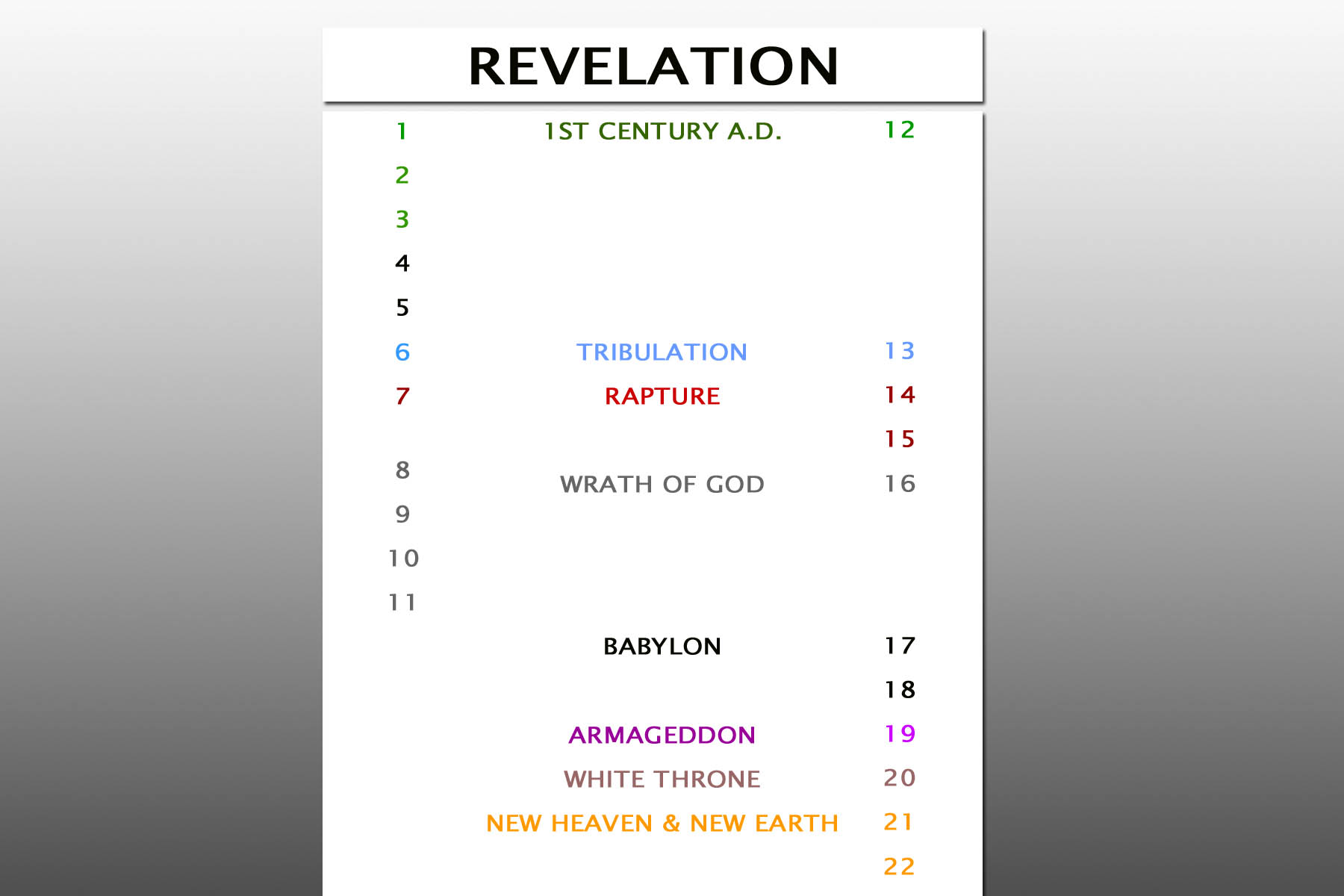
This isn't to say that traditional Post-tribulationists are without fault. Many of them fall into the same trap of confusing the tribulation with God's wrath, and as a result put the rapture at the end of the seven-year period of Rev 6-16. The rapture comes after the tribulation but prior to God's wrath. The best timeline I've come across is this one produced by Pastor Steven Anderson of Faithful Word Baptist Church:


Anderson is a controversial figure for some of his extreme fundamentalist views, but he does get some things right, and this is one of them. Contrary to popular belief, the tribulation is not the seven-year period depicted in Rev 6-16. It's the some-odd 3 ½ year period depicted in Rev 6 (and repeated from a different angle in Rev 13). The outpouring of God's wrath is the next 3 ½ year period depicted in Rev 8-11 (and repeated in Rev 16). The elect suffer through the first, and are raptured by Christ away from the second. At the end of this collective 7-year period, Christ descends again, but leaves the clouds this time and comes to earth with the saints he raptured 3 ½ years ago; the Battle of Armageddon takes place; and then he reigns on earth for 1000 years.

Getting a handle on this chronology helps see the pattern. As Anderson outlines it, there is a critical break at Rev 12 which starts the timeline over again, so that the sequence of tribulation, rapture, wrath depicted in Rev 6-11 is retold in Rev 13-16. Chapter 12 goes back even further to Mary and the birth of Jesus (12:1-6), and then describes the war in heaven which results in the devil being cast down to earth (Rev 12:7-9). It is his wrath (Rev 12:12) -- not God's -- that is about to spill out, as he persecutes God's elect and tries to destroy them.

This is how the tribulation (Rev 13) unfolds. Not with the supernatural events of fire and brimstone, or rivers of poison, or locusts smoking out of pits. But by wars, natural disasters, famine, and martyrdom -- just as in Rev 6:1-11 and Mark's Apocalypse. The anti-Christ emerges and is given worldly power. Back in Rev 6, he was symbolized by the white horse (a mockery, or "fake Christ", of the warrior-Jesus to come in Rev 19:11). In Rev 13, he is symbolized by the beast who rises from the sea. The result is the same: he makes war on the saints to overcome them (Rev 13:7). Everyone worships him except believers (13:7-8), and those who don't worship him are unable to buy or sell anything (13:16-17). Those who defy him are beheaded (see Rev 20:4). His number is 666 (13:18). [Historically, the anti-Christ was the incarnation of Nero Caesar, who persecuted ancient Christians; the numerical equivalents of the letters in his name added up to 666.]

The tribulation of Rev 13 mirrors Rev 6, just as the implied rapture of Rev 14 mirrors Rev 7, and just as God's wrath of Rev 16 mirrors Rev 8-11. The "tribulation, rapture, wrath" sequence is implied throughout other parts of the NT. As I already mentioned, I Thess 5:9 states that believers won't be subject to God's wrath, while II Thess 2:1-3 insists that the Day of Christ (the rapture) cannot come until there is a falling away (apostasy) and the man of sin (anti-Christ) revealed. Taken together, these align pretty closely with the schemes of the Markan Apocalypse and Revelation.

The NT authors were by no means on the same page with all their beliefs. But many of them shared some common convictions, and a post-tribulation rapture was one of them. The NT expects faithful Christians to be tribulated -- persecuted, oppressed, robbed, starved, slaughtered -- and have their faith put to the test in horrendous ways. The rapture was never understood to avoid this. It was the reward that came after.

My point is not to stir up apocalyptic fervor. But if you happen to be a pre-millenial Christian with literal convictions about the end times, then I would insist that a post-trib/pre-wrath rapture is the only sensible option for you; the pre-trib rapture is no more credible than the claims of The DaVinci Code. The more significant point is the early Christian commitment to suffering for the cause of Christ. The apostles were a lot like their savior: they were ready for martyrdom, and didn't expect God to bail their asses out to avoid tribulation.

Monday, April 07, 2014

The Top 10 Apocalyptic Films

Almost every site on the web confuses apocalyptic with post-apocalyptic films. I'm setting the record straight.

By apocalyptic, I mean a film set during a catastrophe that spells the end of civilization, or will do so if not averted. The catastrophe could be anything, and represented on this list are divine punishment (Noah, The Rapture), nuclear warfare (Threads), pandemic (Pontypool), nature (The Birds), alien invasion (War of the Worlds), resource depletion (Sunshine), environmental (Before the Fall), existential (The Tree of Life), and unknown (The Leftovers).

In some cases the apocalypse is averted (Sunshine, War of the Worlds), though at terrible cost. In most of these, however, the "end" actually comes, though it's not always clear what follows.

1. Sunshine, Danny Boyle. 2007. Critical approval: 75%. I can't say enough about this film. It's set in a future where the sun is dying, and people can barely stay alive and warm. A crew of eight embarks on a mission to deliver a thermo-nuclear payload that will re-ignite the sun's fire, so it's an outer-space film as much as an apocalyptic one. To get through one disaster after another, the crew members have to sacrifice themselves, and at one point they even contemplate murdering the one of them "least fit" in order to save oxygen. On top of all this, there is the subplot of a hideously disfigured religious fanatic who believes God wants humanity to die, and does everything he can to slaughter the crew. The theme of the apocalypse is woven in on multiple levels, and while the ending is "happy" on the macro-level (the sun is saved), it's tragic on the micro-level. Sunshine is Danny Boyle's best work, far better than his overrated zombie-fest 28 Days Later.

2. The Birds, Alfred Hitchcock. 1963. Critical approval: 96%. This famous classic is nihilistic to the core and unapologetic about nature's savagery. And like the great horror films rarely seen anymore, it has the patience to let its characters breathe and become people we care about before terrorizing and killing them. The only humans-vs.-nature film that has affected me this strongly was The Grey, which was a wilderness survival thriller. The Birds is apocalyptic, portraying unstoppable biological forces that have suddenly decided to sweep down on a humanity minding its own business, for reasons we never learn. The coastal setting works wonders, and while at first blush it looks like a localized apocalypse, the implication is that birds are attacking elsewhere in the world. By '60s standards the attack sequences are terrifying. When nature comes after us, says Hitchcock, things aren't going to turn out okay, and I think he's probably right.

3. Noah, Darren Aronofsky. 2014. Critical approval: 76%. Here's the story of Noah's Ark, served up Lord of the Rings style. It works perfectly, because the first eleven chapters of Genesis are complete myth; the same sort of mythic pre-history that Tolkien intended by Middle-Earth. So when we see giant rock creatures (the Watchers) and bits of magic here and there, it somehow makes the story of Gen 6-9 seem as it should. It's a sweeping epic that doesn't soft-peddle God's act of genocide. Don't listen to complaints that this theme of divine vengeance has been anachronistically aligned with pagan environmentalism or vegetarianism. If Christians knew their bibles, they would know that a significant amount of "environmentalism" can be derived from scripture; and if we're going to be proper fundies, we would acknowledge that God didn't add meat to the human diet until after the flood (Gen 9:3). Noah isn't pro-environmental in any true modern sense, though it can resonate with some viewers on that level. Reviewed here.

4. The Tree of Life, Terrence Malick. 2011. Critical approval: 84%. It seems that 2011 was the year of abstract apocalyptic films. There was Lars Von Trier's Melancholia, a metaphorical apocalypse manifested in a woman's psychological anguish; Take Shelter, a hallucinated apocalypse of a schizophrenic; and finally The Tree of Life, an existential apocalypse, and one of my favorite films of all time. Malick portrays an apocalypse experienced in the "now", as both wish fulfillment and transcendent reality. A man reflects on his childhood within the grand context of the universe's life cycle, from Big Bang to Absolute End; the latter intrudes on the present through visions of a dead and barren Earth, a white dwarf sun above it, desert shores with waves rolling in, and dead souls walking the shores. It's unquestionably the best apocalypse abstractly conceived.

5. Pontypool, Bruce McDonald. 2007. Critical approval: 82%. Then there was 2007, the year of the "town-under-siege". These are localized apocalypses which could spread globally if not contained. The Mist is set in Bridgton Maine, a town suddenly blanketed by a mist from which otherworldly creatures attack; 30 Days of Night is a vampire slaughter-feed in Barrow Alaska. My pick, however, is Pontypool, set in the Canadian town by that name, not only because it actually results in apocalypse (when the credits roll, it's clear that the town's quarantine fails and the pandemic spreads), but because it's about one of the most bizarre and terrifying ideas I've come across: a zombie pandemic that spreads literally by word of mouth; a quantum virus (born of "perception") that has infected the English language (only English), and hearing certain words dissolves your mind and turns you into a cannibal. Seriously, this is one messed up idea: that you obsess language and become so scrambled by it that the only relief you can obtain is by chewing your way through the mouth of someone.

6. War of the Worlds, Steven Spielberg. 2005. Critical approval: 74%. Yes, it's a Spielberg film and has its problems. But it starts out strong, and is superior to the original classic. It plays especially well in a post 9/11 age, where everyone thinks "it's the terrorists" when buildings collapse around their ears and power goes out everywhere. And there's some weird psychology on display in the basement-shelter of a paranoid libertarian. The heart of the story is the sort of substandard stuff to be expected out of Spielberg (ineffectual father forced to connect with his children and do everything in his power to save them), but what places the film on my list is the sheer visceral imagery of the alien attacks. Honestly, the first sequence is among the best ever shot on celluloid: the weird "lightning storm", followed by the emergence of underground tripod vessels, which blast away and vaporize people running for their lives.

7. Threads, Mick Jackson. 1984. Critical approval: na. This one is both apocalyptic and post-apocalyptic, but I'm placing it on my apocalyptic list since it focuses more on the catastrophe and the build-up to it. It's a British TV-film that was born of the same intent as the American The Day After (1983), but it's much better -- and far, far more traumatizing. And keep in mind The Day After upset Americans so much that people were telephoning the government to ask if this is what a nuclear attack would really do. Threads takes place in the town of Sheffield, and when the bombs strike, things are as ugly as it gets; the aftermath sends humanity hurtling back into a primitive age of famine, lawlessness, and mental retardation. It's a completely miserable film to watch. It's well done, but you don't enjoy any aspect of it at all; you simply suffer through it as an educational exercise that was very necessary back in the Reagan years.

8. The Leftovers, Damon Lindelof and Tom Perrotta. Summer 2014. I'm going out on a limb and predicting I'm going to love this HBO series. It's about a rapture-like event that whisks away millions of people across the globe, and focuses on the left-behinds in a New York town. From an interview with Lindelof: "You've got this big, crazy idea that informs every episode, which is that this thing happened, this sudden departure of 140 million people which depending on what side of it you're on, could be the Rapture. There could be some yet-as-undetermined scientific explanation for it, but still it's miraculous. This is going to be a show about sudden and abrupt loss and more importantly, what will at least in its initial presentation seem to be one that you can't receive closure from. If someone dies, that's a horrible thing and they must be mourned. But in this instance, you don't even know if you're supposed to mourn who’s been departed because they could be walking through your door tomorrow, or you could be zapped up or down or sideways to wherever they are." At the end of the season I'll revisit this list and rank it appropriately.

9. The Rapture, Michael Tolkin. 1991. Critical approval: 64% I was completely fooled by this one. I thought Sharon was a typical nut-job who found Christ and prayed for the apocalypse, but didn't think the film would take her expectations seriously. Especially when she goes out into the desert to wait for the rapture, and ends up (yes) shooting her little daughter to force God's hand. I mean, she blows her crying kid's brains out. For which she's rightfully thrown in jail; obviously the kingdom isn't coming for perverse born-again Christians. Except that it does. The horsemen of Revelation make a stunning literal appearance out of nowhere, jail prisoners are liberated... God, it turns out, is real and ushering in the end times. Tolkin treats his subject matter with a respect it doesn't seem to deserve -- indeed he portrays the outrageous at complete face value -- and in so doing, makes the rapture seem oddly plausible.

10. Before the Fall, F. Javier Gutiérrez. 2008. Critical approval: na. The Spanish title is Tres Dias (3 Days), which is the amount of time humanity has until Earth will be hit by a meteor larger than the one that wiped out the dinosaurs. The apocalyptic setting is used as a backdrop for a horror story: Amidst the chaos and riots, a convict breaks out of prison and decides to go after the children of a man who wronged him long ago. His likes to hang little kids, but the main character can't be bothered to care about protecting his nephews and nieces since the world is going to end. As the psychopath closes in (the film doesn't cop out on the subject of harming children), Alejandro gradually sheds his apathy and realizes that people who will die anyway are worth trying to save. It turns out to be a strong message in an original film.

Dishonorable mentions. The following most emphatically do not make my cut: Independence Day (1996), Armageddon (1998), Deep Impact (1998), The Day After Tomorrow (2004), 2012 (2009). All are embarrassingly absurd.

See also my Top 10 Post-Apocalyptic Films.

The Top 10 Post-Apocalyptic Films

Almost every site on the web conflates apocalyptic with post-apocalyptic films. I'm setting the record straight.

By post-apocalyptic, I mean a film set after the end of civilization or its dramatic upheaval due to catastrophe. The catastrophe could be anything, and represented on this list are nuclear warfare (The Divide, A Boy and His Dog, The Book of Eli), pandemic (Stake Land), technological takeover (The Matrix), dysgenics (Children of Men), resource depletion (The Road Warrior), the breakdown of law and order (Escape from New York), environmental (Snowpiercer), and unknown (The Road).

1. The Divide, Xavier Gens. 2012. Critical approval: 25%. Ignore the critics, this film is fantastic if you have the right expectations. It's a hard-hitting horror show set in the basement of a New York high rise apartment, where nine strangers gather to survive a nuclear holocaust. Despite uneasiness and distrust, they try working together at first, and do pretty well until cabin fever, radiation sickness, and their own base humanity take over. There's torture, rape, sex slavery, and full-blown lunacy on display, but unlike The Road (see #2 below), there's no light at the end of the tunnel -- which in this case happens to be, literally, a tunnel of shit. The Divide holds humanity completely captive to misanthropy and is unquestionably the best Lord of the Flies-themed film I've ever seen. The performances are brilliant; even I was deeply chilled by what Gens believes people are really like under our societal conditioning.

2. The Road, John Hillcoat. 2009. Critical approval: 75%. Dispiriting in the way only Cormac McCarthy novel adaptations are, and the only entry on this list where the cause of humanity's devastation isn't explained. In a dead wasteland of marauding cannibals I would probably do as the lead character's wife and just kill myself. Nothing promises to get better, and it's impossible to survive in any way that makes life meaningful. Even the goodness inside the best of people isn't always so resilient: the father played by Viggo Mortenson sinks to some ugly depths to protect his son. Precisely because of this, The Road is so uplifting, especially when the two lone protagonists reach their destination at the eastern sea, and the father dies. There are even eschatological overtones, as the boy could be an implied messianic figure who, unlike his father, is able to "carry the fire" of goodness to the end. I watched this film a second time after the death of my own father in 2010, and it was helpful in the grieving process. It's a powerful and noble work.

3. Snowpiercer, Bong Joon-Ho. 2014. Critical approval: 83% The U.S. release coincided with that of Darren Aronofsky's Noah, and I saw them back to back as a weirdly surreal double-feature. Noah is of course apocalyptic, telling the biblical story of the flood: a righteous man and his family are spared the global holocaust, and are commissioned to preserve the animal creation while humanity is wiped out; Noah goes homicidal on the Ark and barely stops himself from butchering his newborn granddaughters. Snowpiercer is post-apocalyptic, set in 2031, long after a sudden ice age froze the planet. The only survivors boarded a train called (yes) the Rattling Ark, which after 17 years is still keeping people alive in a perverse state of affairs. As in Noah, the lead protagonist fights urges to kill babies, and the cause of righteousness is under a question mark. The film is many things: a social class war, a claustrophobic horror piece, and bat-shit insanity that would make David Lynch envious.

4. The Road Warrior, George Miller. 1981. Critical approval: 100%. A #1 favorite on many post-apocalyptic lists, and the best movie sequel in any genre. Along with Conan the Barbarian, it was among the first R-rated films I saw as a young teen, and it left a serious impression. The '80s were a horrible decade for film, but a few gems like this from '80-'82 felt like layovers from the '70s. Like Conan (and Snake Plissken, see #7 below), Mad Max is an amoral anti-hero straight out of pulp escapism, something Edgar Rice Burroughs could have created, and his solitary wanderings across a wasteland remain an incredibly inspiring archetype. There's so much about this film impossible to forget: the feral kid with the boomerang who narrates the story as an adult, the amazing road stunts for pre-CGI days, and the idea of gasoline being the most precious commodity -- which resonates rather loudly in the 21st century. The Road Warrior has a high rewatch value, and I've seen it well over a dozen times by now.

5. Stake Land, Jim Mickle. 2010. Critical approval: 75%. Not only is this a great post-apocalyptic drama, it's one of the best vampire films ever made, giving the middle finger to both the aristocratic version (Dracula) and juvenile pop model (Blade, Underworld, Buffy, Twilight). These are vamps as they should be, mindless savages who go for the jugular without fanfare. The story centers around a young man whose family is slaughtered; he's taken under the wing of a hunter who now slays vampires as they can only be killed, by pounding stakes through the bastards' hearts. The two embark on a Road-like odyssey to find a mythical refuge up in Canada, and run afoul a nasty religious cult along the way. This is the proper way to do an undead pandemic, and blows away the overrated 28 Days Later (which isn't even the undead film it pretends, since the "zombies" aren't reanimated from death, just living people infected by mindless rage).

6. The Matrix, Andy & Lana Wachowski. 1999. Critical approval: 87%. What hasn't been said about The Matrix? I will say this: it got me hooked on going to the theater to see movies instead of relying almost exclusively on the VCR. (Chucking the VCR and embracing DVDs would soon follow.) The Wachowski brothers managed to work in everything just for me: martial arts (I'm embarrassed to say I loved those god-awful '80s ninja films), realities inside the mind (Doctor Who's Deadly Assassin from the '70s was actually the first to use the matrix), with as much philosophy as action, even neo-gnosticism, and all in the context of a horrifying future where machines rule and people are nothing more than chemical batteries. And never mind that Keanu Reeves can't act to save himself. Here he doesn't need to. But skip the lousy sequels.

7. Escape from New York, John Carpenter. 1981. Critical approval: 83%. Some deny this qualifies as post-apocalyptic, since it's just New York City turned into a prison. But as this reviewer points out, the background in the untruncated script involves global chemical warfare, and gas released on a massive scale causing people to go crazy and criminal everywhere. I'm amazed how well it holds up, and what the production team accomplished on such a low budget. The criminal world of Manhattan is compelling, and the terrorist plane crash near the World Trade Center is downright chilling to watch after 9/11, not to mention Snake Plissken's risky landing on top of WTC itself. It's no accident this film debuted months after The Road Warrior; Plissken is a lot like Mad Max, a perfect amoral anti-hero.

8. Children of Men, Alfonso Cuarón. 2006. Critical approval: 93%. This is an adaptation of the P.D. James' novel, except that women are infertile instead of the men. It's a future where people can't reproduce, immigration is criminal, terrorism runs rampant, religious nut-cases flagellate themselves, and law officials treat people like beasts. A pregnant woman suddenly offers hope for humanity, but it's not terribly clear why, anymore than how women lost their fertility to begin with. Cuaron's dislike for back-story and clear exposition seems to have led him to use the concept of infertility as a vague metaphor for the fading of human hope; yet the film ends on a note that plays into one's predispositions, so that optimists will sense at least some hope for humanity, others not so much. Whether this means Children of Men is unsure of its vision or profoundly polysemous, I'm not sure, but there's no denying its mythic power.

9. The Book of Eli, Albert & Allen Hughes. 2010. Critical approval: 48%. Yes, there's a lot about Eli that panders to the lowest common idiot, but it's atmospheric as hell, and I love the idea of a last surviving copy of the bible which people are willing to kill for. Gary Oldman's villain wants it for all the bad reasons, to sway and control the masses, while Denzel Washington's hero just wants to deliver it into scholarly hands out on the west coast. And while Denzel, true to form, pretty much plays Denzel, Eli's spiritual guardianship and preservationist sensibilities make him appealing beyond a martial arts superman. Ultimately, this is what spaghetti-western action looks like in a post-apocalyptic setting, and if there are glaring logistical problems (why has it taken Eli thirty years to wander across America to reach the west coast? how did he become such an over-the-top karate killing machine like The Matrix's Neo? he's blind, is he?), it's at least unpredictable and well crafted.

10. A Boy and His Dog, L.Q. Jones. 1975. Critical approval: 77%. I adore this cult classic, not least for its outrageous political incorrectness. And who better to play such an ignorant misogynist than Don Johnson? In an age after nuclear holocaust, women have become a rare commodity, but Vic has a telepathic dog (Blood) who can hunt and sniff them out for him to rape. The rewatch value comes in the relentless bickering sessions between him and Blood, which are strangely reminiscent of those between Tom Baker and his robotic dog K9 from Doctor Who. Both dogs are smug know-it-alls who treat their masters with borderline contempt, the huge difference of course being that while the Doctor and K9 are pretty much evenly matched in intelligence and wit, Vic is a truly ignorant piece of trailer trash. Blood gets in a lot of nice shots, one of my favorites being, "The next time you play with yourself, I hope you go blind." The twist ending is real shocker, where Vic kills the girl he just rescued, and cooks her to feed Blood, who remarks on the closing credits, "Well, I'd certainly say she had marvelous judgment, if not particularly good taste."

Dishonorable mentions. I don't care for the following, but they make enough pick lists on the web to warrant comment: Planet of the Apes (1968) was always too cheesy (even by '60s standards) for me to take seriously, Logan's Run (1976) too flawed in premise, and The Quiet Earth (1985) too stale and hopelessly '80s in style. Dawn of the Dead (1978) almost made my cut, but lumbering zombies are hopelessly cliche and frankly not scary. Then there are the sci-fic crowd pleasers Terminator and 12 Monkeys, which I don't think really count as post-apocalyptic because they don't feel like it; their dramas involve time travel and are grounded in the pre-apocalyptic "present".

See also my Top 10 Apocalyptic Films.

Thursday, April 03, 2014

Noah

"You may have wondered from time to time about the sanity of the decision to wipe out most of humanity. Then again, you've probably had days in which you said 'Amen' to the sentiment behind it." (John R. Coats, Original Sinners, p 47)

Color me a misanthrope, but yes, there are days I wish some deity would give the world a righteous enema. Though I'd want to be at ground zero when it happened.

Noah and his family were at ground zero, but they had the Ark, which is nicely realized in Darren Aronofsky's new film. Noah actually came at the right moment for me, because I'd been thinking how refreshing it would be to see the book of Revelation made into a film. Films about the gospels are cranked out every other year, but what about the more challenging and disturbing corners of the bible -- like Job, the war-stories of Saul and David, and Revelation? When I ranked C.S. Lewis' Narnian chronicles, I explained why The Last Battle is the best of the series. Yes, it still traumatizes kids, and "kills off" the young protagonist Susan Pevensie in the most ridiculously unfair way; some readers decide they want nothing to do with a Christ-figure like Aslan who casts his wayward subjects -- those sweet talking animals -- into the incinerator. But this is what apocalypses are: outpourings of divine wrath that serve a justice so hyper it redefines the meaning of the word. They're mysteries. Like the Book of Job. And of course, like the story of Noah.

Make no mistake, Noah pulls no punches in this regard; Aronofsky doesn't soft-peddle God's act of genocide. He takes license filling in the blanks of Genesis 6-9, but remains true to the heart of the story: a righteous man and his family are spared the global holocaust, and are commissioned to preserve the animal creation while humanity is wiped out -- because people, in God's eyes, deserve nothing less. Don't listen to complaints from the Christian right that this theme of divine vengeance has been anachronistically aligned with pagan environmentalism or vegetarianism. If Christians knew their bibles, they would know that a significant amount of "environmentalism" can be derived from scripture; and as for vegetarianism, if we're going to be proper fundies, we would acknowledge that God didn't add meat to the human diet until after the flood (Gen 9:3). See Chris Heard's wonderful skewering of Christian ignorance on these points. Noah cannot be called pro-environmental in any true modern sense, though it can resonate with some viewers on that level.

There has also been the provocative claim that Noah is pro-gnostic, and it is this claim I want to focus on. Brian Mattson's "Sympathy for the Devil" argues that the biblical story of Noah has not been merely supplemented by gnostic and Kabbalah myths, but wholly subverted and re-appropriated by them. He writes:
"Of all the Christian leaders who went to great lengths to endorse this movie, and all of the Christian leaders who panned it, not one of them could identify a blatantly Gnostic subversion of the biblical story when it was right in front of their faces.... Aronofsky did it as an experiment to make fools of us: 'You are so ignorant that I can put Noah up on the big screen and portray him literally as the 'seed of the Serpent' and you all will watch my studio's screening and endorse it.'... He's having quite the laugh. And what a Gnostic experiment. In Gnosticism, only the elite are 'in the know' and have the secret knowledge. Everybody else are dupes and ignorant fools. The 'event' of this movie is intended to illustrate the Gnostic premise. We are dupes and fools."
Which is why, according to Mattson, everyone in the film -- protagonists and antagonists alike -- worship "the Creator" (never called "God"). The sides of Noah and Tubal-Cain are equally deluded. Noah isn't wicked like Tubal-Cain, of course, but he's a far cry from the righteous figure of the bible; he forces Ham to abandon a girl to her death, progressively alienates his family as they ride out the flood, and finally comes within a hair's width of butchering his two newborn grandchildren. This, says Mattson, is not a side commentary on the evil in everyone, but rather a deliberate alignment with the Zohar scheme of the Jewish Kabbalah, where "on the side of Cain are all the haunts of the evil species" (Tubal-Cain) and "from the side of Abel/Seth comes a more merciful class, yet not wholly beneficial" (Noah).

The crux of the film -- Noah's homicidal mania on board the Ark -- is, according to Mattson, the expected behavior of a deluded follower of the false murderous god the gnostics believed Yahweh to be. When Noah finally breaks with this malevolence, lighting on love and mercy (which according to the gnostic myth the Jewish God doesn't have a single atom of), his enlightenment appears to have been triggered by the snakeskin relic: the skin of the serpent from the Garden of Eden.
"The serpent was right all along [in gnostic traditions]. This 'god,' 'The Creator,' whom they are worshiping is withholding something from them that the serpent will provide: divinity itself. The world of Gnostic mysticism is bewildering with a myriad of varieties. But, generally speaking, they hold in common that the serpent is 'Sophia,' 'Mother,' or 'Wisdom.' The serpent represents the true divine, and the claims of 'The Creator' are false."
The snake-skin relic is what controls Mattson's interpretation of Noah. It's the key, for him, that unveils Aronofsky's conspiracy. At the start of the film,
"Lamech, rather strangely for a patriarch of a family that follows God, takes out a sacred relic, the skin of the serpent from the Garden of Eden. He wraps it around his arm, stretches out his hand to touch his son—except, just then, a band of marauders interrupts them and the ceremony isn’t completed. Lamech gets killed, and the 'villain' of the film, Tubal-Cain, steals the snakeskin. Noah, in other words, doesn't get whatever benefit the serpent's skin was to bestow."
That's an astute observation, but there's a glaring problem with it. Even if Noah remains unblessed by the snake-relic, Lamech has obviously received its spiritual benefits, and so on Mattson's argument he would be the gnostic prototype. Yet he counsels Noah to "walk with the Creator in righteousness" (I hope I'm remembering the quote right). Obviously a good gnostic would never associate the Creator with anything positive like righteousness.

Mattson blunders at the endpoint too, in claiming that Noah finally learns love and mercy only immediately after obtaining the snake-skin relic from Tubal-Cain:
"Noah kills Tubal-Cain and recovers the snakeskin relic: 'Sophia,' 'Wisdom,' the true light of the divine."
Except that Noah does neither of these things. Ham is the one who stabs Tubal-Cain to death; Ham is the one who takes the snake-skin relic (and he's not blessed by it when he does; his arm doesn't light up with the appropriate glow). Noah doesn't even touch the damn thing until the very end of the film, when Ham yields it to him. Frankly, I saw no implied connection between Ham's removing the snake-skin relic off Tubal-Cain's corpse and the separate scene on top of the Ark, where Noah is about to butcher his granddaughters but after long moments of agony finally stops his blade. What I saw was Noah struggling brutally with his conscience and barely winning. I certainly didn't whiff any subtle enlightenment triggered by a relic acquired below deck.

It's safe to say that the snake-skin doesn't carry the loaded significance Mattson ascribes to it. I agree there is something gnostic about it, just as there are gnostic and Kabbalah elements that crop up elsewhere. But they serve a supplemental role at best. Noah, on whole, doesn't denigrate the Creator (far less the creation, which is esteemed as positive) or glorify the serpent. It does take the vengeful character of God seriously, as obviously did the bible of "orthodox" Jews and Christians. Later gnostics couldn't cope with this dimension to God, and so cast him a lesser, primitive barbaric deity. Apparently Christians like Mattson can't cope with fleshed out (homicidal) portraits of figures like Noah -- who indeed are only mirroring the image of the divine on this point, yet with a balance that I think comes across loud and clear.

The only part of Noah I felt betrayed by was the treatment (or lack thereof) of Gen 9:20-27. In the epilogue Noah gets drunk in a cave, passes out, and Ham sees him naked. But that's it. Ham does not sodomize (or castrate) his father, nor does Noah curse Ham and his descendents. It's a complete cop out.

I realize this is a PG-13 movie, but seriously, if Aranofsky is going to have the license to make Ham hate his father for forcing him to let a girl die, and if he's going to then have the balls to make Ham take revenge against his father by (yes) teaming up with arch-enemy Tubal-Cain, then what better segue into the foul deed of Gen 9:20-27? What better explanation for what Ham was driven to "do" to his father (Gen 9:24), and which in turn caused Noah to disinherit Ham (Gen 9:25), a mystery that has plagued commentators for centuries? Aronofsky set the groundwork perfectly, then walked away from it. The epilogue is a rip-off; a non-event.

Anyway, do see the film. It's entertaining above all, and has a great battle scene that tries to outmatch Peter Jackson's ents. But it also forces the hard questions of Job, the stories of Saul and David, and Revelation. It's probably the best film I've seen made of a biblical story, and I'll be seeing it again this week-end.

Rating: 4 ½ stars out of 5

Saturday, March 08, 2014

Gnostic Mumbo-Jumbo

I enjoyed Larry Hurtado's dismantling of the myth of gnostic intellectualism. As a Unitarian who celebrates religious diversity, I come into enough contact with neo-gnostics, and there are even aspects of gnosticism I find positively interesting. Salvation by self-discovery is something orthodoxy could use more of. But there's also a lot to laugh about in gnosticism, especially fantasies that they were intellectually and/or spiritually superior. Hurtado writes:
"It's perhaps a natural mistake for people who haven't read the texts, given that 'gnostic' comes from the Greek word 'gnosis', which means 'knowledge'. But in the case of those called 'gnostics,' the kind of 'knowledge' that they sought wasn't 'intellectual,' but (to put it kindly) what we might term 'esoteric,' secretive truths expressed typically in cryptic, riddling form, deliberately intended to make little sense as expressed. Put unkindly, one might characterize it as a bunch of 'mumbo-jumbo' with no attempt to present them reasonably and in terms of the intellectual climate of the time... There are modern equivalents to the ancient gnostics, people who go for the esoteric, who imagine themselves special in some way [and] can leap into mystical truths."
That's not uncharitable, just accurate, and again as a Unitarian I know all about the allure of pretentious spiritualities.

Hurtado's post reminded me of a novel called The Throat, by Peter Straub. It's a mystery about a serial killer, narrated by a protagonist named Timothy Underhill who likes the Gospel of Thomas. At one point in the story he is derided for it by his friend and professor of religion, John Ransom (see pp 485, 487-88):
John Ransom: "What's that mighty tome? I thought the gnostic gospels were my territory, not yours... I like the verse where Jesus says, 'If you understand the world, you have found a corpse, but if you have found a corpse, you are superior to the world.' [Thom 56] That has the real gnostic thing, don't you think?... Why are you bothering with such drivel?"

Tim Underhill: "I'm hoping to find out. What do you have against it?"

John: "Gnosticism is a dead end. When people allude to it now, they make it mean anything they want it to mean by turning it into a system of analogies. And the whole point of gnosticism in the first place was that any kind of nonsense you could make up was true because you made it up."

Tim: "I guess that's why I like it."
Note that Tim Underhill is a lead character in many of Straub's novels, and according to the author a lot like himself, so Straub could be having some fun at his own expense. That's commendable. As I said, there's plenty to laugh about in gnosticism. Even if John Ransom is a despicable man (as we later learn), he nails the gnostics properly like Hurtado does.

I once joked with another blogger about gnosticism being parasitic, latching onto a host religion, feeding off its nutrients, leaving little if anything recognizable. This is as true today as it was in antiquity. Consider John Sanford, who gives Jesus' sayings a complete psychoanalytic overhaul. The Good Samaritan, for example, is translated from a subversive parable about ethnic conflict into an interior jerk-off that has nothing to do with a "good Samaritan" at all:
"We find our identity in the man who fell among the thieves... [We] fall prey to our own collective rigid attitudes, which in times of crises leave us bleeding and beaten on the road. In these crises all that is respectable and accepted -- the priests and levites -- pass us by. These persons in our lives whom we most adulate, and whose acceptance we most want, are the very ones whose opinions we fear in the time of crisis... Salvation comes from the 'Samaritan'. The Samaritan is the despised one, the one in ourselves whom we have looked down upon for so long. In being administered to by our inferior side, we can make a beginning towards wholeness." (The Kingdom Within, p 146)
That's a perfect illustration of esoteric "mumbo jumobo" (per Hurtado) and indeed just "making things up" (per Ransom); of emptying out real-world entities like Samaritans, priests, and levites, and pouring into the shells whatever abstractions you want. Jesus (or the early Christians, or Luke) had been suggesting that cultural enemies (Samaritans) and evil men (traders) can be unexpected heroes. However orthodoxy later tamed the moral, the original idea remained. Even the trivial Sunday-school lesson you can derive from it carries echoes from the hills of Galilee. But the gnostic puts us in another universe.

Let me again stress that I don't bash gnosticism in favor of orthodoxy per se (that wouldn't make me a good Unitarian). Gnosticism's root idea is salvation by self-discovery, which I believe has solid potential. It's the parasitic strategy that's problematic. Theological evolution is one thing, and scriptural reinterpretation, however radical, can be for the better or worse. But gnosticism was less an evolution and more a hostile takeover. In its extreme forms, the material world became an evil place, the human body an evil vessel. The Hebrew scriptures praised an evil demigod, and Jesus became the remedy for this (badly perceived) problem. His sayings were interiorized to provide an inner escape route -- most of which, frankly, are obtuse spiritualizations masking as superior theology.

Tuesday, February 25, 2014

Ellen Page Ranked

Post updated here.

Monday, February 24, 2014

Why Dark Tower is My Favorite Module

There's something extraordinarily primal about Dark Tower. You have a cursed village, dominated by an evil cult, its inhabitants never aging, hardly able to recall a time of law and good. Two buried towers, barely poking above the ruined countryside, its ancient powers locked in stalemate. An underground network connecting the towers, every other room a death zone. It haunts my imagination like no other module, and is the best dungeon crawl ever designed.

It doesn't hurt that it relies on my favorite pantheon of the Egyptians. (My lawful-good leaning PCs worshiped Egyptian deities; my chaotic-good characters bowed to the Norse.) Here the opposing gods are Mitra and Set, and the history bears repeating. During his mortal life (around 1500 years ago), Mitra was a paladin who opposed the serpent-demon Set. Both were killed in the battle between their followers, and both ascended to godhood. A thousand years later (500 years ago), Set finally enacted his revenge on the village of Mitra's Fist by creating a dark tower to oppose the white sanctuary. On a starless night the tower suddenly appeared out of nowhere and crushed half the village. Few reached the safety of Mitra's tower, and most of the village was wiped out.

New settlers came to Mitra's Fist, naturally hoping to find buried treasure. But their greed awakened the evil of Set's buried tower, and for the last three centuries the village has been dominated:
"It took a hundred years of digging before searchers found the location of the original village. However, they encountered the unexpected. Something was digging up to meet them. News eventually stopped coming from the village. Mitra's Fist had changed almost overnight. Some force had possessed the village and its occupants, causing them to slay children, non-humans and Mitraic priests in one night of hell possessed fury. It is these very same villagers who have inhabited the old decaying buildings of Mitra's Fist for three hundred years since, never aging. For three centuries the village of Mitra's Fist has existed, unmolested by the outside world. Few have noticed that the village has had the same occupants for over ten generations. Few have noticed because few are those who can visit the village and not fall prey to the sharp, ceremonial dagger of the high priest of Set."
That powerful set up takes the long defeat theme of The Village of Hommlet (evil is cyclical, it can never be truly defeated, it will keep coming back) and meshes it with the steady creep of chaos in The Keep on the Borderlands (lonely isolated outposts fending off evil forces), but with a threat worse than either. This is a close-quartered clash of good and evil, in an underground of sadism and sacrifice. Enemies lie only rooms away, and the cold war has been festering for bloody centuries. The villagers above are cursed by immortality and unable to leave the mountain pass, dominated by the Set cult. Avvakris the Merchant (actually the high priest of Set) is one of the most memorable villains from any module, his son a half-reptilian, and his concubine a ravishing beauty who can either be found making love to him or as a half-eaten corpse with her heart removed.

The architectures are genius. Jennell Jaquays is famous for her non-linear dungeons and confusing environments in which no two groups of PCs can possibly have the same experience going through (note that the credits refer to Paul Jaquays, the name she used at that time in her career). They can retreat, circle around, bypass underneath, go back over old ground, or even use teleporting short cuts that appear without rhyme or reason. The dungeon is nested between the two towers via equally contorted passages. The rough path is a descent of Mitra's Tower followed by a climb up Set's, with a lot of unavoidable dungeon mess in between.

Dark Tower is cherished even by today's players, and that surprises me a bit. The design is uncompromisingly old school: The clash of good and evil is primitive, and the forces of light don't always come across as benign. Mitra may be lawful good, but he speaks the language of war. His "lions" (saints) don't suffer fools gladly, and their holy relics are as likely to rape and possess you (even rob you of intelligence or leave you insane) in order to bring down Set's minions. The module is also light on plot, and equally tailored for evil-aligned PCs. There are rules provided for the bonuses received by clerics of both Mitra and Set when they enter the dungeon areas or tower under control of their deity. Needless to say, the scenes of blood sacrifice and mutilations are alien to the sissified elements that overtook the game by around the mid-'80s.

I suspect the module is widely loved because it's so archetypal. Villagers hunker down in oppressed, cursed isolation, whilst hideous rites are conducted beneath their homes. It's as haunting as D&D settings get, and I already mentioned the long defeat theme. Even assuming the PCs succeed in killing Pnessutt the lich, the liberation isn't a happy one: the villagers die (their bodies fast-forwarding 300 years of borrowed time), and neither tower is completely destroyed by the underground cave-in. The final sentence points to a future replay: "Considering the history of the dungeon, it probably won't be long before the digging starts again..."

What can I say? Dark Tower is my favorite module for every obvious reason.

Sunday, February 23, 2014

Why Inferno is My Favorite Module

Inferno is my ultimate gaming fantasy come true. But it's an anomaly in this six-part series, because it's a half module that was never finished. It's being finished now, however, in a delayed-blast profusion of modules and gazetteers. The first four circles comprised the classic module (1980), the fifth and sixth circles were published six years ago in Fight On, issue #3, and a gazetteer of the seventh-ninth circles was released just three months ago. There are more gazetteers of the upper circles and modules of the lower ones on the way. For sake of simplicity, I will refer to this vast body of work as the Inferno Project. Though the recent publications aren't written for 1st edition D&D (for copyright reasons), they are entirely in the old-school vein and designed by the same genius, Geoff Dale.

As I said, the Inferno Project is my dream come true, and it's a dream that began with Ed Greenwood's famous Dragon articles in 1983. I always loved The Divine Comedy, and Greenwood's Nine Hells took at least some inspiration from that epic. He gave us the wastelands of Avernus with atmospheric fireballs; the emerald clouds and stagnant rivers of Dis; the foul marshes of Minauros, plastered with rotting carrion, pelted by rain and hail; the volcanoes and lava rivers of Phlegethos; the swamp of Stygia, with surrounding mountains flashing their white "cold fires"; the black, smoke-filled layers of Malbolge and Maladomini; the glaciers and outer-space cold of Caina; and the misty realm of Nessus, where the very ground scorches those of non lawful-evil alignment. I wanted a module for all of this -- for the most epic outer-plane adventure imaginable. Little did I know that such already existed! Inferno had been published three years before, and even more incredibly was based exactly on Dante. But it was one of those obscure Judges Guild modules, not TSR, which my local stores didn't carry. It would be years before I became aware of Dale's version of Hell.

I should stress that I still admire Greenwood's version. But Dale's is superior -- more imposing, and far more weird. In depicting the torture of souls, he produced a medieval canvass completely aligned with a literary classic. Some object to the Christian baggage, but that really isn't an obstacle; those elements have been tweaked for D&D's pagan context.

In fact, the Christian layovers are some of Inferno's best parts. My favorite encounter area in the history of D&D moduledom is the Noble Castle on the First Circle. It isn't a place of torment, rather a state of shadowy bliss for "virtuous atheists" who had the simple misfortune of existing in a time long past: "They are the just and good peoples from the Days Before the Gods and live in relative bliss and comfort." That's a brilliant translation of Dante's Limbo, which is the resting place for the virtuous unbaptized; i.e. those whose only sin was not knowing Christ, such as righteous Old Testament figures who predated Christ, and noble pagans from any time. There's something grievously upsetting about this pocket paradise stranded in an ashen wasteland, with its gardens, trees, clean water, benign wildlife, even music, and the benign hospitable souls (including paladins) forced to dwell here for eternity. They're content for the most part, yet aware their fate is somehow blighted. Above all, the Noble Castle underscores how weird the Inferno is, unpredictable and unfair. In the official rules, good souls could count on eternal rest in an upper plane befitting their alignment (the Seven Heavens, Twin Paradises, Elysium, etc). Dale's template of the afterlife is much less secure, and seems premised on the idea that souls can be kidnapped and confined where they don't really belong.

On the circles below the first, souls are tortured for whatever deadly sin they committed in life, and the juiciest punishment by far is the second bolgia of the Eighth Circle. As in Dante's poem, these are the flatterers, who live in a pit of shit since that's all they spoke in mortal life:
"A noxious mix of sewage, offal, and other liquid filth fills the pit to a height of seven feet, and clouds of buzzing insects (flesh flies, poison gnats, giant mosquitoes) swarm above the liquid. Mortals swimming across the filth contract 1d3 disease each from the contact. Determine diseases from 1d12: (1) dengue fever, (2) tuberculosis, (3) diptheria, (4) tetanus, (5) malaria, (6) elephantitus, (7) yellow fever, (8) dysentery, (9) smallpox, (10) typhoid fever, (11) tapeworms, (12) bubonic plague; see Codicil of Maladies for details. An encounter occurs to mortals swimming the muck... (1) mud snakes, (2) giant slugs, (3) giant leeches, (4) type 8A devils. Mortals flying above the muck are attacked by type 8A devils."
The Inferno Project owes to Dante also in terms of the tour-guide approach. Duke rulers like Plutus (Fourth Circle) can be receptive enough to show PCs around torture pits where souls labor in degrading tasks, and answer questions provided they have the proper passes and behave themselves. These civilized devils are also leering sorts who will as likely attempt to rape female PCs before murdering them -- a typical reminder of how faithful modules were to gritty pulp fantasy before D&D became so sissified. Some of the most vile and deadly magic items (often cursed) can be found throughout the Inferno, as well as hidden talismans that can be used against the devils.

But it's the Dantean landscapes that mesmerize: the River Archeron, the Styx River, the City of the Heretics, the River of Boiling Blood, the Wood of the Suicides, the Desert of Fire (a smoldering 125 degrees), and, especially at bottom, the Frozen Swamp of Cocytus. The Ninth Circle encases all breeds of traitors and backbiters, is a constant 15 degrees, has winds blowing up to 80 miles/hr, blinding fog and roiling thunder that makes normal speech impossible. Lucifer is confined at the pit's center, and he's a piece of work at 750 feet tall -- and unfortunately the only ticket out of Hell.

On the one hand, I think it's unfortunate that Dale's vision of Hell didn't become official. It became an obscurity I wouldn't even learn about until the days of internet. But then it's probably just as well. Not only did Inferno remain a half-finished product, it was too offbeat and worrying for many gamers. I consider it a superior alternative to the Greenwood template and am so glad to see the project nearing completion. It's my wet dream of Dante's hell-hole made real. If I could run only one more campaign in my entire life, it would involve every damned circle of the Inferno.

Next and final: Dark Tower.

Saturday, February 22, 2014

Why Vault of the Drow is My Favorite Module

If Tomb of Horrors is the most punishing D&D module, and The Lost City the most inspired, and Castle Amber the most rewarding, what is Vault of the Drow? Without doubt, it's the most brilliantly conceived. Many grognards call it the best thing Gary Gygax ever designed, and in hindsight it's obvious why. But back in the day it wasn't esteemed so highly. Certainly gamers I knew didn't think much of it; it was almost a non-event.

I think there are two reasons for this, the first being Vault of the Drow's problematic relationship to the modules which surround it in a series. D3 falls in the worst possible place, penultimately trailing five dungeon crawls: the giants of G1-G3, the caverns of D1, and the kuo-toan shrine of D2. By the time players hit D3 they're itching to get to the final module set on the Abyss (Q1), to which the Vault effectively serves as a mere doorstop. The second reason feeds into the first. The Vault is an underground realm, not a dungeon crawl, and with enough care can be mostly sidestepped by PCs not interested in lingering. Which is a shame, because the city of Erelhei-Cinlu resounds with opportunity.

The problem is that I was blind to this, not only because I couldn't read a map properly, but because I and my players couldn't wait to get to the Abyss for the showdown with Lolth. Which is, of course, its own problem.

As widely acknowledged today (with some embarrassment), Queen of the Demonweb Pits is an abominable module. Not only is the design a joke (resembling nothing horrifying like you'd imagine the Abyss to be -- even involving, yes, a goddamn spaceship as the spider-queen's lair), but there is simply no reason, per the plot design of G1-D3, for players to take the suicidal step of confronting Lolth on the Abyss. Lolth and her priesthood have been all along opposing the renegade drow attempt to invade the surface world. The goddess isn't the problem; her wayward servant in the Vault is. Q1 is a complete non-sequitur, and only makes sense if the PCs are overambitious hotheads or fools, or if they just want the orgasmic thrill of trying to kill a deity on her home plane. (Which of course is what we all wanted.) It's unclear what kind of module Q1 would have been had Gary Gygax not bailed on the project and left it in the hands of David Sutherland, but it's one of the greatest old-school ironies that a masterpiece like Vault of the Drow was overshadowed by a poorly designed follow-up that made absolutely no sense.

The Vault is best used as either the final module in Gygax's G1-D3 series, or (as I prefer) a complete stand-alone. If I had respected the thing and gotten proper play out of it, I have no doubts it would be my favorite sandbox, eclipsing even The Lost City. The descriptive writing of the underworld is mind-blowing. Here's what greets the PCs upon entrance:
"The Vault is a strange anomaly, a hemispherical cyst in the crust of the earth, a huge domed fault over 6 miles long and nearly as broad. The dome overhead is a hundred feet high at the walls, arching to several thousand feet height in the center. The radiation from certain unique minerals gives the visual effect of a starry heaven... These 'star' nodes glow in radiant hues of mauve, lake, violet, puce, lilac, and deep blue. The large 'moon' of tumkeoite casts beams of shimmering amethyst which touch the crystalline formations with colors unknown to any other visual experience. The lichens seem to glow in rose madder and pale damson, the fungi growths in golden and red ochres. The rock walls of the Vault appear hazy and insubstantial in the wine-colored light, more like mist than solid walls. The place is indeed a dark fairyland."
DMs who know what they're doing (as I clearly didn't back in the day) can serve up a nightmare world where factions of dark elves plot against each other, demons and undead walk the streets, and obscene sacrifices are offered to Lolth, all under that purple glow of phosphorescent fungi and bizarre "moon". There are torture parlors, bordellos, drug saloons, and avenues where the undead feast openly, but here's the thing: everything is disturbingly civilized. And gorgeous.

It's worth nothing that Dragon Magazine #298 fleshed out the Vault, especially the city of Erelhei-Cinlu (see right), as well as the sadistic culture of the drow. Their bloodsports entertainment is downright obscene, involving bound captives held beneath magic acid that drips onto the forehead, opening up a hole in the victim's skull and melting the brain: "During this time, orbs of telepathic power communicate the dying victim's memories to the salivating crowd. Attendees vicariously savor the captive's most traumatic and painful experiences as he slowly succumbs." There is also the matriarchal sexism, which allows females to fuck whomever they please, while husbands must remain faithful and are usually sacrificed if caught cheating. On the other hand, if a powerful priestess makes advances on another woman's husband, she can have him sacrificed for daring to spurn her advances. Attractive males often face these no-win situations and disfigure themselves to stay alive. As for whore houses, there are many, but the Alabaster Slab is the most degenerate, and one I'd be sure to patronize if I had a PC with nihilistic inclinations: a brothel of the dead, run by a demonic madame who provides the "darkest sort of oblivion" to clients.

The drow are D&D's most iconic race, and it's an outrage that they were later bastardized. Gone (by the mid-'80s) were the deprave sadists, and in their place a Disneyfied race of dark elves -- those poor misunderstood anti-heroes of a dawning political correctness. Gary Gygax had created a genetically evil race without apology, and his are the only drow I acknowledge. I was glad to see Dragon #298 do likewise, and honor the Vault with new surprises. In my teen years I grasped none of the Vault's potential, but in fact it has more potential than any other module. That's why it's my favorite.

Next up: Inferno.