Monday, February 21, 2011

A Playlist for Napping

Of all the playlists in my iTouch, the following gets touched the most. I use iTunes for napping and exercise, and this is definitely the napping playlist (which I guess means I don't get enough exercise), with rock lullabies, transcendental performances, and really just a lot of my favorite music for drifting in and out of sleep. I list albums as well as my picks from them: you may wish to experiment with different songs. Sweet dreams!

1. "Skeletons," It's Blitz. The Yeah Yeah Yeahs. 2009. This album is a serious fan divider, claimed by many to betray the band's earlier sound, by others like myself as their best work to date. Edgy, post-punk songs like "Zero", "Dragon Queen", and "Faces" complement pristinely beautiful pieces like "Hysteric" and "Skeleton", the latter of which is one of my favorite songs of all time. It's almost transcendental. The regular version starts this playlist, and the acoustic version ends it, the perfect backbone.

2. "Par Avion," Mike & the Mechanics. Mike & the Mechanics. 1985. Easily identifiable as an '80s album, but better than most of what passed for good music in a faddish decade. Popular songs like "All I Need is a Miracle" and "Silent Running" don't hold up too well, but the almost unheard of "Par Avion" is a song I never tire of hearing. I doubt I could point to a simpler, more straightforward song that's so moving. Perfect for napping, almost made for it in fact. Mike Rutherford, of course, is the guitarist for Genesis, who by this point (with Invisible Touch in '86) had sacrificed all originality for top-40 tripe.

3. "Ode to My Family," Stars. The Cranberries. 2002. The song I'm choosing comes from the 1994 album, No Need to Argue, but while I usually avoid best hits albums, in the case of The Cranberries it's unavoidable. Everyone Else is Doing It So Why Can't We? is an even better album ("Linger" finds a home in other playlists of mine), even if it doesn't have the best song. "Ode to My Family" could in fact qualify as my favorite song of all time. Dolores O'Riordan owns the best singing voice in any rock band.

4. "Mountain Lions," Restless Ghosts. Old Abram Brown. 2010. Currently getting a lot of play in my car and at home, this indie album shows a group of college kids clearly on the road to greatness. I haven't been mesmerized by a slow-paced album opener like "Your House on the Hill" since Depeche Mode's "Never Let Me Down". "Little Feet" is almost ideally suited on a playlist used for sleep-inducing purposes, but "Mountain Lions" works just as well and really has to be the pick here. It's a song I'll never tire of hearing, and for me that's saying a lot.

5. "No More I Love You's," Medusa. Annie Lennox. 1995. She's a legend, of course, and it seems unjust to represent her with a cover album, but the spin she puts on well-known hits takes them to deeper levels. What she's able to do with Neil Young's "Don't Let it Bring You Down" is spellbinding, but her performance of Lover Speak's "No More I Love You's" is pure art. Somedays I think the Grey Havens piece she did for Lord of the Rings is her best (it brings me to tears), but I only have to think of the Lover Speak cover to dispel doubts.

6. "Drowning Man," War. U2. 1983. Since almost 30 years ago, I haven't heard a song quite like "Drowning Man", which immediately puts me on a different plane, and easily tops great classics like "New Year's Day" and "Sunday Bloody Sunday". It's known as Bono's cry for Adam Clayton's conversion, but you don't have to be Christian to feel the power here. Devoid of percussion, saturated with bass, and dominated by spiritual lyrics like the variation on Isa 40:31, it's one of those songs that makes you wonder about the inherent magic in music.

7. "She Sells Sanctuary," Love. The Cult. 1985. If U2 reigned over a deficient '80s decade from above, The Cult did so from underground. The amazing thing about Love is how it's still claimed by everyone, from alternatives to metal heads to goths. "She Sells Sanctuary", "Phoenix", and "Rain" are the most obviously alternative-leaning songs, and the first of these is the easy playlist choice. I've lost count of how many versions of the song there are -- the Howling Mix, the Sundance remix, others -- but nothing tops the original. Then too, countless bands have paid tribute by covering the song.

8. "Smile and Beware," The Future Isn't What It Used to Be. Girl Nobody. 2004. You know, when you google this band, you get zip. And the album isn't available through iTunes, though used CDs can still be found on Canadian amazon. Rush to purchase before it's too late; it's tragic that such a talented band broke up as soon as they made a mark. Songs like "Cages", "Why Am I Alone?", and "Carlucci" are pure magic. But "Smile and Beware" is easily on par with the best of The Cranberries, used brilliantly in the gritty Canadian TV series Regenesis for a dying boy.

9. "Worlock," Rabies. Skinny Puppy. 1989. This one may seem out of place among everything else on this list, but not really, because for Skinny Puppy it's a curiously beautiful piece. The trademark rough synths and corpselike vocals quickly morph into an epic of lush melodies that makes this a truly unique song. I could listen to it any time, any place, no matter what mood I'm in. And the extended mix (#16) is no less a work of art. The lyrics attack movie censorship, animal cruelty, while the lead singer cries out to a strange muse ("Blue") who reportedly represents an ex-girlfriend.

10. "Disarm," Rotten Apples. The Smashing Pumpkins. 2001. A greatest hits album, but as with The Cranberries (#3), it's rather unavoidable for this band. The song I'm choosing comes from the 1993 album, Siamese Dream, renowned for controversial lyrics, even banned sometimes, but of course intensely personal and cutting into the psyche, perhaps even the band's most timeless song. "1979" may be their most popular but is highly overrated, and ditto for "Cherub Rock". "Disarm" is the most arresting and poignant, and the video just kills me.

11. "Mother," The Wall. Pink Floyd. 1979. If this is my favorite album of all time, it's almost impossible to decide which song stands well on its own in a playlist. "Comfortably Numb" has the greatness but has been worked to death; "Another Brick in the Wall" is weighed down by the bricks of popularity. So it boiled down to a choice between "Hey You" and "Mother", and the latter perhaps best fits with the overall feel of this list: escalating from a quiet dynamic to a louder one, yet smooth and serene. Themewise, the metaphorical Wall comes into play in the overprotectiveness of Pink's mother, who helps insulate him from the world of personal relationships.

12. "Until the End of the World," Achtung Baby. U2. 1991. After two decades I still stand in awe at this combination of alternative, industrial, and electronic dance which is so radically opposite the U2 of the '80s. And I can never decide between "Ultraviolet" and "Until the End of the World" as favorites (though of course every song on this album is compelling), but go with the latter for its addictive minimalism and fantastic passion theme intersecting with eschatology. Depicting a conversation between Jesus and Judas Iscariot, the song itself is sung conversationally, almost completely devoid of high and low keys, and laced with amazing bass runs.

13. "Xavia," Honeysuckle Weeks. The Submarines. 2008. This indie duo has a curious history of romantic break ups and reunions, and their music chronicles this business on various levels. People who know me may be shocked that I'm choosing their second album, which shakes off the sedate melancholy of the first in favor of bouncy and sunny songs like "You, Me, and the Bourgeoise", but it's really one song which allows me to overlook the dominating glibness. "Xavia" captures perfection in a rare way, and though the word apparently means "bright" or "splendid", there's something subterranean going on in this song too.

14. "No Surprises," OK Computer. Radiohead. 1997. Though there's a special place in my heart for the cryptic Bends album before the coming of fame and glory, OK Computer is obviously the band's best, and the only song to go on a playlist used for napping is "No Surprises". The song itself is about being asleep, and plays like a lullaby, with xylophone chimes and slight foreshadowing of inferior songs from Counting Crows and Coldplay. It's oddly reminiscent of the chord progressions heard on the previous Bends album, and hints at a paradise where nothing changes, the news being equally good and bad.

15. "Daddy's Gone," Glasvegas. Glasvegas. 2008. I could just as well use "Geraldine", and have done so on other playlists, but this one resonates so powerfully in the wake of my father's death last September. It really shouldn't, because it's about an absent or irresponsible father, and my dad was anything but. For whatever reason this song hits me hard. It's from a very dark and haunting album that holds special place in my heart, and the singer's rough, Scottish voice punches the soul. This is how rock ballads should be done.

16. "Worlock" (Extended Mix), Singles Collection. Skinny Puppy. 1999. I love this song so much I have to use it twice on the list, and that's saying something since extended mixes usually displease me. Many crimes can be laid at the '80s doorstep, but vacuous echo laden remixes are one of the worst; the influence persists. There are exceptions, of course, like "Worlock". Does it match the original? Not quite. But it comes damn close, alternating segments from the original with other parts that isolate or emphasize certain elements of the song. So you get some of the lush synth themes suddenly standing alone, then unexpectedly launching into a good part of the chorus, constantly surprising in a good way.

17. "The Book of Love" (Remixed), Scratch My Back. Peter Gabriel. 2010. As with Annie Lennox (#5), it seems criminal to go with a cover album, but the funny thing about Peter Gabriel is that his power derives from the cumulative effect of his albums in their entirety. Aside from a few pieces loved by every human being ("In Your Eyes", "Secret World"), his songs don't carry the same effect in isolation. I adore his cover of the Magnetic Fields' "Book of Love", and while this album has been criticized for stripping classic hits of their bass and percussive rhythms, that's much the point, doing something entirely different, and making an argument for the songs' depth and complexity.

18. "Kite," All That You Can't Leave Behind. U2. 2000. After the miserable nadir period of Zooropa and Pop, U2 re-attained greatness at the turn of the millenium. "Beautiful Day", "Stuck in a Moment", and "Kite" are as good as the best of their '80s music from The Unforgettable Fire and Joshua Tree, and on this playlist "Kite" is cleanly at home. As for what it's about, pay your money and take your choice. The plight of two lovers? Living life to the fullest without fear of death? The duality of fatherhood and sonship? Like other U2 songs, it sends me to another plane, and the live version performed at Slane Castle even surpasses the studio version.

19. "Your Arms Around Me," Night Falls over Kortedala. Jens Lekman. 2007. I don't think I've ever heard a song so shamelessly sentimental and so good. This Swedish singer serves up guitar-based pop with a heavy use of strings and horns, and romantic lyrics that draw me in even as I want to hate him. Then again, it doesn't hurt that this song was used effectively in the roller derby film, Whip It!, playing over Ellen Page and a lanky-looking dude diving into a swimming pool and having fun with each other, as they hold their breath for amazingly long periods, somersault, kiss and grope each other... you get the idea.

20. "Skeletons" (Acoustic Version), It's Blitz. The Yeah Yeah Yeahs. 2009. Many people think this version tops the original (#1), and some days I agree with that assessment, but the original is flawless in its own way. I also once heard it said that the original version is for night dreaming, the acoustic for day dreaming, which is an interesting way of looking at it. In any case, it's extremely rare for derivative versions to come close to outing a good original (on which see #16), let alone one a favorite, and so both versions of "Skeletons" proudly frame this playlist.

Tuesday, February 15, 2011

Sad News: Alan Segal

Jim Davila reports the sad news of Alan Segal, who passed away on Sunday afternoon. Though I never met Alan, I've been an admirer of his works for a long time. Readers of this blog may recall his guest post concerning Life After Death, and if there is such, I hope Alan is at peace.

Also see April DeConick's post in honor of Alan.

Wednesday, February 09, 2011

Secret Mark Conference

A conference on the Secret Gospel of Mark will be held at York University in the spring. Tony Burke and Mark Goodacre list the details:

"Ancient Gospel or Modern Forgery? The Secret Gospel of Mark in Debate"

April 29, 2011, York University (Vanier College)
Scholarly Discussion (9 am - 5 pm) and Public Debate (7 - 9 pm)

Featuring: Scott Brown, University of Toronto; Tony Burke, York University; Bruce Chilton, Bard College; Craig Evans, Acadia Divinity College; Phil Harland, York University; Charles Hedrick, Missouri State U.; Peter Jeffery, U. of Notre Dame; Marvin Meyer, Chapman University; Allan Pantuck, U. of California; Pierluigi Piovanelli, U. of Ottawa; Hershel Shanks, Editor of Biblical Archaeology Review.

Tuesday, February 08, 2011

A Cinematic Black and Blue

Black Swan and Blue Valentine have little to do with each other, but would make a cathartic double-feature, showing tormented people battered by inner contusions. And there's another commonality: the ferociously talented female leads. Natalie Portman never particularly impressed me before Black Swan, so I've been forced to revise my opinion of her; Michelle Williams simply delivers as expected in Blue Valentine alongside co-star Ryan Gosling. The acting on display by both Oscar nominees is grand, artistically subtle, with tensions constantly seething under the surface, as Nina (Portman) battles inner demons and hallucinations, and Cindy (Williams) an empty marriage. If there was ever justification for giving a joint award for best actress, here it is. I really can't decide between the two.

Black Swan is the psychological thriller directed by Darren Aronofsky, who seems riveted these days by the theme of individuals willing to die for sport or athletic art. But where The Wrestler (2008) was grounded in social reality, Black Swan revels in hallucinations and Jungian archetypes, stylistically reminiscent of his earlier work like Requiem for a Dream (2000). Film noir and horror elements blend to convey a sense of inner isolation, as Nina's mind caves under the pressure of a demanding dance instructor -- and at home a suffocating mother -- whereby everyone becomes a threat, especially colleague dancers like Lily. Her body breaks out in sores, lending to bizarre delusions of metamorphosis; her passion for ballet unfolds in irony, as she never even seems to enjoy what she's doing. The initial ecstasy in getting the lead role in Tchaikovsky's "Swan Lake" is short-lived, as neurotic fears pound away at her until she suicides after a climactic stage performance. Along the way something, or everything, is lost. Nina's metamorphosis into the White Swan's evil twin is realized on multiple levels, as her nightmare world tugs her down and she discovers the impulses of "Swan Lake", tragically, mirrored in life.

Blue Valentine is a romance drama directed by newcomer Derek Cianfrance, who hopefully has more gems like this up his sleeve. Romances tend to be hit or miss with me, and Cianfrance nails Cindy and Dean perfectly in every frame. Flashing back and forth between the time they first meet and six years after marriage, the story captures the start and end points of a hopeless relationship begun in puppy love followed by stagnation. As in Black Swan for Nina, something was lost along the way for Cindy, but that something is elusive; it may not be really anything other than a foreordained deterioration into pointless existence and loss of affection for a husband who has no interest in growing professionally or personally. The scene where she tries to enjoy a night out and have sex with Dean, and is revolted by his touch, is the mirror opposite in every way to Nina's energetic lesbian fantasy over Lily: one grossly real, the other wildly arousing; the first an attempt to heal real-life wounds, the other a retreat from reality, each desperately futile. Cindy's tragedy is mundane to the core, the relationship between her and Dean a reflection of too many real-life marriages doomed from the get-go.

Portman and Williams are completely compelling in their roles, and again, I recommend watching them back to back. If neither takes best actress, I'll be threatening black and blues myself.

Sunday, February 06, 2011

Political Spectrum Quiz

I've taken political quizzes before, though the Political Spectrum Quiz breaks things down with more precision than most. I'm socially liberal and fiscally moderate, as expected.


My Political Views
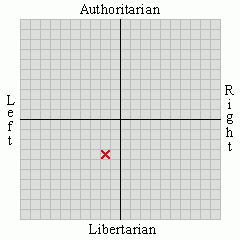
I am a center-left moderate social libertarian
Left: 1.35, Libertarian: 3.46


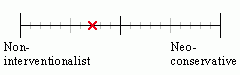
On foreign policy, also moderate, but with leanings toward non-intervention:

My Foreign Policy Views
Score: -2.89


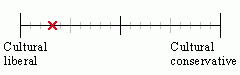
On multiculturalist issues, fairly liberal:

My Culture War Stance
Score: -6.76


I vote Democrat more often than not, but there are the occasional Libertarian-leaning candidates I warm to on matters of foreign policy, fourth amendment rights, and fiscal management. For instance, Ron Paul could have gotten my vote in place of Obama if not for his strong anti-abortionist views and a few other things. Though in truth, Paul seems more Constitutionalist than Libertarian (on which differences see here) -- he's a bit hard to pin down.

So that's me coming clean about my politics.

Saturday, February 05, 2011

Forged: Writing in the Name of God

Bart Ehrman's new book is due out in April, and here's a blurb from the current issue of Library Journal (2/1/11, p 69):
"Ehrman provides evidence here that the ancient world, in fact, generally condemned forgeries as much as the modern world does. He then goes on to discuss works that were wrongly claimed to have been written by Peter or by Paul as well as other forgeries, including some in the last two centuries. He distinguishes between the use of a pen name to hide the writer's identity and a forgery that claims to be the work of someone else. Most of the forgeries Ehrman discusses served anti-Jewish propaganda, although some were anti-pagan, while the so-called Gospel of Nicodemus was an attempt to correct the very anti-Christian Acts of Pilate. Ehrman uses other forgeries as well to support his conclusion that 'Christians intent on establishing what was right to believe did so by telling lies.'"
Telling lies, indeed, as per my earlier series on lying and deception. It will be interesting to how Ehrman has developed his ideas over the past few years.

Wednesday, February 02, 2011

Utilitarianism and Deontology

I'm reading an interesting collection of essays, Batman and Philosophy: The Dark Knight of the Soul, which covers the slippery moral ground of the Batman world. In the first essay, "Why Doesn't Batman Kill the Joker?", Mark White discusses the differences between the classic Utilitarian and Deontologist positions, of which Batman is clearly the latter. Utilitarianism is the system of ethics requiring us to maximize the total well-being resulting from our actions, while deontology judges the morality of our actions based on features intrinsic to the actions themselves, regardless of the consequences which follow. Thus a Utilitarian would easily endorse murdering the Joker to save lives, while a strict deontologist would counter that the ends don't justify the means -- the means have to be justified on their own merit. It is this latter position which governs Batman. He's religious about not becoming like the criminals he opposes, on account of personal integrity and for fear of fueling less enlightened vigilantes.

I'm afraid I'm not cleanly one or the other. In an ideal world, I'm a strong deontologist, but in practice I have to lean at least sometimes on utilitarianism. Philosophically, the deontologists have it right. Killing even the worst criminals, no matter how necessary (self-defense being allowed by even the most aggressive deontologists), harms the inner being of the killer. But it's irresponsible, even selfish, to want to shield our inner beings at the expense of innocent lives. Some criminals are just too dangerous to let live, and while I would never endorse killing for justice or vengeance sake (as natural as it is to crave justice/vengeance, killing the criminal doesn't resurrect the victim), I do sometimes endorse it for sake of preventive maintenance (to save future lives). But I do so with serious unease, for two reasons. First is that ideally, capital punishment doesn't represent enlightened thinking. The fiery prophet who counseled turning the other cheek perhaps saw this too clearly. But in reality we have a lot of work to do before we can hope to put such wisdom into practice on a global scale and be responsible to society at the same time. Second is the message sent to others. Even if we know we are being utilitarians for the right reasons (preventive maintenance), others readily hear the wrong message and allow their biological impulses towards vengeance and "blood justice" take over. And when that happens, utilitarianism cuts its own throat: we are indeed harming ourselves, and thus society at large, under pretense of doing otherwise.

The case of Batman and the Joker is admittedly extreme (few in their right mind would advocate sparing the life of a real-life nihilistic Joker), but it's extreme scenarios that work so well in the context of drama. Doctor Who fans think Tom Baker was crazy to question committing genocide on the Daleks, yet acknowledge that it's one of the Time Lord's most powerful (and convincing) character moments. Ditto for Batman's deontology vis-a-vis the Joker. The extremity of his morality asks us to think through all the implications of utilitarianism, and realize that answers which may appear easy in particular dramatic moments carry harsh implications.

Tuesday, February 01, 2011

Batman: Who Belongs in the Nolan Universe

Six years ago, on the eve of Christopher Nolan's brilliant revamping of Batman, IGN produced an excellent list of The Best & Worst Batman Villains. Aside from Mister Freeze and Harley Quinn, the "best" list looks remarkably similar to my own, and I'm glad to see Penguin on the bad list. I would have put Riddler there too. The author of these rankings clearly understands Batman as originally conceived, before the pollution of popular interpretations -- the TV show of the '60s being obviously the most offensive.

For my money, these are the villains who best invoke the grim, dark world of the Batman comics, and would work well, or already have worked well, in a Nolan film. I'm more than a little pleased that the six villains chosen by Nolan (two in each film) come from my top seven. My #4 choice, Professor Pyg, is admittedly too much to hope for, and would undoubtedly have pushed even Nolan's envelope into R-rated territory.
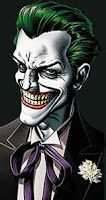
1. Joker. Nihilism incarnate, completely unpredictable, reveling in chaos. He thinks everything is funny, and even takes his own beatings with a laugh. Jack Nicholson gave us a campy trickster, but Heath Ledger was vastly superior as a cold-blooded serial killer who enjoyed putting smiles on people with his knives. Both versions have basis in the canon: the Joker began as a homicidal maniac (in the '40s), then watered down to a goofy prankster (throughout the '50s-'60s), then revived to nihilism as originally conceived (from the '70s on). But true fans recognize the hard-core version as the true Joker. He's a timeless villain, the Dark Knight's nemesis, and wholly irreplaceable.

2. Two-Face. Crusader for justice turned psychotic, with a powerful guilt hold over Batman. The fall of Harvey Dent is wonderfully tragic, and milked to epic proportions by Nolan. The idea of a highly esteemed district attorney going off the deep end and developing a split personality, obsessed with duality and opposites, is to me fascinating, and I love the idea of being a slave to fate by letting coin tosses decide whether to do good or bad, and never questioning the result. Combining the Joker and Two-Face, the two best villains, in one film is what made The Dark Knight so strong.

3. Catwoman. Placing in the top three for being as dangerous as an ally, even lover, who is able to make Batman betray his deepest convictions. Not sure how Nolan will use her in his third film, but the potentials are many. Will she be the Selina Kyle of high-stakes thievery in the '40s, the murderess of the '70s, the prostitute/dominatrix of the '80s, or (more than likely) some combination of the three? An entirely sympathetic character with a history of abuse, and honestly, what hetero/bisexual male doesn't thrill to a woman like this with a whip?

4. Professor Pyg. A very recent creation in the Batman canon (only three years ago, in Oct '07), and one sick bastard, performing hideous surgeries on people to "make them perfect". Cordless drills, hammers, ice picks, and other nasty instruments are used to convert his victims into Dollotrons. Even Nolan would probably steer clear of this guy (how to represent a Mengele-like figure on screen without an R-rating?), but that's too bad. For a fourth film I could envision a powerful story involving Pyg, supplemented by someone like Black Mask. Rather fitting, this villain made his debut in Batman issue #666. After the Joker, this guy could well qualify as an anti-Christ of Gotham City.

5. Bane. Intelligent as he is huge, and legendary for breaking Batman's back as well as his spirit. A fairly recent part of the canon (introduced in '93), he's going to fit perfectly in Nolan's world on account of his complexity. He's not all bad: he occasionally brings down drug overlords, even with Batman's assistance, and had a Jesuit priest as a mentor while growing up in a hellish South American prison. Who wouldn't want to witness the infamous spectacle of this brute bearding the bat in his cave under Wayne Manor, pulverizing his back, and leaving him a paraplegic? Bring it on.

6. Ra's Al Ghul. Batman's mentor: the obvious choice for Batman Begins, and ideally suitable in the post 9/11 age of terrorism. He's the one villain who threatens on a global scale beyond Gotham City's borders, believing that industrial societies need to be destroyed periodically to keep the world in balance. Liam Neeson fit the role like a glove (I still remember him as an unknown in '87 playing an IRA terrorist in a Miami Vice episode), especially in the backstory of Batman's ninjitsu training. One of the few villains who knows Batman's true identity, a father-figure furious with the way his protege turned out.

7. Scarecrow. Another excellent choice to start with, making clear that Nolan's world is one of horror as much as thriller-action. Dr. Crane uses his psychiatric profession not for wealth or prestige, but for the sole purpose of suffocating people with fear. He's an underrated villain, in my view, and closely resembles the Joker in the sense that he isn't constrained by any code: he has no interest in balance (like R'as Al Ghul, Two-Face, and Poison Ivy), justice (like Catwoman and Bane), or even "helping" people (like Professor Pyg). He just wants to see people go mad with terror, like the Joker wants -- in the words of Michael Caine's Alfred -- "to watch the world burn".

8. Poison Ivy. Eco-terrorism, toxic seduction, and domination over men are her forte, and like Professor Pyg, she would work splendidly in an R-rated context, though for quite different reasons. Killing men with toxic bodily fluids has lurid potential. But in spite of her misanthropy, she shows heart on rare occasion, such as when Gotham City was destroyed in an earthquake, and she turned Robinson Park into a tropical paradise and haven for orphans who were abused like she was. Her raging environmentalism and fanatical devotion to plant life is matched only in the character of Harrison Chase (in the Doctor Who classic Seeds of Doom), and I love how these noble causes are pressed into abominably vile service.

9. Black Mask. Mastermind of the criminal underworld and mob scene of Gotham City. Thoroughly sadistic, he does things like making people eat corpses to drive them mad. His chief grievances lie with Bruce Wayne more than Batman -- since Wayne bought out his parents' company -- though Batman has caused him considerable grief too, most notably when in a battle his mask burned permanently into his face. His sadism grew exponentially in proportion to the decline of his empire, and it's almost too bad he won't be in Nolan's third film, since it's Catwoman who got the pleasure of shooting him in the head and blowing off his jaw. Wouldn't that be a spectacle.

10. Deadshot. The assassin who "never misses", and doesn't care if he dies. In fact he rather wants to die in some spectacular fashion, which was his reason for joining the Suicide Squad. He's dangerous because he's so lethally accurate, and feels he has nothing to lose -- and no one wants a mercenary like this on their ass. Like many Batman villains he has serious childhood baggage, having unintentionally killed the brother he loved to save the father he hated. He believes in guns as much as Batman doesn't, and would make a solid supplementary villain in a Nolan film.

And now for my bad list: characters entirely unsuitable for Nolan's films. I'm ignoring the super-lame villains everyone hates (like Crazy Quilt, Kite Man, Maxie Zeus, Killer Moth, and Batzarro) and focusing on figures who are actually widely liked -- two heroes and two villains. Thankfully Nolan has no use for them.

1. Robin. The Boy Wonder may work wonders in the comics, but he's the kiss of death on screen. Cinematically, Batman works best alone. Robin's colorful nature completely undermines the darkness of the knight, and like most sidekicks he serves as a foil, to voice questions for the audience, or just lame humor. This is something Tim Burton and Christopher Nolan readily grasped, but which Joel Schumacher did not. (Schumacher's casting of Chris O'Donnell was actually perfect -- but that's not a compliment!) There's a part of me that would endorse adding Robin if only we could see the Joker brutally kill him off, as per the comics.

2. Batgirl. Heroic wannabes are as bad as sidekicks, and even the comic editors deemed Batgirl silly enough to phase her out during certain periods. On top of this, she was only conceived as a means to dispel homophobic fears that Batman and Robin were getting it on. (That's the '50s for you.) In any case, we don't need a family of bats fighting crime in Gotham City. Again, Batman works best alone, undiluted by trivial lightweights. Even the name is offensive. "Batgirl"? Batshit.

3. Riddler. How sinister, really, is a guy who dons question marks and poses cerebral puzzles? He's a prisoner of his personality in a way that completely shatters his threat factor -- being unable to simply kill opponents when he has the upper hand without giving them a chance to solve a puzzle. At best he functions as a pale imitation of a certain side of the Joker, and I suspect the pirate's dilemma set by Heath Ledger in The Dark Knight was sort of a nod to the Riddler. (Of course, the beauty to the Joker's puzzles is that there's no guarantee he's telling the truth about the ground rules.) Jim Carrey deserved to play him in the atrocious Schumacher film, just as Chris O'Donnell deserved Robin, and let's just bid good riddance to both of them, actors and characters equally.

4. Penguin. I was stunned to see this guy placing on many of the worst/overrated lists as I surfed the web, and I'm glad I'm in good company. As others point out, there's nothing especially interesting about Penguin. He's not even insane, just an obese chain-smoker who dresses up nicely and loves trick umbrellas that conceal stupid gadgets. He became popular in the '60s, thanks to the dreadful TV show: for whatever reason, people couldn't get enough of Burgess Meredith's squawking laughter. The Penguin's a laugh, all right, a bad joke, and entirely unsuitable for Nolan's version of Gotham City.