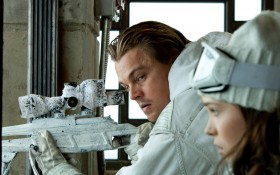
Wednesday, July 28, 2010

Top 10 Films About Dreams

Inspired by the current success of Inception, here are what I judge to be the best films dealing with dreams and architectures of the mind, rated in descending order, not necessarily by their strength as films in general (otherwise Eyes Wide Shut would be much higher and The Cell at the bottom), but as "dream films".

1. Mulholland Drive, David Lynch. 2001. Critical approval: 81%. A dream-fable of Hollywood upturned by cruel reality, and a film that Lynch was clearly destined to make. The dream comprises the first two thirds of the story, and is made sense of by the devastating third part, a complete analysis of which can be found at Salon. Being inside the mind of Diane Selwyn amounts to a heady experience no other film has offered; I've seen this masterpiece many times, never tire of it, and never will. The manner in which various people from Diane's life fill the roles in her dream shows a brilliant understanding of projection and how dreams work in the context of frustrated wish-fulfillment. And the lip-synced Llorando, precipitating the intrusion of reality, is one of the most cherished musical moments in the history of film.

2. Amy's Choice, Simon Nye. 2010. It usually doesn't make sense to mix TV with film rankings, but this episode of Doctor Who is such a work of art it claims second place. Here the Doctor and his companions find themselves flicking back and forth between two dreams, one of which they are told is reality, and they are supposed to figure out which is which. The figure of the Dream Lord is a brilliant creation, a manifestation of the Doctor's own subconscious, his shadow self forcing him to see things about himself he can't stand. In the end, Amy's choice is a choice between the Doctor and her boyfriend more than between dream scenarios, a welcome introspective drama in a season dominated by themes of fairy tales and weird imagination. See my review for more details.

3. Inception, Christopher Nolan. 2010. Critical approval: 87%. A dream heist team is hired to implant an idea in the mind of a corporate executive so subtly that he will believe it's his own, and decide to allow his financial empire to dissolve. The idea must be planted on a deep level of the subconscious, a third-level dream -- a dream within a dream within a dream -- where minutes in the higher-level dreams expand into months and years, and the danger of never waking up and falling into limbo escalate exponentially. Convoluted, action-packed, but with an emotional side-story too, it's a film only Christopher Nolan could have made, and definitely demands repeated viewings. As for making sense of what's going on, see my detailed plot analysis.

4. Open Your Eyes, 1997. Alejandro Amenábar. Critical approval: 84%. A disfigured man chooses to kill himself and be preserved cryogenically in order to live out pleasant fantasies, but gets more than he bargained for as his catatonic dreams become nightmares. As with Inception (#3), it's not always clear what's real and imagined: does César's dream start after he passes out on the sidewalk, or after his earlier car crash -- or is the entire film a dream? Identities are confused, the roles of César's lady friends swap, and he kills the wrong one thinking she's the right one. Avoid the American remake, Vanilla Sky, at all costs, where higher production values, actors like Cameron Diaz, and other atrocities rob the story of the original's graceful etherealness.

5. Eyes Wide Shut, Stanley Kubrick. 1999. Critical approval: 77%. Based on the 1926 novella, Dream Story, in which a man attends a bizarre orgy that parallels the dream of his wife going on at the same time. Alice Hartford's fantasy, involving adulterous sex with an endless crowd of strangers, is never actually portrayed on screen -- only related tearfully when her husband returns home from the orgy -- but it grounds the story to the extent that Bill Hartford's reality has a constant dreamscape quality to it, as he's been obsessing another of his wife's fantasies anyway. Kubrick's film is at heart about the compulsive power of dreams and what perfectly normal people are willing to seek out in order to live their obsessions. And as Bill Hartford says in the end, "no dream is ever just a dream."

6. What Dreams May Come, Vincent Ward. 1998. Critical approval: 55%. A blazing canvas of the afterlife, where the experience of heaven or hell is shaped by one's dreams. Yes, Robin Williams stars (strike one), and the "love conquers all" theme too melodramatic (strike two), but the transcendental concepts are ragingly effective, and the imagery at every moment stunning. Chris' heaven is a literal paint job, and parts of hell are straight out of Dante's Inferno. The film is about reincarnation, though Christianized. Side note: be sure to watch the alternate ending on the DVD, which is viscerally faithful to the book, showing Chris and his wife reborn in a third world (among the pain and screams of childbirth) in order to pay off their debts of karma, instead of America again, as toddlers, just to have fun meeting each other again for the first time.

7. The Cell, Tarsem Singh. 2000. Critical approval: 46%. A psychotherapist enters the mind of a serial killer and is pulverized by his warped universe. This isn't the best movie you'll ever see (and Jennifer Lopez is a hindrance), but it does contain some of the most disturbing architectures of the mind ever put on celluloid. Vincent D'Onofrio plays the killer, and in his inner world we see how he was terribly abused as a child, and has now become king of a world in which women are dressed up and painted to look like white dolls and tortured in hideous contraptions out of a new age Inquisition. Watch this for a taste. The resolution is fairly pedestrian, but the grueling journey to get there makes it worthwhile.

8. The Science of Sleep, Michel Gondry. 2006. Critical approval: 70%. About a young man's inability to reconcile his dreams with reality, and his childlike infatuation with a woman who shares his creative interests. Gondry serves up a lot of eye candy here -- cellophane-like water, cardboard television sets, giant rubber body parts, animated miniatures, and other forms of bizarreness that serve as the "building blocks" of dreams. As the film progresses, the line between Stéphane's dreams and waking state blurs in direct proportion to his romantic obsession, pathetically insecure and asexual, causing him to hurt himself (physically and emotionally) as a child would. Like Lynch (#1) and Kubrick (#5), Gondry was pretty much destined to make a dream film, and indeed Mulholland Drive, Eyes Wide Shut, and The Science of Sleep serve as the "artist trilogy" on this list.

9. MirrorMask, Dave McKean. 2005. Critical approval: 54%. On the night before her mother's surgery, for which she believes she's responsible, Helena is plunged into a dream fantasy in which she must save a dying queen. Everyone wears masks in this world (Helena's lack thereof is seen as a dearth of ability to express emotion), fish swim in mid-air, library books function as air-skateboards, and orbiting giants bellow with impossibly deep resonance. There are shades of What Dreams May Come (#6), as we learn that Helena's dream is tied to the reality of pictures she has drawn in her bedroom, especially when she and her shadow counterpart are able to view each other through windows that are part of those drawings. Probably the one film on this list suitable for all ages, and a treat from the mind of (scriptwriter) Neil Gaiman.

10. Requiem for a Dream, Darren Aronofsky. 2000. Critical approval: 78%. A searing trip down the rabbit hole of drug addiction and dream worlds of delusion and desperation. Sarah is an elderly woman who gets hooked on amphetamine pills (by day) and sedatives (by night) in order to lose weight so she can appear as a guest on a TV game show; her son is addicted to the heroin he deals in hopes of opening a fashion store for his girlfriend. Both dreams are crushed: Sarah's TV invitation never comes, and she ups her dosage until she's hallucinating and must be hospitalized; Harry's drug business goes bad, his addiction gets out of hand, and his arm must be amputated; Marion prostitutes herself for money. The unhappy ending shows each "dreamer" curled in a fetal position after a climax that leaves the viewer stunned by its manic fury as much as by its brilliant symbolism.

Wednesday, July 21, 2010

Inception

The most curious thing about Inception has been its reception. While generally positive, it's been overpraised and savaged by loud minorities, the former by those who see philosophical profundity in Deepak Chopra, the latter by those whose expectations were too high or who insist on judging the film by the wrong yardstick. This is a heist movie, not epic drama, and one should no more expect a Godfatheresque thriller than fault it for not being so. The one legitimate complaint that can be leveled is the remarkable lack of character development over its two and a half hour length. But even that's a small crime in a film whose important strengths lie elsewhere.

I won't waste much time on the plot, since I've already broken it down completely, only to reemphasize that it's not nearly as inconsistent as some believe, though Nolan does drop the ball on a couple of points. The time differential on the level two dream isn't correct, and by rights Arthur should have woken up on level one when his team of dreamers missed the first kick. As far as I can tell, everything else lines up properly. With regards to the ending, there seems no end to debate. Did Cobb wake up in reality and go home to his kids? Did he choose to stay down in limbo? Did he dream the entire mission on the plane? I favor the second option since upon reuniting with his children, they appear exactly the same as he remembers them (same clothes, posture, age, etc). It's not clear whether or not the totem tops, and Nolan was obviously leaving the matter ambiguous. Either the first or second scenario is satisfying since the mission is successful in either case, though the second has the added benefit of tragedy. The third is lame, and I rather doubt was intended to take seriously. [Edit: I now accept the first reality option, since it has been pointed out that Cobb’s kids are actually wearing different shoes, and they are at least implied to be older by the fact that different actors were used to play the kids (per IMDB).]

Regarding the structure of dreams, Inception takes the opposite approach of What Dreams May Come, serving up clearly defined labyrinths, mazes, and landscapes which conform to the laws of physics (when things are going well), purposely designed this way by an architect (Ariadne, played by Ellen Page) so that when the subject's mind is invaded, everything will seem "normal" and not prompt defensive reactions from the subconscious. Nolan is hardly suggesting that dreams usually function this way; they are imposed this way on a victim for a specific purpose. Dramatically this works to great effect, and I love the minimalist feel to Inception's dream architecture, especially the preponderance of greys and blacks (again, opposite the blazing rainbow colors in What Dreams May Come), which go well with the gritty action sequences.

I also adore the story's premise: that the "protagonists" of the Inception team are basically on a mission to destroy a decent man (or at least his financial world), though a critic like Carson Lund is nonplussed, complaining that "the emotionality that drives this complex operation is cruel" and that "any rewards the team receives after their inevitable success are at the expense of ruining one man's personal and professional life, pounding into his head that his father never loved him and was disappointed that he tried to repeat his own path". But that's a strength of the story, not a weakness, making us pause before shelling out too much sympathy for the lead character (Di Caprio's Cobb) who is tormented by his wife's suicide, for which he was tragically responsible.

The strongest indicator of the film's success is that it's over before you know it. Even on second viewing I couldn't believe I spent two and a half hours in my seat -- it's as if that seat had been a lower level dream with the film taking up a fraction of its time. Surely that's the most fitting praise for Inception.

Rating: 4 ½ stars out of 5.

Tuesday, July 20, 2010

Wind Through the Cradle

Carson Lund, former employee of the Nashua Public Library, and who authors the blog, Are the Hills Going to March Off?, has made a short film along with Michael Basta (another ex-library employee). The film is called Wind Through the Cradle, is 27 minutes long, and may be watched here. The synopsis:
"A retired writer (Clifford Blake) who once had a passionate intellectual following has since retreated to the woods to live in complete isolation. Wind Through the Cradle involves the arrival of his distant relative, a young journalist (Natasha Mogilevskaya) for an unspecified source who comes to immerse herself in his lifestyle and probe his inner being in an attempt to bring his enigma to public light. A tension builds as the journalist stays for longer than intended, which builds to a deeply ambiguous climax. Told with languorous narrative rhythms, minimal dialogue, and a graceful observational camera, Wind Through the Cradle is a mysterious examination of the limits of familial bonds in the foreboding silence of the forest."
Check it out. Carson generally has fine cinematic tastes, though must be forgiven for his misguided hatred of Christopher Nolan's Inception.

Monday, July 19, 2010

Inception: Plot Analysis

This isn't a review of Inception but a careful outline of the plot. Many complain that the film is confusing to follow (on first viewing anyway) and even that it violates its own rules of the dream world. While I don't think it's a fraction as confusing or inconsistent as some critics make it out to be, there are a few points where I could use more closure. Please leave comments if you think any part of this analysis is askew, or if other parts of the plot demand clarity.

I'll review the film later, but for now simply note that while it's very good, I don't agree with Doug Chaplin that it's Nolan's best, certainly not as good as The Dark Knight, and perhaps not even Memento though admittedly close. My one problem with Inception is the remarkable lack of character development over two and a half hours. The actors do a fine job with what they're given, but aside from Leo Di Caprio's Cobb, we don't get to know them well. (In stark contrast, The Dark Knight's two and a half hour length gave us an intimate look at almost every character.) But that's an admittedly small complaint, given that the film's strengths lie elsewhere. And Doug is right about the tempus fugit effect of watching it: it certainly doesn't feel like a long film at all -- almost as if we're dreaming it ourselves.

THE PLOT OF INCEPTION

The mission of the Inception team is grand: to implant an idea deep in the subconscious of a corporate executive (Robert Fischer Jr., played by Cilian Murphy) so subtly that he will believe its his own idea, and choose not to follow in his fathers footsteps, thereby leaving business to others and allowing a rival competitor to dominate. Planting this idea requires such intricacy that it must be done on a very deep level, a third-level dream -- a dream within a dream within a dream -- where minutes in the higher-level dreams expand into months and years, and the danger of never waking up or falling into limbo escalate dramatically.

The level one traffic dream is dreamed by Yusuf (Dileep Rao) on the airplane (level zero). Saito is shot on this level and starts dying. The team captures Fischer, and Eames (shapechanged as Fischer's right hand man, Browning) tells him they've been torturing him (Browning) to get the combination to his father's safe, and that his father left an alternate will in the safe allowing him to dissolve the empire if he so chooses. The first seed is planted: that Fischer may not wish to follow in his father's footsteps. Fischer's defensive projections zero in on the Inception team, who flee in a van. They are relentlessly chased and shot at in busy traffic. Yusuf stays behind on this level to keep driving the van as the rest of the team go to sleep and enter the level two dream. He will signal down to level two when he's ready to initiate a kick by driving the van off a bridge.

The level two hotel dream is dreamed by Arthur (Joseph Gordon-Levitt) in the van on level one. Saito continues dying on this level from the previous gun wound. Cobb (posing as "Mr. Charles") convinces Fischer that the Inception team are Fischer's own defensive projections to help fend of dream invaders, and that Fischer's actual defensive projections are the enemy invaders; they encounter Fischer's projection of Browning, whom Fischer accuses of working with the kidnappers and wanting the alternate will for himself. The Browning projection says he can't just let Fischer destroy the empire by rising to his father's last taunt -- to build something for himself. Fischer's subconscious is feeding these ideas given by Eames on the first level, so in effect Fischer is by now giving himself the ideas. The second seed is planted: that Fischer can create something for himself. The Inception team succeeds in recruiting Fischer on this level, convincing him that Browning isn't telling the whole truth, and pretend to use Browning's subconscious to enter level three and determine his motives (but of course they're still using Fischer's subconscious). Arthur stays behind on level two to watch over the rest of the team as they go to sleep in the hotel room and enter the level three dream. He will signal down to level three when he hears Yusuf's signal from above and is ready to initiate a kick by detonating the charges he planted in the ceiling of the room below, bringing the dreamers through the floor.

The level three snow-fort dream is dreamed by Eames (Tom Hardy) in the hotel room on level two, who then stays behind on level three when Cobb and Ariadne unexpectedly have to enter limbo in order to retrieve Fischer when he is killed by Mal. They hook up to the dreamware and navigate their way to limbo as Cobb had learned how to do long ago with Mal. Eames will signal down to limbo when he hears Arthur's signal from above and is ready to initiate a kick by planting explosives on the building to make it drop. They are only guessing that limbo might function as a "level four dream" this way in being responsive to kicks. Saito finally dies on this level after Cobb and Ariadne go to limbo.

The limbo level is dreamed by no one, since it is a place of shared consciousness. (On levels one to three, each dreamer's dream is filled by Fischer's subconscious.) It contains nothing other than decaying remains of whatever was built by those who had been there before, such as Cobb and Mal. Cobb and Ariadne find Mal, who gives up Fischer only after extracting a promise from Cobb to remain with her in limbo. Ariadne learns from Cobb that one can escape limbo by dying in it (he tells how he and Mal freed themselves from limbo after fifty years by throwing themselves in front of a train), and so she pushes Fischer off a building and then throws herself off likewise, not bothering to wait for the kick from Eames on level three (and they were never quite sure they could be kicked out of limbo as in "regular" level dreams anyway). Cobb remains behind, telling Ariadne that Saito must have died by now and he needs to find him (lest Saito succumb to the lure of limbo and decide to stay there forever, believing it to be reality; Cobb of course needs him to clear him of charges so that he can go home). Ariadne warns him not to lose himself as he did before with Mal.

Back on level three Eames resuscitates Fischer with the defibrillator (after Ariadne frees him from limbo by killing him) who then enters the hospital room and meets his dying father. The third and most critical seed is planted, thus completing the mission: that Fischer Sr. never wanted his son to be like him. Note that Saito cannot be resuscitated the same way since he has been dying on all three levels of the dream, unlike the case of Fischer, whose bodies remain intact on levels one and two; and even if Saito could be resuscitated this way, he is still lost below in limbo. He becomes trapped there, believing it to be reality (like Mal did). Cobb also loses himself in limbo, until he eventually finds a very aged Saito and kills/liberates him.

So when the mission is completed on level three (Fischer meeting his dying father), the kick from level two (the elevator falling down the shaft) snaps Eames, Ariadne, and Fischer out of the level three dream and they wake up on level two. Then the kick from level one (the van hitting the water) snaps Arthur, Eames, Ariadne, and Fischer out of the level two dream and they wake up on level one. Finally, after a few days of milling about on level one, Arthur, Eames (still shapechanged as Browning on this level), Ariadne, and Fischer get "kicked" up to reality when the sedation wears off on the plane. Cobb and Saito wake up too, but they had to wait many years since they were stranded down in limbo.

Note: The first kick on level one -- the van falling off the bridge -- was missed, as the mission was still unfulfilled and no kicks from levels three or two had taken place yet. The team would be given a second chance when the van hit the water, but because the level one dreamers were now in freefall, the level two dreamers became suspended likewise, thereby requiring Arthur to come up with a new and creative kick for zero-g environment (the elevator falling down the shaft). (The van's freefall didn't effect the gravity of the level three dream, only the level immediately below.)

Note: It appears that kicks can be resisted. (1) When the the first kick on level one is missed (the van falling off the bridge), it at least should have woken up Arthur, since he was awake (and not dreaming like the others) on level two. (2) Similarly, the kick on level three (the fort crumbling and falling) should have woken up Cobb from limbo (assuming that one can get kicked out of limbo like this, which the team is unsure of), but didn't. Obviously Arthur needed more time on level two to initiate a kick there, and Cobb needed to find Saito in limbo. The implication is that (trained dream invaders?) can resist kicks.

Regarding time: We are told that ten hours of real time (on the airplane) translates into seven days in a level one dream, six months in a level two dream, and ten years in a level three dream (and God only knows how much in limbo). So when the van has a mere (three?) seconds to hit the water, that should translate into one minute on level two and twenty minutes on level three. We are indeed told that the team on level three has twenty minutes to complete their mission after they miss the first kick, but we're told that Arthur has three minutes (not one) to initiate a kick on level two -- and it sure seems like it takes longer than three minutes (let alone one) for him to bind everyone up and rig the elevator.

Finally, the ending is left wonderfully ambiguous, since it's not clear if the totem tops or not. Did Cobb stay down in limbo or go home? Given Chris Nolan's penchant for the tragic, I prefer to think the former. Notice that when he finally meets his kids, they appear exactly as he remembers them, in the same clothes, not having aged a day. I believe that Cobb decided to remain in a dream with his wife and kids, rather than in reality with his kids alone.

UPDATE (7/21/10) Here's my actual review.

UPDATE (7/23/10): I stand by everything said in this post except the last paragraph. Eagle-eyed Vic Holtreman points out that at the end Cobb’s kids are actually wearing different shoes, and they are at least implied to be older by the fact that different actors were used to play the kids (per IMDB). So Cobb's homecoming is probably real after all.

Saturday, July 17, 2010

Fake Reviews

Michael Bird mentions the BBC report of an historian required to pay libel damages and costs for writing fake amazon reviews disparaging the works of others and praising his own. It makes me wonder about the risk of certain "guest" reviews I have allowed published on this blog (see here and here).

Shogun: Fact and Fiction (IV) -- Treachery and Loyalty in an Honor-Shame Context

In the last post we looked at the theme of homoeroticism in James Clavell's Shogun and considered commonalities between the medieval Japanese and ancient Mediterraneans. In this post I want to examine the tricky relationship between treachery and loyalty in honor-shame cultures. If the reader of Shogun is struck by the imperative of loyalty to one's liege lord, it is just as striking that so many of the novel's characters are constantly scheming against their superiors, and backbiting each other left and right, saying one thing and thinking another. What gives?

In Learning from Shogun, Henry Smith, who doesn't hesitate to point out Clavell's errors when he sees them, concedes that on the point of duplicity and treachery Clavell understands the Japanese mindset quite well:
"Clavell was scarcely deviating from historical reality in his heavy reliance on the theme of duplicity to build the plot and create the driving suspense of his novel. While this undeniably perpetuates the Western stereotype of the Japanese (and other Asians) as 'inscrutable', one must realize that the stereotype was in full flower in the era of Shogun. Consider the advice of the pilot Rodrigues to Blackthorne: 'Never forget Japmen're six-faced and have three hearts. It's a saying they have, that a man has a false heart in his mouth for all the world to see, another in his breast to show his very special friends and his family, and the real one, the true one, which is never known to anyone except himself alone'... There is little doubt that both treachery and loyalty were the central themes of sixteenth-century Japanese politics, and Clavell can scarcely be accused of exaggerating them." ("The Struggle for the Shogunate", pp 52-53)
Smith attributes much of Japanese duplicity and treachery to the transitional era of c. 1600, "from the utter chaos of the mid-sixteenth century to the amazingly stable and well-ordered regime of the Tokugawa shogunate a century later. It is precisely this process of transition that helps us better understand the seemingly contradictory mixture of a country which is alternatively described as in total political chaos and at the same time a paragon of law and order (p 54)". But that's a largely superficial answer, because the issue transcends politics. Rodrigues' remark is a general one suggesting people conditioned more by culture than politics.

To me, the issue is pressed home most strongly in chapter 34, when Toranaga, about to invite the daimyo Yabu to be one of his vassals, asks Mariko for advice:
Toranaga: "What's your opinion of Yabu?"

Mariko: "Yabu-san's a violent man with no scruples whatsoever. He honors nothing but his own interests. Duty, loyalty, tradition, mean nothing to him. His mind has flashes of great cunning, even brilliance. He's equally dangerous as an ally or enemy."

Toranaga: "All commendable virtues. What's to be said against him?"
On the face of it, this is rather astounding praise for a soon-to-be vassal. In a culture that values honor, duty, loyalty, and tradition above everything else, why would someone commend the precise opposite in a subordinate he needs to rely on so heavily? Toranaga is just as aware as we are (as readers) that Yabu is a backbiting shark who's constantly itching to splash Toranaga's head on the ground even as he's drawn into alliance with him.

Retainers and vassals are always walking a tightrope in honor-shame cultures, keeping their lords' interests at heart enough to not incur wrath while keeping their own interests even closer, but discreetly so as not to arouse undue suspicion, yet still enough to insure their own gains. Lords like Toranaga know the system perfectly, and as long as their subordinates mind their interests to the appropriate degree and give all due outward displays of respect, they don't begrudge duplicity in their subjects -- in fact, if they're smart, they stand to gain a great deal by encouraging such duplicity and self-serving interests. Retainers can do a lot of dirty work for them, siphon off anger that would otherwise be directed at the lord, exploit others for profit, and other activity that carries dishonorable risk.

Looked at this way, treachery is simply the other coin side of honor-shame loyalty. One calls forth the other. Human beings are self-serving creatures, after all, and in a culture that has strong loyalist mechanisms to contravene that inclination, treachery will out in other ways -- and fiercely. It makes for constantly precarious relationships: Toranaga never trusts Yabu, who indeed doesn't get through a day without contemplating murdering or betraying him to get ahead; Omi is just as hell-bent on killing Yabu (though Yabu is oblivious to this, thinking his nephew a genuine loyalist). While lords like Toranaga of course need truly loyal retainers (like Hiro-Matsu) as their closest confidents, they also need sharks like Yabu to obtain goals otherwise out of reach. But the sharks have to be shrewd. Shrewd enough not to get caught, and shrewd enough to make everything seem loyal and honorable. In the character of Yabu, Clavell portrayed this phenomenon better than anything I've read in any work of literature.

Insofar as biblical parallels go, it's difficult to light on them for the obvious reason that one doesn't portray treachery where loyalty is expected, save in places where (shameful) treachery is the issue at hand (as in the case of Judas and Peter's thrice denial of Jesus). And the biblical writers don't get into the minds of their protagonists the way a modern novelist like Clavell does so well. Yet biblical specialists have been using the duplicity model to help us understand treachery in various texts. For instance, in the parable of The Dishonest Steward, we find a master commending the dishonest behavior of his own manager who cheats him, and at Antioch we see how the pillars backstabbed Paul despite the "agreement" made in Jerusalem.

In the next and final post, I'll wrap up this series and suggest what a novel like Shogun can help teach us about biblical values.

Wednesday, July 14, 2010

Bill Arnal Reviews Crossley's Jesus in an Age of Terror

Check it out at RBL. Readers will recall my own review for The Nashua Public Library blog, and of course there was the colorful review on this blog by Leonard Ridge.

Here's Arnal's commentary on Crossley's Context-Group bashing:
"...Crossley goes after the Context Group for promoting Orientalist scholarship (disclosure: I am a member of the Context Group, though not an active one). It is, in the first place, unclear why this particular group of scholars is being singled out for scrutiny when there are so many potential foci for Crossley's analyses; the work of the Context Group (as Crossley admits at points) is hardly consistent in its Orientalism, nor hardly the most egregious example of such an approach. Crossley's point is certainly well taken that broad characterizations of 'Mediterranean' culture as, for example, rather timelessly based on honor-shame tend to play into and confirm stereotypes about a contemporary 'clash of civilizations.' But does this have any real bearing on the motivations of the scholars who reconstruct such anthropological models? Are such motivations even relevant? Indeed, does the potential misuse of these models (even by their own authors) have any implications at all either for their accuracy or their utility in the analysis of ancient Mediterranean cultural artifacts (which is, after all, what they are being used for)? Crossley needs to provide satisfactory answers to these questions."
Bill is one of the panelists who will be reviewing Crossley's book in Atlanta this November (the others being Mark Goodacre, Zeba Crook, and Roland Boer). I'm looking forward to the session. Zeba Crook is a Context Group member and will naturally have some interesting things to say. I didn't know that Bill himself was a (non-active) member of the group until reading this review.

Shogun: Fact and Fiction (III) -- Homoeroticism in an Honor-Shame Context

In the last post we looked at the theme of love in James Clavell's Shogun, and saw that it was about duty and attachment more than affection, just as it was for ancient Jews and Christians. We turn now to homoeroticism. What parallels do we see between medieval Japan and the ancient Mediterranean?

The issue is addressed at a memorable point in the novel (in chapter 20). The English pilot John Blackthorne has just been granted an audience with the future Shogun, Lord Toranaga, who then departs and leaves him in the care of a few guards and ladies, in particular the lady Mariko, his interpreter. Conversation turns to matters of pillowing (sex), about which Blackthorne is very embarrassed, but Mariko and the ladies are concerned that he isn't getting enough sex and so offer to send him a woman or indeed many women. He grows increasingly uncomfortable by the bluntness and lack of delicacy, and Mariko misconstrues his lack of enthusiasm as a preference for boys.
"Oh! Perhaps - perhaps you would prefer a boy?"

"Eh?"

"A boy. It's just as simple if that's your wish." Her smile was guileless, her voice matter-of-fact.

"Eh?"

"What's the matter?"

"Are you seriously offering me a boy?"

"Why, yes, Anjin-san. What's the matter? I only said we'd send a boy here if you wished it."

"I don't wish it!" Blackthorne felt the blood in his face. "Do I look like a God-cursed sodomite?"

His words slashed around the room. They all stared at him transfixed. Mariko bowed abjectly, kept her head to the floor. "Please forgive me. Here some men want boys sometimes. I foolishly presumed that your customs were the same as ours."

The samurai leader, Kazu Oan, was watching angrily. He was charged with the barbarian's safety and with the barbarian's health and he had seen, with his own eyes, the incredible favor Lord Toranaga had shown to the Anjin-san, and now the Anjin-san was furious. "What's the matter with him?" he asked challengingly, for obviously the stupid woman had said something to offend his very important prisoner.

Mariko explained what had been said and what the Anjin-san had replied. "I really don't understand what he's irritated about, Oan-san."

Oan scratched his head in disbelief. "He's like a mad ox just because you offered him a boy?"

"Yes."

"So sorry, but were you polite? Did you use a wrong word, perhaps?"
Homosexual practices were widespread in medieval Japan and entirely respectable, just as they were in the ancient Mediterranean, particularly Greece. In Learning from Shogun, Henry Smith, often critical of Shogun's portrayal of Japanese culture, acknowledges that on this point Clavell gets it right, noting further that homosexuality was particularly esteemed as training for samurai warriors, again comparable to the ancient Spartans:
"Although in general homosexual love was merely accepted without censure among the samurai, one does find in certain instances a positive and idealistic justification of homosexual practice as useful training for a warrior. A homosexual relationship was seen as a sort of tutorship in Bushido, with the younger lover imitating the older in the cultural and martial arts, much as among the warriors of ancient Sparta. In particular, such relationships were considered invaluable for teaching the virtue of loyalty, and samurai lovers generally proved dependable comrades in battle, loyal vassals, and trustworthy bureaucrats." ("Consorts and Courtesans", p 112)
Medieval Japan, in fact, is probably the closest analog we can find to the ancient Mediterranean with regards to homoeroticism. Or at least to the ancient pagans. What about the Jews and Christians?

There is no uniform view of male homoeroticism in the Judeo-Christian bible (and it is studiously silent on the question of female homoeroticism, depending on how one reads Rom 1:26). There are texts from the Holiness Code of Lev 18:22 and 20:13, which speak of one who "lies the lying down of a woman" -- probably referring to men who "take it up the ass" -- and demands that both the penetrator and the penetrated be put to death. Paul echoes this in Romans (1:27), affirming that men who engage in homosexual activity "deserve to die" (Rom 1:32), but before this also makes an unprecedented and ambiguous remark about women who "exchange natural intercourse for unnatural" -- which could refer to women who either "like to be on top" of other women or "take it up the ass" from men. Clearly there is a strand of Jewish tradition, which an apostle like Paul affirms and goes further, that is hostile to homosexual practices and/or anal intercourse.

Of course, the existence of a regulation like Lev 18:22 and 20:13 doesn't mean that reality always conformed to it. There is the well-known case of Jonathan and David (I Sam 18:1 and II Sam 1:26), where the latter speaks of the former's love to him being "greater than the love of a woman". Jonathan's "delight" in David (I Sam 19:1) recalls Shechem's earlier "delight" in Dinah (Gen 34:19), where the same word (kaphets) refers to sexual delight, and his asking David to "go out into the field" (I Sam 20:11) evokes the place where lovers go when they want to be alone (as in the blatantly erotic Song of Songs, 7:11). Jonathan and David may have shared the same kind of relationship as Achilles and Patroclus, and it's no accident that their love occurs in the context of "comradeship in arms". In the ancient Mediterranean, like medieval Japan, homoeroticism was especially taken for granted in military contexts. That still leaves the question as to why Israelites eventually developed taboos against homoeroticism, to be followed (at least in some circles) by later Jews and Christians.

The answer hinges on purity. Homoeroticism, like incest and bestiality, became viewed as morally impure to the extent it was seen as almost coterminous with idolatry (certainly Paul is leveling his diatribe against the pagan faction in Rome, reminding them how their godless heritage convicts them). Many scholars emphasize that in honor-shame cultures, the only thing offensive about men having sex with men is when it involves men of equal status, thereby forcing one of the males into the passive role reserved for women, boys, or men of lower social class. That's true, but it's not the full story. The Holiness Code demands that the "macho" penetrator be put to death as much as the "effeminate" one who takes it up the ass. And it's not just the two men who contract uncleanliness, but the whole land of Israel. Purity laws (whether ritual, like regulations for corpse preparation and menstrual blood, or moral, like the one under consideration) were designed to keep Israel separate from the "pollution" of unholy Canaan. In the case of Lev 18:22, the prohibition follows that of 18:21, which forbids worship of Molech, who had a fertility goddess consort named Ashtoreth; in pagan shrine prostitution, anal sex was viewed as an offering to the goddess. This background likely accounts for the origins of the fierce taboo against Israelite men who engage in the "lying down of a woman". It was, in a word, idolatry.

It remains significant that aside from Lev 18:22, 20:13 and Rom 1:26-27, the bible has nothing to say about homoeroticism (in I Cor 6:1, malakos refers to the "soft", or men who "pretty themselves up", often for heterosexual as much as homosexual exploits; and arsenokoites refers to some form of sexual exploitation too, though again not necessarily homosexual). The Holiness Code is a strand of Israelite tradition, and Paul is one apostle. Any "homophobia" on the part of early Jews and Christians had little to do with sexual ethics in any case, and a western prude like John Blackthorne could hardly have been reared in a culture that produced the Song of Songs or esteemed a character like David. The texts of Lev 18:22, 20:13 and Rom 1:26-27 later became co-opted by western sexual ethics, just as the virtue of love became understood in terms of affection more than duty.

In the next post we'll deal with the tricky relationship between loyalty and treachery.

Sunday, July 11, 2010

Shogun: Fact and Fiction (II) -- Love in an Honor-Shame Context

In the last post we looked at the theme of death in James Clavell's Shogun, particularly suicide and martyrdom, and teased out commonalities between Japan and the Mediterranean area. Now let's consider love. To what degree does this "alien" emotion in medieval Japan parallel the views of early Jews and Christians?

The love affair between John Blackthorne and Toda Mariko has to be one of the most memorable in modern literature. But it takes Mariko a long time to understand and experience love. Early in the novel (chapter 23) she explains to Blackthorne:
"Love is a Christian word, Anjin-san. Love is a Christian thought, a Christian ideal. We have no word for 'love' as I understand you to mean it. Duty, loyalty, honor, respect, desire, those words and thoughts are what we have, all that we need."
In Learning from Shogun, Henry Smith critiques what Clavell (through Mariko) ascribes to the Japanese:
"If all Mariko means is spontaneous affection, as she seems to, then she is dead wrong, for simple love was one of the most ancient themes in Japanese literature and could be expressed with a rich vocabulary: the Japanese 'have no word for love' only in the sense that they have many, many words for love. Nor should the unsuspecting reader be lulled into thinking that the Japanese in 1600 AD, or at any other time in their history, were incapable of falling in love without instruction from abroad." ("Consorts and Courtesans: The Women of Shogun", p 106)
Yet Smith acknowledges in the same breath that "the rise of the samurai class and its concern with duty, loyalty, and the subjugation of personal emotions helps explain the decline in the status of love in medieval Japan" (p 107). There seems to be something about a code of honor-shame that represses feelings of affection, and in such contexts "love" carries a different emphasis.

In fact, Context Group members tell us that the biblical understanding of love is precisely about duty and attachment to a group or person: "there may or may not be affection, but it is the inward feeling of attachment, along with the outward behavior bound up with such attachment, that love entails" (Malina and Pilch, Social Science Commentary on the Letters of Paul, p 376). That's pretty close to what Mariko describes to Blackthorne, though she eschews the actual word "love". According to Malina and Pilch, Paul's famous triad in I Cor 13:13, "faith, hope, and love", is best translated as "personal loyalty, enduring trust in another, and attachment to another or others" (ibid). By the same token, "hate" involves dis-attachment, non-attachment, or indifference. There may or may not be feelings of repulsion, but severing ties and duties to some group or person is what it's really about. Thus Jesus' command to hate families (directed at his closest disciples) is seen to be synonymous with "leaving everything" -- leaving one's home and attaching oneself to Jesus and other disciples instead -- not necessarily accompanied by feelings of ill will.

My sense is that we should accept affection (the emotion we usually associate with love) as a universal phenomenon, but that it takes a back seat in honor-shame cultures, in favor of duty and loyalty. In that sense, I think Clavell gets it right through Mariko more than Smith allows. Yet there is an irony in her claim that "love [affection] is a Christian word". As we just saw, affection wasn't for the early Christians any more than the medieval Japanese. As with the theme of death, the question of love owes more to cultural values than religious ethics. For all the ways in which "Christianity" serves as a foil in Clavell's narrative, the precise foil is Anglo-European Christianity. Ancient (biblical) Christianity was more aligned with medieval Bushido than Clavell ever realized. Or at least in general terms: samurai obviously didn't go so far as to "love" and enjoy solidarity with their enemies.

In the next post we'll address the theme of homoeroticism.

Saturday, July 10, 2010

Shogun: Fact and Fiction (I) -- Death in an Honor-Shame Context

I'm rereading Shogun for what must be my fourth time since 1992, and as always am struck by parallels between the honor-shame values of medieval Japan and the ancient Mediterranean. Stephen Carlson and I have blogged certain comparisons in the past (Stephen about the proper understanding of grace, I about breaking promises), and now I want to consider what undoubtedly hits every reader of Clavell's novel as the strongest contrast between European and Japanese values in the sixteenth century: the view of death. To what degree does the "ready" acceptance of death in medieval Japan parallel the views of ancient Jews and Christians?

In Shogun samurai commit seppuku ("hari-kari", suicide by disembowelment) left and right, on the whim of a liege lord, and they do so proudly; it's an honorable way to die. As readers we share the point of view of the English pilot John Blackthorne, initially appalled at such nihilism, then gradually coming to appreciate the dignity in seppuku. In Learning from Shogun: Japanese History and Western Fantasy, Asian scholars William Lafleur and Henry Smith each critique this portrayal. While accepting the obviously common reality of seppuku at the time of 1600 AD, they believe Clavell has exaggerated aspects of the phenomenon. Lafleur claims that he has overstated a contrast between East and West, and Smith charges that it's too extreme to characterize the Japanese as warriors who actually look forward to death.

Let's take Lafleur's essay first, "Death and Karma in the World of Shogun":
"Over the years it has become the (sometimes unpleasant) task of Asianists like myself to raise red flags of warning when we observe too easy a contrast being made between the West and the various cultures of Asia. I am worried about the implication in Shogun that a continual fear of death grips the Western heart whereas virtually every man, woman, and child of sixteenth-century Japan could face death without flinching and even with pleasure." (p 72)
Reading this preface puts me in mind of James Crossley's Jesus in an Age of Terror, which sharply criticizes the work of the Context Group for (supposed) racist stereotypes of Middle-Eastern people. I wonder what Crossley would think of a novel like Shogun. At any rate, Lafleur continues:
"It is possible, however, to give quite a different interpretation to all the talk about 'the honor of a noble death' in the writings of late medieval Japan. The frequency and insistence of such references may, in fact, suggest that for the Japanese themselves such attitude could be made to appear 'natural' only through constant justification. The instinct for self-preservation has, after all, through millions of years remained fundamentally natural to creatures still in the prime of life. A fear of death was, then, as natural for the late medieval Japanese as it is for any other people; what is interesting about their society in that period was the elaboration of cultural mechanisms to contravene such natural fears. 'Bushido' is in many ways precisely this. But its existence as a code or norm does not in any way indicate that reality in the sixteenth century, for instance, was anything like the ideal or that large numbers of Japanese -- as Clavell depicts in Shogun -- walked willingly into death.

"We can blunt the edge of too sharp a contrast between Japan and the West by working from the other direction as well. It is helpful to remember that, although the West never created anything quite like the Bushido ritual of dying, there has always been an admiration for persons who had personally conquered death. Socrates' tranquil acceptance of hemlock inspired others to at least think about the possibility of 'dying philosophically'. Likewise, deeply rooted religious convictions carried many early Christians through martyrdom with relative tranquility and made it possible for some Jews to conceive their forced deaths as opportunities for 'sanctifying the name of God'." (pp 72-73)
The flaw in this critique is that ancient Greco-Roman philosophers and Jewish/Christian martyrs hail from the honor-shame milieu of the ancient Mediterranean, even if parts of the region may be thought of as "the West" to an Eastern scholar like LaFleur. Biblical specialists like David Seeley, Stephen Finlan, and Jeffrey Gibson have written about the noble death theme, particularly with respect to Paul's death metaphors. In IV Maccabees the Judean heroes are understood to defeat tyranny by courageously dying for the Torah, and inspiring others to do so as well, and Greco-Roman philosophers died in order to free others from the fear of death, again as vicarious models. LaFleur's examples aren't the best, because he's appealing to a place and time sharing honor-shame values similar to (though in many ways different from, to be sure) medieval Japan. Of course, LaFleur was writing his critique of Shogun in 1980, well before the genesis of the Context Group.

Henry Smith critiques Clavell from another angle, in his essay, "The Paradoxes of the Japanese Samurai":
"Much is made in Shogun of the samurai as one who can face death with complete equanimity. This is indeed a central theme within the historical tradition of the samurai, although it should be emphasized out the outset that Clavell clearly departs from the historical ideal when he characterizes the samurai as a 'death-seeking warrior'. We see this in practice, for example, when Buntaro is ordered to cease his preparations for seppuku and thereby 'cast himself back into the abyss of life', or in the query of Yabu's death poem, 'What is life but an escape from death?' While such exaggeration may help dramatize Clavell's personal message about facing death, it has little basis in Japanese history... The Japanese are fundamentally a life-affirming people and the ideal of the samurai was to face death not with yearning, but with indifference. The more appropriate emphasis, and one which finds ample expression in Shogun, is that for a samurai honor was more important than life." (p 94)
And on the last point Smith concedes that Clavell gets it right: if the only way to avoid dishonor was through death, then so be it. Samurai faced and accepted death without hesitation -- for indeed honor was more important than life itself -- but that hardly means they looked forward to it.

I'm wondering, however, if Smith is misrepresenting Clavell, at least in part. His critique gives the impression that Shogun portrays samurai as looking for any excuse to die ("yearning" for death, "seeking" it out), but that's not the case. In the cases of Yabu and Buntaro, each goes out of his way to avoid death, try every possible means of self-preservation, and in general to achieve plenty in life. Only when all seems completely hopeless (Yabu stranded at the base of a cliff with the tide rushing in, Buntaro completely cornered by the enemy and about to be captured -- the most shameful fate for a samurai) do they prepare to kill themselves; only at this point do they "look forward" to death as an escape from "the abyss of life", which surely must be understood relatively as accepting one's karma and moving on to something better (like nirvana). I never understood Yabu and Buntaro's tranquil acceptance of death as a negation of the more frequent affirmation of life. These characters crave the end only when all avenues to self-preservation have been exhausted.

What I find most fascinating is that when Clavell was interviewed by scholars like Smith and Lafleur, he characterized the fear of death as a "stupid part of the Jewish-Christian ethic" (he was raised Protestant, like the hero of his novel, John Blackthorne). But the Maccabean martyrs and the gospel/Pauline portrayals of Jesus show that the noble death theme is rooted in the earliest parts of the Judeo-Christian tradition. With regards to suicide, Shogun makes much of the harsh Christian view, and it's true that by Blackthorne's time suicides were consigned to hell by European Catholics and Protestants. But the bible itself is a Mediterranean product, and while it hardly lends support to a ritual like seppuku, it is nonetheless silent on the fate of those who take their own life. It would seem that the theme of death owes more to cultural values than religious ethics per se.

In the next post we'll address the theme of love.

Saturday, July 03, 2010

The Best and Worst of New Who

Each and every one of them are ranked on this page -- from the crown jewels (5 jelly babies) to the very good (4 jelly babies) to the decent (3 jelly babies), to the mediocre duds (2 jelly babies) to the absolute stinkers (1 jelly baby). There's a good portion on every step of the ladder, as it turns out.

Of these 69 stories, 26 were penned by Russell Davies and 12 by Steven Moffat, which means that over half the stories of the new series were scripted by one of these two men. It's worth contrasting their quality:
Davies -- 0 crown jewels, 5 very good, 7 decent, 7 mediocre duds, 7 stinkers

Moffat -- 4 crown jewels, 4 very good, 3 decent, 1 mediocre dud, 0 stinkers
So it's no mystery that Moffat is a superior writer, but I don't know that makes him a better captain at the helm. His overall vision as producer seems about as strong as Davies'. If we contrast their entire eras:
Davies Era -- 22% crown jewels, 24% very good, 12% decent, 22% mediocre duds, 20% stinkers

Moffat Era -- 16% crown jewels, 37% very good, 33% decent, 7% mediocre duds, 7% stinkers
This confirms what I've always said about the Davies era, that the highs are really high, and the lows are really low, with very little in-between. The Moffat period, on the other hand, hasn't sunk as low as his predecessor's, but there are also less pinnacles, with the weight falling in the very good-middle categories.

My favorite season is actually from Davies (season 2); aside from a couple of lemons, it's near unassailable. Moffat's debut (season 5) would be a close second, however. Davies' last (season 4) is the absolute worst: literally half the stories are duds and stinkers. And somewhere in between these fall seasons 1, 3, and 6. Off the cuff, I'd probably rank the seasons 2->5->1->6->3->4. So I'm certainly not of the mind that Russell Davies was bad for Doctor Who just because he himself wrote shit half the time. I can't even decide between Rose and Amy as the best companion of the new series, so that's another tie between him and Moffat. (For that matter, I can't decide between Mickey and Rory as the beta-male who drives me more crazy.)

I think it's fair to say that the Davies era had a lot of soul when it was on top of its game, but was brought low by kitchen-sink soap opera, silliness, and cop-out climaxes when it wasn't. The Moffat era has rectified these deficiencies, but at the expense of some of the soul -- papered over, lamely, with the recurring "triumph of love" theme. What happened to the Moffat who served up rich characters like Madame de Pompadour and Sally Shipton? What happened to the brilliant emotional power delivered in stories like Forest of the Dead and The Big Bang? This has been lost in his season-six stories, and we had to rely on others -- Neil Gaiman, Tom MacRae, Toby Whithouse -- to be really moved, just as we, ironically, had to rely on Moffat, Cornell, Shearman, Jones, Moran, etc. to deliver the goods under Davies.

Enjoy the list.

1. Blink. 5+ jelly babies. Yes, it's everyone's favorite, and for good reason. It's completely beyond criticism. I can't even nitpick Murray Gold's scoring, as he gets even that right for a change, hitting every beat perfectly. The weeping angels are brilliant creations, the best aliens of the new era, and definitely the most frightening. Most remarkable is the status this story has achieved despite, or perhaps because of, being Doctor-lite. It's a sign of something special when the Doctor can be sidelined for the better, and of course Sally Shipton is a fantastic character, possibly the best guest performance of the six seasons. Moffat is at his best playing with time paradoxes in Blink, the highlight of course being the DVD Easter Egg scene, as the Doctor uses a copy of the transcript Lawrence is writing to have a conversation across time, which in fact generates the script. And it takes pure genius to cap it all off with a final scene that has absolutely nothing to do with the story, yet everything, designed to make kids afraid of statues.

2. The Impossible Planet/The Satan Pit. 5 jelly babies. In a way I think of this as my favorite story, since Blink doesn't really count being everyone's favorite. I'll never forget when I first watched the second season DVD set, and this no-holds-barred epic came in the middle, trailing a fantastic werewolf story, a wonderful return of Sarah Jane Smith, a dark fairy-tale, and an amazing reboot of the Cybermen in a parallel Earth. The devil outdid them all in the deepest space where truly no one can hear you scream, stealing shamelessly from Alien, The Abyss, and The Robots of Death, yet never feeling like a cheat. The dread and tension and claustrophobia never let up, with Rose and crew battling Ood on the sanctuary base above, and the Doctor blindly freefalling into Satan's Pit below. We haven't seen the Doctor show down a godlike adversary since he went against Sutekh in Pyramids of Mars and the ancient evil in The Curse of Fenric, and this masterpiece ranks right alongside them. When I finally caught my breath at the end, I remember thinking, "Okay, it's official: we're in a new Golden Age of Doctor Who."

3. Dalek. 5 jelly babies. The story that convinced me of the potentials of the new series is a pure classic. When I'm crying over a Dalek, something unprecedented is going on, and what's mind-numbingly brilliant is the way this episode inverts the legendary Genesis of the Daleks with just as much economy in the span of 45 minutes. The brutally tortured Dalek draws not an ounce of sympathy from the Doctor, who has to be stopped by Rose from blasting it to atoms -- the exact opposite of Sarah who once urged genocide against his pacifism -- all climaxing in a weird "E.T." moment as the creature forms a strange bond with her. If anyone had described the plot to me in advance, I would have dismissed it as a sentimental betrayal of what Doctor Who is about, but Dalek is absolutely transcendent, and the second best Dalek story (after Genesis) in the entire history of the show.

4. Human Nature/Family of Blood. 5 jelly babies. Some consider this the best story, even over Blink, and no surprise. Drama can't go any deeper than making a Time Lord human, taking away his TARDIS, and erasing all memories of his true identity. And it's really a story that only Paul Cornell could pull off so that it plays like something adapted out of high-brow literature. The Doctor makes the sacrifice of becoming human out of kindness (preferring evasion over a grim sentence he's forced to carry out on the aliens in the end), but ends up bringing horror and death to an innocent village. David Tennant gets to show off new acting skills, as he's a completely new character, emotionally vulnerable, and devoid of the flippant sarcasm that defines his role as the Doctor. When the jig is finally up and he refuses to change back into a Time Lord, having fallen in love with a fellow schoolteacher, he delivers a performance so painful, so angry and tearful, that we almost don't want the Doctor back anymore than he does.

5. The Girl in the Fireplace. 5 jelly babies. A creep-show, fairy-tale, and tragedy all in one. It captures the innocence of The Chronicles of Narnia and horror of Pan's Labyrinth to produce something rather unique in Doctor Who, something I wish we'd see more often. Moffat must have had me in mind when writing the spaceship powered by human body parts -- especially the beating heart in the interior smelling like cooking meat -- and the demented robots who believe that a certain woman's are needed just because the ship is named after her. Madame de Pompadour herself is brilliantly scripted, making it easy to accept that she could fall in love with The Doctor she has only known for fleeting moments throughout her life, since he arrives out of nowhere like a mythical protector in times of need. When he comes the final time to find her dead and gone, and her letter waiting, it's truly heartbreaking. This is pure magic, pure storytelling.

6. The Doctor's Wife. 5 jelly babies. Getting Neil Gaiman to write for Doctor Who was a coup, and true to expectations he managed to deliver the most powerful story of the Moffat era. He takes the living essence of the TARDIS, pours it into a human being, gives it voice, and explores its (her) relationship with the Doctor. Idris is a spellbinding character, constantly speaking out of tense as she lives moments of the Doctor's life in non-linear fashion, and insisting on an equal playing field by insisting that it was she in fact who stole him and not the other way around. In a perfectly geeky way, the TARDIS gives the Doctor what no other "woman" can (not even River Song), constant adventure, which he gives her back in turn. When Idris finally has to die and they both start breaking down, I was doing the same. And those aren't even the best parts, which go to Amy and Rory trapped inside the darkened TARDIS robbed of its soul, and tormented by a voice out of hell.

7. Silence in the Library/Forest of the Dead. 5 jelly babies. As a librarian I have to love this one; hell, I dream of planet-sized libraries. The menace is bloody chilling: shadows that kill on contact and strip flesh to the bone, hard to distinguish from the garden variety, and as hard to evade as the weeping angels from Blink. And of course this is where the Doctor first meets River Song, though for her it's their last meeting, and she dies with appropriate tragedy. True, she awakens in the matrix to continue in some sort of metaphysical existence, but at least her demise is permanent on the physical side of things, which is more than can be said for the deaths in The Empty Child/The Doctor Dances. Even if the epilogue waxes schmaltzy, this is Moffat at his best -- the best two-part story he ever wrote, with the first half being a nail-biting horror piece, the second taking us inside the disturbing matrix where Donna is married and has kids and no memory of anything else.

8. Amy's Choice. 5 jelly babies. By far the weirdest story of the new series, an actual nightmare that evokes David Lynch. It finds the Doctor, Amy, and Rory flicking back and forth between two scenarios, one of which they are told is a dream they are sharing, the other reality. To die in the dream will cause them to wake up in reality for good, and to die in reality will cause them to really die; so they must choose wisely. The choice, however, Amy's choice, ultimately boils down to a choice between the Doctor and Rory, and I love the twist that the frozen TARDIS circling a cold star is as much a dream as the idyllic countryside where feeble grandmas are getting whacked by crowbars and thrown off the roofs of houses. The perversity is grand, but at heart the story is ingeniously introspective, a welcome rarity in Doctor Who, and a true work of art.

9. Father's Day. 5 jelly babies. Paul Cornell's tragedy proved at once that tear-jerkers can work outside the cloying sentimentality of Russell Davies' stories. The plot is simple, the resolution predictable, but only in way the tragedy often is; the drama is brilliant, the acting Oscar-worthy. Rose persuades the Doctor to take her back in time to when her father was killed by a motorist, and despite being forbidden to alter the past, she intervenes and saves him anyway, ushering in nothing less than Armageddon. Everywhere on earth people are suddenly assaulted by Reapers (winged creatures resembling Tolkien's Nazgul-steeds), parasites that act like antibodies, destroying everything in wounded time until the paradox is gone. The Doctor nearly disowns and abandons Rose, and it's one of Eccleston's harshest and finest moments. But in the end the Doctor and Rose are closer than before despite (no: because of) their falling out, after the painful lesson that triumph costs.

10. The Rise of the Cybermen/Age of Steel. 5 jelly babies. Of the twelve stories I consider crown jewels, this one tends to surprise people, but frankly I think it's about as strong as Father's Day to which it serves as a sort of sequel. Not only is this the best Cybermen story of all time (though let's face it, they were never used very well in the classic period), it's before even that a parallel-Earth story, like the Pertwee classic Inferno, in which all bets are off as we get to see familiar faces die (Jackie), others beat hasty retreats when confronted with "relatives" they never knew (Pete), and then a major character from our world choose exile when he finally realizes his girlfriend will always choose the Doctor over him (Mickey). Much as I loathed Mickey up to this point, I had to admit this story justified his existence, and his farewell to Rose was really moving. As for the Cybermen, the Davros-type genius who creates them is a ranting megalomaniac and alone worth the price of admission.

11. Fires of Pompeii. 5 jelly babies. The most ambitious historical of the new series achieves greatness with everything -- drama, comedy, horror, tragedy, time paradoxes, and not a minute of screen time wasted. It tackles the dilemma of whether or not history should be altered to save lives, and the Doctor's struggle to pull the lever recalls Tom Baker's agony over whether or not to change history by committing genocide on the Daleks. The Sibylline Sisterhood is another throw-back to the Hinchcliffe era (The Brain of Morbius), and half of the fourth-season's special effects budget seems to have gone into creating the Pyrovile (stone-magma creatures resembling Balrogs) which the priestesses are hideously transforming into. That the Doctor is the one to blow up Vesuvius and murder thousands is genius, and if you aren't weeping with Donna at the end you're made of stone yourself.

12. The Time of Angels/Flesh and Stone. 5 jelly babies. This two-parter is to Blink as Aliens is to Alien: bigger, longer, more; not quite as perfect but still excellent. The weeping angels are back in droves, faced off by an army of priestly soldiers who aren't nearly as equipped as they think. Like Ripley, the Doctor understands the menace better than anyone, though not always quite enough, and the angels have some alarming new tricks, like breaking peoples' heads open in order to reanimate their consciousness. In terms of suspense, I hadn't been kept on the edge of my seat so much since the Ood closed in on the space crew back in The Impossible Planet/The Satan Pit; and as in that story the body count is high. Amy is in deep trouble, and when on death's door she cries out in a pitifully broken voice, "I'm scared, Doctor," I love our hero's callous retort: "Of course you're scared, you're dying, shut up." Amusingly, when all is said and done, she wants to jump in the sack and fuck his brains out in one of the best epilogues of the new series.

13. Midnight. 4 ½ jelly babies. The best thing Russell Davies ever wrote is by his own admission a low-budget afterthought, asking what would happen if Voyage of the Damned were turned on its head. If the garishly bombastic Christmas special was about feel-good togetherness and people bringing out the best in each other when united against an outside threat, Midnight is about the beast inside everyone bringing out the worst. With the claustrophobic intensity of United 93 and rapid dialogue-fire of Twelve Angry Men, the story succeeds by undercutting the Doctor's hero qualities as he's left at the mercy of an hysterical mob. Opposite Voyage, where his is melodramatic speech about a being a Time Lord makes the ship's passengers obey him without question, now it's precisely his arrogant superiority that shoots him in the ass. The tension and yelling reach a horrifying crescendo as the passengers try to kill him and he's unable to save the day. That's something unique in the Tennant years, and this is a uniquely strong story for Russell Davies.

14. A Christmas Carol. 4 ½ jelly babies. I never wanted to see Christmas specials again after the stream of Davies-fiascos, convinced that The Christmas Invasion was a one-off exception. Not only did Moffat prove me wrong, he did even better with a brilliant spin on Dickens. The sets and lighting with purplish-black hues set a perfect tone, haunting yet mystical, and Michael Gambon as the tormented Scrooge character is as evil as greed gets. And I love how the Doctor is so unethically manipulative in trying to save his ugly soul. It reminds of the Seventh Doctor who tried to save as many lives as possible in carrying out his vendetta against Fenric: there's no reason why he couldn't simply have taken the flask he trapped Fenric in and dumped it in a black hole like he once did with the Fendahl-skull. Ditto here: there's no reason he couldn't have gone back in time to prevent the Starliner from taking off in the first place instead of jumping through hoops to rewrite a man's life on the slim hope that he'll change his mind. Part of me that thinks the Doctor is getting off on using people as pawns, rewriting their lives -- as the Scrooge character rightly charges -- "to suit himself". Brilliant.

15. The Unquiet Dead. 4 ½ jelly babies. A superb gothic story harking back to the Hinchcliffe era, and the first episode that showed promise with the new series. Doctor Who is almost always in top form with period pieces like this one, and Charles Dickens is used splendidly, as a skeptic who becomes more open-minded about ghostly matters on account of his dealings with the Doctor. Of course, the undead corpses stalking Cardiff aren't really undead, but animated by gaseous aliens from another dimension, as they want to reclaim every corpse on earth for bodily existence. The best part is that the Doctor actually aids them in their morbid goal out of pity (after all, human corpses are just corpses), not realizing the aliens' real goal goal to dominate planet earth once they acquire physical existence. The Doctor is amusingly incompetent in this story, and it's up to Dickens to save the day.

16. Tooth and Claw. 4 ½ jelly babies. The second best thing Russell Davies ever wrote is something I still have a hard time believing, as it shows none of his bad traits at all. It's as if he donned the professional writer's cap to prove he could match the previous season's Unquiet Dead, and that's exactly what happened. I'd always wanted to see a werewolf story in Doctor Who, and you can't do better for setting than the Scottish highlands. Queen Victoria is one of the best guest performances of the new series, and the ninja monks are a big bonus too. The monks' agenda is to get the Queen bitten so they can rule the British empire through her, though it's never quite clear whether they're worshipping the werewolf or using it for their own ends. The ending is priceless, when the Queen rewards the Doctor with a knighthood, and then promptly banishes him, "not amused" by his heathen nature.

17. Vincent and the Doctor. 4 ½ jelly babies. This one is as good as the previous two and by far the most emotional. By portraying Vincent Van Gogh as a tormented genius who sees things others are blind to, the story is able to explore artistic insight on both literal and metaphysical levels. It represents the final year of Van Gogh's life quite well, recreating various sites painted by the artist, the paintings themselves in arresting color, and his disturbing fits of manic depression. The theme of vision permeates almost every frame, and on the literal level this plays out in the attack of the Krafayis, an invisible giant bird-reptile that Vincent fends off entertainingly with long wooden poles and armchairs, while the Doctor gets slammed against walls by its tail. On the deeper level, Van Gogh sees things in nature's midst and people's souls. And of course, the ending hits hard: the Doctor brings Vincent to a museum in the present, where the artist breaks down in front of his paintings that are now famous.

18. The Girl Who Waited. 4 jelly babies. This story may wield sentimentality like old-Amy does her sword, but the emotions on display ring true, and it's impossible not to be moved during the scenes between her and Rory. It's completely defined by its title: Amy's tragedy from The Eleventh Hour is repeated, but with infinitely worse results, the simple press of a wrong button costing her half her life. The beauty to this episode is that it does so much with so little; there are no guest characters, just the three regulars; the Two Streams Facility is minimalist as sets get in Doctor Who, but eye-candy just the same with its blinding whiteness and lush topiaries. At heart, the story exposes the Doctor's destructive nature as Amy faithfully waits on him and evolves into a bitter isolated warrior, whom Rory must find the will to kill, and segues neatly into her swan song, The God Complex. Which, incidentally, is just as good...

19. The God Complex. 4 jelly babies. A perfect exit for Amy, not only for trailing her most harrowing experience in The Girl Who Waited, but for crushing her childlike faith in the Doctor. It does this in a tense story about a beast who feeds off corrupted belief in a haunted hotel, where each room contains the worst fears of one individual. Amy faces hers and is liberated, and her farewell at the end is beautiful, the best since Sarah's in The Hand of Fear. Fans might object to me ranking this above Rose's departure, and part of me agrees; Doomsday is an unrivaled tear-jerker. But I ultimately put Rose in a class by herself on account of the exceptional (if unrealized) romance between her and the Doctor. Amy's farewell, like Sarah's in the '70s, delivers so much in simple gestures and looks that speak volumes. There's a real feel in the closing scene that the Doctor and Amy have have become best friends and find it enormously painful to part company.

20. School Reunion. 4 jelly babies. Speaking of Sarah's departure, let's talk of her return. Three decades later, she's spirited and feisty as ever -- and royally pissed that the Doctor never came back for her, prompting an amusingly jealous bitch-fight with Rose. K-9 is back too and in rusty form. Around the fun nostalgia revolves a plot involving batlike aliens who have taken over a school and are turning children into geniuses to help them solve an equation that unlocks complete control of time and space. A powerful concept like this really deserved more attention than serving as a backdrop to the return of old friends, but this is still a very good story, a special one I hold dear like many fans. The Doctor gets in a particularly compelling moment when he considers using the paradigm to save Gallifrey, and Sarah reminds him that pain and loss are essential in the course of evolution. Their final farewell choked me up as much as back in the '70s when Tom Baker sent her away.

21. Bad Wolf/Parting of the Ways. 4 jelly babies. For all the garbage Davies cranked out, he went out strong in seasons one and two. This finale is a massive adrenaline rush, a sequel to Dalek (in theme) and The Long Game (in setting), and involves the riotous plot of people trapped in reality television where everything is a game and losers get vaporized. When the Doctor, Rose, and Captain Jack play for their lives they discover the outfit is a front for an impending Dalek invasion of earth. This is what I was waiting for when I finally started watching the new series: the sight of zillions of Daleks (who can levitate and fly now, thanks to CGI) balling "EXTERMINATE!" and other horrible mantras, more fearsome than ever for having found religion. The Dalek God is awesome, as demented and entertaining as Davros, and calls forth obsequious devotion from his subjects who go ape-shit when the Doctor interrupts him ("DO NOT INTERRUPT!"). The climax is both fantastic and awful, the latter for involving the intrusion of Jackie and Mickey with, of all things, a trailer truck.

22. Army of Ghosts/Doomsday. 4 jelly babies. This finale is a sequel to The Rise of the Cybermen/Age of Steel, with Daleks thrown in for good measure, and Rose's swan song to boot. It's a Who-fan's wet dream -- the two most popular villains invading earth, and then fighting each other to see who's best -- and remains an example of fanwank that's actually good, completely unlike The Stolen Earth/Journey's End. The appearance of the Daleks caught me way off-guard, and the cliffhanger is one of the best of all time. And I love the Cult of Skaro: four elite Daleks with actual names, designed to think as the enemy thinks. A great moment is when the Cyberleader proposes an alliance with the Cult, is refused, and demands: "You would destroy five million Cybermen with four Daleks?" To which the response, of course, is that they would destroy five million Cybermen with but a single Dalek, for "this is not a war, this is pest control". As apocalyptic as the previous finale, and just as good, with Rose going out incredibly emotionally, knowing she'll never be able to see the Doctor again.

23. Utopia. 4 jelly babies. For purposes of this list, I consider the season-three finale to be three separate stories, not only because a new plot launches at the beginning of each (within the overarching thread of the Master), but they end up rating differently as a result. Utopia is unquestionably the best, though as always, Davies' futuristic vision isn't terribly strong. The Futurekind somehow come across as both savage and lame, and the centipede-humanoid assistant is a bit awkward. Penalties also for the return of Captain Jack. But aside from these irritants, this is a dark and compelling look at a dying humanity trillions of years in the future, and its desperate quest to seek out a mythic utopian planet. The plot then suddenly turns into a race against time as the Professor spearheading this mission turns out to be the Master, who shockingly -- even for the Master -- murders his assistant and hijacks the Doctor's TARDIS. It's a great start to a finale, but that greatness unfortunately isn't maintained in the subsequent episodes.

24. 42. 4 jelly babies. This may be a rip-off of the previous season's Impossible Planet/Satan Pit, but I'm a sucker for spaceship-in-distress stories where sweating crew members fight hopeless odds, race against time, and get picked off one by one. Here the Doctor and his companion appear on a ship which is going to crash into a sun in 42 minutes. Like last time, they get cut off from the TARDIS almost as soon as they step out of it (thus preventing a convenient rescue and escape), and just as before, we get possessed crew members (this time by an angry sun), suffocating claustrophobia, and the Doctor going EVA in the middle of it all. Because the drama unfolds in real time (Doctor Who episodes are 45 minutes long), and punctuated by a nerve-racking countdown, it keeps your blood racing. An awesome episode.

25. The Pandorica Opens/The Big Bang. 4 jelly babies. The season-five finale shows Moffat giving his predecessor the finger whilst feigning homage. The subtext essentially is, if you're going to raise the stakes to extreme heights, Mr. Davies, this is how you do it. And indeed, the crack in Amy's bedroom wall proves to be the most successful seasonal story arc in the new series, and while there are certainly resets to be found here, they're not cheap. They come at a fair price, and there's solid emotional payoff. The Doctor's farewell to Amy as he prepares to sacrifice himself -- "You don't need your imaginary friend anymore" -- got me choked up. Also, the reset carries the unexpected surprise of giving back people we never knew existed, notably Amy's parents, which beautifully accounts for the emptiness of Amy's many-roomed house and why she never talked about a family. Another bonus over Davies: we didn't have to suffer through yet another season of a TARDIS companion weighed down by a dysfunctional family, a formula which by seasons three and four had taken its toll.

26. The Impossible Astronaut/Day of the Moon. 4 jelly babies. Moffat followed the big bang finale with something just as good, and which smashes the season opener formula to smithereens. For one, it's scary: the Silence are as terrifying as the Autons and Adipose are laughable. Two, it's lengthy, the first two-parter to launch a season. Three, it doesn't find the Doctor fending off an alien invasion, but rather leading a revolution, for the aliens are already well ensconced and in control. Four, no time is wasted bringing out the big guns: the Doctor is killed seven minutes into the story, and while it was a guarantee this would be undone by the end of the season, the message was loud and clear: no messing around. It's only too bad the continuations of this Silence/River Song thread in the mid-season double bill and finale didn't live up to what's established so nail-bitingly here.

27. The Empty Child/The Doctor Dances. 4 jelly babies. Some consider this Moffat's masterpiece, but I think it's overrated. There's no denying it's very good, but there are things which irk: the "everyone lives" trope, and the dreaded Captain Jack. Yes, the happy ending was copied in the library story, but at least it was only in the matrix, so some semblance of protagonist death was felt. In this story it feels more like a cheat and trivializes the horror, though this isn't a major complaint on my part. Worse is Captain Jack, who is really a Russell Davies character through and through, even if Moffat wrote him, and whose interactions with the Doctor and Rose clash with the story's dark tone. That being said, this has become a classic for obvious reason, with the setting of the London Blitz inspired, where microscopic robots are turning people into zombies made over in the image of gas-masked victims of the war. Everything is gloomy and surreal, from war-torn London, dark alleyways, a smoky nightclub, a creepy hospital, to an old house where starving kids gather for repast. It's incredible cinema.

28. The Shakespeare Code. 4 jelly babies. The mystery of Shakespeare's lost play is finally solved in this historical, where William is being harassed by a trio of witches who use the power of words to unlock space-time boundaries. They need a wordsmith to open a gate for their kind to invade earth, and Love's Labour's Won becomes the medium for that goal. As always, there's science behind the superstition: voodoo dolls are DNA replicators; spells are incanted the same way mathematical computations are intoned in the Tom Baker classic Logopolis. There's also plenty of humor here, with the Doctor citing quotes that Shakespeare hasn't come up with yet, and the climax is hilarious as Shakespeare defeats the witches by using their own weapon against them: pure verse, which burns them like holy water and closes the gate forever. Some of the levity keeps this story from reaching the heights of other gothic historicals, but it's a gem nonetheless.

29. Planet of the Ood. 4 jelly babies. It's not often the Doctor gets political and crushes oppression, but it happens from time to time, especially on alien planets in the future, and Planet of the Ood is in fact the best "revolution" story after Tom Baker's Sun Makers (taxation), E-Space trilogy (servitude and slavery), and Sylvester McCoy's Happiness Patrol (fascism). It's great seeing the Doctor bring management to its knees when provoked, and in this case he clearly feels guilty for having let so many Ood die in his battle against Satan in season two. But what really sets this story above average is the musical climax, which is simply transcendent, and defines the story in a way never seen on the show. I get chills during the last five minutes of this episode, and not from the ice planet.

30. The Hungry Earth/Cold Blood. 4 jelly babies. Channeling classic Who with a vengeance, this one taps into how everyone remembers the Pertwee era to be, but also the Colin Baker period, with protracted torture scenes and luminescent underground sets; I must confess that Vengeance on Varos was more on my mind than Pertwee's encounter with the Silurians, who this time around look more human than reptilian when their masks come off. That's a compliment, mind you, since I like more about Colin Baker than most, and less about Pertwee than many. The minimalist setting is a welcome reprieve to the urban noise from four seasons of Davies, and as in the Pertwee classic, the story takes a tired cliché and turns it on its head: the alien invaders aren't really aliens but "Earthlians" who have as much claim to the planet as humanity, which is why the Doctor bends over backwards to put them on the same playing field with homo sapiens. A splendid installment that takes us completely down the season-five rabbit hole.

31. Turn Left. 3 ½ jelly babies. Now here's a gem that would positively glow if not weighed down by the baggage of Davies' previous lemons, especially The Runaway Bride and Partners in Crime, and also the gaping plot hole that if the Doctor died at the start of season three, the world would have retroactively ended in 79 AD since he doesn't go back to Pompeii and stop the Pyrovile. But for the most part Davies manages to pull off a compelling time-warp scenario in which Donna replays her life without ever meeting the Doctor, with catastrophic results for the world. There's a lot of good drama here: the Italian family being taken off to a "labor camp" is heartbreaking, as is Donna's life as a refugee. The return of Rose is handled surprisingly well (since she doesn't meet the Doctor, thus remaining true to the season-two finale), and Catherine Tate puts in a hell of a performance as she sacrifices herself to turn left and get the world back on track. Again, if this story weren't saddled with ridiculous spectacles like marshmallow-men invasions (the adipose), it would have gotten a solid ranking of 4.

32. The Eleventh Hour. 3 ½ jelly babies. The next two fall into the category of stories I adore despite myself, where I find myself enjoying the ride even as I'm loathing, conceptually, much of what I'm seeing. There's a term for this, of course, guilty pleasures, and that's what The Eleventh Hour and The Christmas Invasion are. They follow the invasion-of-earth formula that leaves me cold, but they do it so well that they turn out to be splendid introductions to a new Doctor. The Eleventh Hour even copies the plot of Smith and Jones to the point that it has no right to succeed yet does. The real high point is the tempus fugit drama with the seven-year old Amelia Pond, who of course becomes established as the "girl who waited". On whole this one-hour special remains what it is, an invasion-of-earth story in which the Doctor saves the entire planet in the space of twenty minutes, and by (of all things) using a laptop to spread a global virus. But it's an incredibly fun ride, drawing us back for repeated viewings almost against our will.

33. The Christmas Invasion. 3 ½ jelly babies. The first and only good Christmas special written by Russell Davies turns out to be a great introduction to the Tenth Doctor, and as in The Eleventh Hour the invasion-of-earth baggage works for rather than against it, even the offensively ludicrous killer-Christmas trees. The story actually reminds me of Tom Baker's own first entry, Robot, involving a threat in present-day London which calls forth a military response, and his female companion playing a key role "negotiating" with the threat that ultimately needs to be destroyed. The dramatic tension builds well in the first half due to the Doctor being out of commission as he recovers from regenerating, and when he finally emerges from those TARDIS doors, we almost want to clap like little kids. He gets in a good sword fight with the alien-king before banishing his race from earth, and the best scene is his hand getting chopped off then immediately regenerating. And the "Song for Ten" at the end is perfect.

34. The Waters of Mars. 3 jelly babies. The "special year" between seasons four and five is a year I wish I could pretend never existed, for there was nothing special about the stinkers Davies was rolling out before Moffat took charge. Except for Waters of Mars, that is, which is actually quite good. It works on two levels, the first completely successfully, the second not so much, so it ends up feeling like the proverbial less than the sum of its parts. The straightforward level offers plenty of horrific entertainment, as crew members on Mars are being infected by water that turns them into alien zombies. The other level attempts to explore the Doctor's dark side as he violates the laws of time. The problem is that his crime doesn't seem particularly reprehensible, not least because there's no convincing reason why the deaths of this particular crew on Mars are unalterable "fixed points" in time. A textbook example of shooting too high and missing, but a very creepy and enjoyable story nonetheless.

35. The Wedding of River Song. 3 jelly babies. Somewhere in season six Moffat exhausted his genius. The thread launched in a fantastic season-opener, and continued in a mid-season disaster, landed results somewhere in-between, and confirmed not only that he never really had a plan with River Song, but that he was getting buried under the onus of his own cleverness. The Wedding of River Song is a decent story on its own right, but as a finale doesn't go out strong as it should. The major disappointment is River Song herself, who turns out to be the Doctor's assassin at Lake Silencio, yet this turns out a cheat, because she shoots him against her will, at the Doctor's command so that time can resume its course. River, in other words, wants desperately to save the Doctor, not destroy him, at the expense of everyone else in the universe locked in a moment of time. That doesn't make her dark, just astronomically selfish, and frankly unbelievable. There are certainly things to admire in this story, not least the horrifying Silence, and the way all of time and history blends together, but The Big Bang this isn't.

36. The Sound of Drums. 3 jelly babies. The middle chapter of the Master finale is good, but not nearly as good as Utopia, and the biggest problem is that John Simm is a rather embarassing Master. Unlike Derek Jacobi who was flawless in the role, Simm hams it up like a comic book villain. He's admittedly amusing at times, my favorite point being when he mockingly pantomimes zipping his lips for the American president, but his general flair for giving victims two thumbs up, reveling in pop music, and gurning like an oaf are painful to watch. Stronger is the general plot of his takeover of England and the ensuing political clash when America comes to chastise him, and there's a lot of good suspense when the Doctor and Martha are on the run being chased by his cronies.

37. The Lazarus Experiment. 3 jelly babies. An undervalued story that takes the theme of John 11:1-12:11 and fuses it with The Fly: a scientist finds immortality at the price of uncontrollable shapeshifting. Not worth it, if you ask me, but I enjoy the fact that Lazarus can burn the Doctor philosophically; when lectured on what it means to be human (as if the Doctor knows), Lazarus retorts that clinging to life at whatever cost is as human as you can get. The creature that keeps overpowering his human DNA rather puts me in mind of the freaky metamorphosis Noah underwent in the classic Ark in Space. The Lazarus Experiment may not achieve the greatest heights, but it is a fun romp in the purest sense, a quintessential example, actually, that comes to my mind when I think about Doctor Who "romps". It includes all the standard ingredients in a Who story -- creepy monster, high body counts, sci-fi weirdness, and solid philosophical debates with no easy answers.

38. The Rebel Flesh/The Almost People. 3 jelly babies. Another undervalued story, and saturated with homage: the isolated monastery setting, an acid-mining operation using slave labor, base-under-siege suspense, and running down corridors. Add to this Tom Baker's shockingly intrusive voice asking after jelly-babies and you've got a classic-Who stew. Especially noteworthy is the dark manipulative side to the Doctor at work before the story even begins, as he acts with a plan up his sleeve instead of blundering blindly into a situation and doing his best to sort it out. When the TARDIS is "caught" in a solar tsunami, it is being hurled deliberately to a time and place that will allow the Doctor to learn how to destroy Amy, whom he suspects is rather less than she seems. That in the process he shows himself to be concerned with fair play to both humans and their dopplegangers does not effect this conclusion; in the end he callously blasts almost-Amy to smithereens. The audience is invited to ask, though few ask it, whether his moral outrage over the murder of another ganger can be taken seriously.

39. The Beast Below. 3 jelly babies. This story works on two levels, one as a political fable about society kept in ignorance, albeit democratically by their own choice, and two as a metaphorical commentary on the Doctor's nature. The "Last of the Starwhales" allows Amy to understand the Doctor better, and more polysemously, than previous companions, and on top of that she gets to save the day, as the Doctor is caught up in helpless fury as he works to kill the poor whale on humanity's behalf. At this point in the series we hadn't seen Time Lord fallibility like this since the Ninth Doctor, and it's seriously refreshing. Minus points, however, for the Smilers, which are scary in the first five minutes, but never end up killing anyone and are way too easily disposed of by Her Majesty, the cavalierly pistol-slinging Liz Ten. On whole, an impressive attempt at something new, but it could have been much better.

40. Vampires of Venice. 3 jelly babies. For a gothic historical this one is substandard, but it manages to hold its head above water, and that's no mean feat given the subject matter; it takes courage these days to play the vampire card. The aristocratic Dracula model has been way overused, and the bubblegum teen version is offensive beyond words. Vampires, in my opinion, should be brutally savage (e.g. From Dusk Till Dawn, 30 Days of Night), but the problem is that the R-rated breed isn't suitable for a family program. State of Decay actually did astonishingly well by the aristocratic model, and The Curse of Fenric even better with sea vampires that were products of human evolution caused by pollution. Venice goes a more radical route, with vampires that aren't really vampires, but rather alien fish monsters who want to drag Venice under water and call it home. It works pretty well, though a part of me wishes the myth wasn't stripped away to this extent. Still, I applaud the originality.

41. The End of the World. 3 jelly babies. For all my Davies bashing, I'm fond of the following three stories which I affectionately call the New Earth Trilogy. They're silly in the way only Davies can be, but oddly enjoyable, and form a nice arc across the beginnings of the first three seasons. The End of the World sees the destruction of our planet in the year 5 billion, under an apocalyptic solar expansion. Rich aliens gather to watch the event on an observation platform, and the drama becomes an action mystery when someone starts killing the others for greed. Notable are the Face of Boe, and the bitchy Cassandra -- the mutilated flat mass of skin who represents the last surviving human being -- who appear again later in the trilogy.

42. New Earth. 3 jelly babies. There's something soothing about the first few minutes of this story, as we see the Tenth Doctor settle into his role by reliving his first "date" with Rose in the far future, this time 5 billion 23, where New Earth has replaced the old. Suspense is carried on two subplots, the first involving human clones stuffed into cells like lab rats and subjected to hideous experiments, the second seeing the return of the bitchy Cassandra (the flat mass of skin resembling a vertical trampoline) who will stop at nothing to take over a real human body. The humanoid cats are used effectively, as they honestly believe their hideous experiments justify the hospital they run, in which a cure can be offered for every known disease. Comedic, pedestrian, but quite fun -- and Cassandra's death is unexpectedly moving for such a hateful character.

43. Gridlock. 3 jelly babies. The third part of the New Earth Trilogy is loved by many fans -- far more than it deserves. Its premise is the most ludicrous of all the stories on this list: a perpetual traffic jam in an undercity, where it takes six years to travel ten miles, the air pollution suffocates you, and snapping Macras wait to tear apart your car if you're lucky enough to get promoted to the fast-lane. It's up to the Doctor to liberate the underworld, which he does with flair, leaping from car to car like a neo-James Bond, and eventually finding the means to open the surface of the city. It's a fun bit of nonsense that works despite itself, but I certainly can't join the enthusiasts who (astonishingly) consider Gridlock a crown jewel. It's as good as The End of the World and New Earth, frankly, amounting to a fun ride, nothing more.

44. Night Terrors. 3 jelly babies. Think The Girl in the Fireplace meets Fear Her: monsters in the closet, worlds behind portals. And it just so happens you could add the ratings of those stories (5 and 1) and divide by 2 to get the score for this one. It's an effective nightmare of giant dolls, and while some critics complain about poor special effects, that's much the point, meshing with a child's rough, haunted perspective. The major weakness (which prevents a solid rating of 4 from me) is the melodramatic climax which sees the destruction of the doll world through the father's love and final acceptance of George. Part of me likes this, but the other part says this kind of device has been used too often for the show's good. Though to be fair, this story can get away with it much better than The Lodger and Closing Time on grounds of its premise. Bedroom nightmares easily feed into themes of childhood trauma and parental neglect, and what child underneath it all doesn't simply crave love?

45. The Curse of the Black Spot. 3 jelly babies. For reasons that escape me, this story is panned as one of the worst of the new series, but it's enjoyable enough as long as you don't expect anything more out of it than, say, Vampires of Venice. On the plus side, it's a base under siege drama calling to mind a classic like The Horror of Fang Rock and harkens back to the Hinchcliffe era in terms of style, as a period piece with a distinct gothic horror feel. It then shifts in emphasis and tone to become a rather banal morality lesson, with the villain turning from a murderous pirate to a responsible father in the blink of an eye. The hyperspace punchline is reminiscent of Stones of Blood (the best installment in the Key to Time classic), where things get less mythic and more sci-fic: the Siren is really an automated physician that whisks people off at the first sign of injury in order to heal them. The story feels a bit disjointed, but it certainly has features that on whole make it fun.

46. Victory of the Daleks. 3 jelly babies. Here's another one that's often deemed mediocre at best. In my view, it's a fun World War II piece that sees Britain training an army of Daleks to be thrown against the Third Reich, and a great homage to Power of the Daleks, which similarly involved the hate-mongers feigning servility to humankind whilst really working against them. The sight of them gliding around Churchill's Cabinet War Rooms, carrying files on their sink plungers and bleating out subservient inquiries like, "WOULD YOU CARE FOR SOME TEA?", are hilarious, and unlike many, I'm fond of the rainbow-colored reboot, which is fitting for Moffat's fairy-tale epoch. There's also the ridiculous but entertaining Star-Wars-like battle between the Spitfires and Dalek ship. More of a let-down is the way the Doctor and Amy neutralize the bomb-android by putting it in touch with his most affecting memories as a human being, inaugurating the "triumph of love" theme that would come to plague Moffat's tenure.

47. Love and Monsters. 2 ½ jelly babies. Of all the stories in the new series, this is one I still can't get closure on. On first viewing I loathed it, indeed felt punched in the gut after a stellar run of season-two stories culminating in the mind-blowing Impossible Planet/Satan Pit. Subsequent viewings helped, though not as much as I hoped. For to this day I really want to love Love and Monsters. I adore the concept of Doctor-lite episodes, and I admire what this story tries to do. It portrays the Doctor from the perspective of an innocent bystander who only briefly gets involved with him, thus appearing different from the hero we're used to following with our God's-eye view, someone who leaves chaos and pain in his wake. It also takes an affectionate swipe at nerdy Doctor Who fans with the LINDA group, and for all my Davies-bashing I applaud the way he can make us laugh at ourselves. The problem is that the story falls flat with way too much slapstick comedy, and crumbles under a ridiculous creature -- the green fat man in a thong. Thus my rating of 2 ½, straddling the mediocre with (what I want to be) the worthy.

48. The Unicorn and the Wasp. 2 jelly babies. I went into this one thinking I'd love it, as it promises so much with an inspired setting and a fun murder mystery. It's refreshingly unusual for Doctor Who in that there's no threat to humanity, just the mystery -- a bizarrely comedic Clue game involving an alien. But it makes no sense whatsoever and delivers the non-sequitur reveal of a huge alien wasp that assumes human form at will, and which for demented reasons thinks Agatha's mysteries are the way the world really works, and so kills people in caricature of them (i.e. wielding a ridiculous lead pipe instead of just stinging the poor sap to death). This being Doctor Who, there has to be an alien element, but there's no internal logic leading to how the mystery is solved. It's a true shame, since the guest playing Agatha Christie does a good job; if she'd been only been given a half-decent script, this could have been a great story.

49. The Long Game. 2 jelly babies. This one is marred by an incredibly lazy vision, tacky set designs, and supporting characters we couldn't care a whit about. The setting of the orbital broadcasting platform in the year 200,000 doesn't feel very futuristic, human society hasn't evolved much, and the premise of people being dominated by the media network, while having potential, is exploited in a lame plot. On the plus side, the alien lording himself over humanity is enjoyable, and what occurs on Floor 500 yields some admittedly tense moments involving frozen corpses. But ultimately, the revelation that everyone is living in a nasty dictatorship where a blob-alien controls all flow of information just isn't felt in any real way. Davies evidently wanted to satirize media propaganda and the climate of fear, but boredom is what comes through for the most part, and the biggest crime is that Simon Pegg's talents playing the diabolical Editor are rather wasted in a bland script.

50. The Idiot's Lantern. 2 jelly babies. I never liked the concept of possessed TV sets (hated Poltergeist and The Ring), so this one didn't have much of a chance with me. It's about an alien who has escaped execution on the home planet by transforming itself into pure energy, and has come to earth to reconstitute itself. To do this it needs massive amounts of human energy, which it gets from the people of London via their televisions. The setting of 1953 is almost pointless -- though the crowning of Queen Elizabeth provides the excuse for everyone turning on their TV's at once -- there's really no feeling of period at all, and it could have easily taken place in the present. And the point of peoples' faces vanishing is never explained, nor for that matter how they manage to breathe in their state of takeover. A mediocre story in every way leaving much to be desired.

51. The Doctor's Daughter. 2 jelly babies. Susan's mother unveiled at last? Not hardly. "Jenny", spawned from the Doctor's tissue sample in mere seconds, is more Little Miss Rambo than Time Lord, born to kick ass in a war against the alien Hath. On an underground planet in the distant future, people have been fighting these Hath for "generations", which it turns out means for a single week, since twenty generations are born daily from their progenation machines. Under the delusion they need to combat aliens who usurped power from them in decades past, they imprison the Doctor and Donna as pacifist invaders. The story's center of gravity is the relationship between Jenny and the Doctor, but it isn't at all impressive, and the emotional climax of her dying in his arms is robbed by a last minute return to life and zipping off like a comic hero. Really.

52. The Last of the Time Lords. 2 jelly babies. After the excellent Utopia and decent Sound of Drums, Davies veers off into unacceptable melodrama, heavy-handed Christian allegory, and a cheap reset. The Master deserved to go out better than this, though the final moment between him and the Doctor -- who begs him to regenerate and "not leave him alone" -- is admittedly moving, and encapsulates an entire history of these adversaries being addicted to each other even in despite. But the Doctor being angelically restored to life by having the world's population think of him is something not even Davies usually pulls out of his ass, though unfortunately this story is where the real rot sets in, and foreshadows worse gimmicks to come in season four.

53. A Good Man Goes to War/Let's Kill Hitler. 2 jelly babies. Or when Moffat dropped the ball. After a disappointing non-drama at Demon's Run, things don't get any better in Nazi Germany. In fact, half of me thinks this mid-season mess was secretly penned by Russell Davies. The not-war completely fails the first title's promise, with armies allowing the Doctor to grandstand on stage without even shooting him. The non-sequitur of Hitler being squirreled away in a cupboard and completely ignored just adds insult to injury. But worst is the non-payoff of River Song, who was supposed to evolve in an increasingly evil direction, but here just does things for no reason -- hating the Doctor one moment, inexplicably deciding she loves him the next, and in a matter of moments, presto, learning to fly the TARDIS. There is no story here, and we're light years away from the brilliance and tragedy that ended Silence in the Library/Forest of the Dead and promised more of the same. The headless monks and the Teselecta are admittedly enjoyable, but they're just window dressing.

54. Aliens of London/World War III. 2 jelly babies. This one wins the award for most appalling opening to any Doctor Who story, which in fact has nothing to do with the story at hand, just a soap-opera throwaway as Rose's mother shrieks lines in a voice that makes me want to kick her face in. When we finally get to the story, it's yet another in a long line of Davies' invasion-of-earth cheese fests, and it doesn't help that things don't get any scarier than humanoid pigs and lame Slitheen. There's one thing, however, that keeps this story out of the rock-bottom category, and that's the dominating theme of flatulence. This is an exceedingly guilty pleasure on my part, but farting aliens entertain me on the basest possible level, especially the fat woman played by Annette Badland, whose gleeful facial expressions as she continually breaks wind have me laughing so hard my stomach hurts.

55. The Sontaran Stratagem/Poison Sky. 2 jelly babies. Sontarans who chant hakas like football jocks aren't any more compelling than farting aliens, and even less entertaining. The story isn't even redeemed by UNIT, as the military outfit isn't the same without the Brigadier we knew and loved. And it certainly isn't helped by Martha, who for crying out loud just left at the end of season three. This is yet another substandard invasion-of-earth plot in which Sontarans are using human agents to release poison gas into the atmosphere. Expectations were high for a Sontaran return in the new series, but this story laughs at our expectations and gives us the finger. I did like the Doctor's passing remark about working for UNIT "back in the 70s...or was it the 80's?", a nod to the unresolved contradictions in the classic chronology. But boobytrapped automobiles don't do it for me.

56. Rose. 2 jelly babies. And now for the trio of stories that barely hold their noses above the stinker category, and that's me being generous. Their sole value lies in introducing a new companion, but like the two above, they follow the tiresome invasion-of-earth formula that Davies adores so much but is unable to do anything decent with. In the case of Rose, we meet not only her but the Ninth Doctor through her eyes, as London (wait for it) is being taken over by an army of mannequins. We haven't seen the Autons since the Pertwee era and for damn good reason: they're lame. It's hard to be intimidated by an army of plastic. But the Nestene Consciousness (the animated vat of living plastic controlling the rest in London) is admittedly on the impressive side these days, bolstered by CGI. We also get a lot of Rose's irritating mother, which unfortunately foreshadows things to come.

57. Smith and Jones. 2 jelly babies. Or when grandma puts on vampiric airs, and makes us cringe in embarrassment rather than fear. The plot involves rhino-headed aliens invading a hospital in order to ferret out a stowaway alien for execution. To do this they teleport the hospital to the moon to prevent interference from earthly powers, and the stowaway turns out to be the aforementioned grandma. Amidst all this rubbish we are introduced to Martha, who turns out to be a decent enough companion though the least compelling to date in the new series. She's basically an educated Rose, developing a crush on the Doctor which is thoroughly unrequited on account of his pining for Rose. As such, Martha never becomes as distinctive on her own right as Rose, Donna, and Amy.

58. Partners in Crime. 2 jelly babies. Last and certainly least is this appalling joke, Doctor Who meets Pokemon, or the invasion of the marshmallows, take your pick. Actually these menaces are pieces of human fat, and the plot admittedly leans toward the amusing: a company in present-day Britain is selling diet pills which make body fat come alive, break off in chunks, and kill the host. Bonus points go to the way Davies milks so much fun out of obesity, but let's face it, this is really dumbing down to an all-time low. On the bright side, Donna turns out to be more than the screeching fishwife we saw in The Runaway Bride and a worthy companion, more subdued and genuinely funny, though of course nowhere near as good as Rose or Amy.

59. Boom Town. 1 jelly baby. Seasons one, two, five, and six share the weird commonality of a penultimate stinker, and the cynic in me sees a strategy at work: to make the finale shine brightly as possible. In the case of Boom Town, it's a chance for Davies to revisit farting aliens, but not even the juvenile flatulence is enough to entertain me this go around. The story is a complete waste of time, involving the Doctor pondering the ethics of doing humanity a favor by deporting the last Slitheen to its home planet where the death penalty awaits it. And we get plenty of soap opera between Rose and Mickey too. It also explores the question of whether people commit crimes as a result of nature or nurture, leaning toward the latter, but neither convincingly nor profoundly regardless of what side you happen to fall on.

60. Fear Her. 1 jelly baby. The great thing about Doctor Who is that it's a children's program without ever feeling like one -- until you watch a story like this. It plays like goddamn Sesame Street, so much that I felt slapped in the face when I watched it. The plot of children vanishing out of thin air on account of a girl controlled by an alien intelligence is promising, but when it boils down to capturing them on paper by (yes) drawing them in her bedroom, we've jumped the shark. Add to this that the intelligence doesn't mean any harm, just wants a lot of company, that kills the menace factor even more. Fear her? The only thing to fear is the appalling script.

61. The Lodger. 1 jelly baby. I annoyed people when I declared two years ago that I would sooner eat my own feces than watch The Lodger again anytime soon, and rest assured it hasn't aged any better since. I've heard it claimed ad nauseum that the story works wonders for the Eleventh Doctor like Human Nature/Family of Blood did for the Tenth, but that's rubbish. Tennant's story was harrowing: the Doctor had literally become human, truncated and trapped by love, unable to save people as they died around him. Smith's story is a mockery: the Doctor plays at being human in a ludicrous parody. Just because comparisons and contrasts can be drawn, it doesn't mean one is as good as the other. In fact, the appropriate contrast is simple: The Lodger is crap as Human Nature/Family of Blood is classic.

62. Closing Time. 1 jelly baby. As if The Lodger weren't bad enough, its sequel is even worse. With Closing Time we can again slide into comparisons, this time with Journey's End, which was not only atrocious, but went out of its way to be atrocious with non-payoffs and outright betrayals. This story isn't quite as vindictive, aiming instead for the preposterous: Craig, on the verge of being made into a Cyber Controller, hears his infant son crying at a distance, and his paternal love swells to such epic proportions that the influx of emotion causes the Cybermen's heads to explode along with their ship. Not only is this the same kind of ridiculous ending as The Lodger's, it's worse for making horses' asses out of the Cybermen.

63. The Runaway Bride. 1 jelly baby. After the near unassailable season two (the best of the new series, in my opinion), and Rose's wonderful closure, we get kicked in the teeth with this dross. It dumps a screeching bride inside the TARDIS and a pantload of nonsense that's supposed to serve as a Christmas special, but the only thing special is the all-time low for Doctor Who, as it's the worst story of the new series up to this point. (The Dalek double-bill in Manhattan would soon rectify this.) Our bride has been infected with a strange energy (that whisked her to the TARDIS) as part of an alien plan to take over earth, and that's only the start of the silliness. But the really bad news (at the time, anyway) is that this foreshadows Donna's return in season four as a regular TARDIS companion. Merry goddamn Christmas.

64. The Voyage of the Damned. 1 jelly baby. Damned in every sense, this Christmas special offends like The Runaway Bride but twice as garishly. The Doctor finds himself on a floating spaceship, caught between corporate greed, sabotage, and robotic angels armed with killer halos. It sounds impressive but it's entirely not: there's comedy in every line, but nothing funny; noise and action in every other sequence, but no excitement. It's a sign of how bad a story is when the body count is so commendably high (as in classic Who) but you just don't care about who dies. Ironically, we have this episode to thank for Midnight, the inverse story in which Davies wrote this one all over again but did everything right for a change. Was he making fun of himself and produced a work of art by accident?

65. The Next Doctor. 1 jelly baby. The Cyberking may be badass, but this story is still a steaming pile of manure. Just as the Daleks were used abominably in the season-four finale (on which see the very bottom of this list), the Cybermen are abused in a horrendous follow-up, as if Davies were determined to ruin every single aspect of Doctor Who before turning the reins over to Moffat. Let alone that it makes no sense that the Cybermen are able to unleash their own King Kong when they've been stuck in the Void. That's a triviality compared to the preposterous handling of the story's deeper theme about loss and what happens to the mind when it tries to cope with it. Applied to a traumatized guy who thinks he's the Doctor (with his own sonic screwdriver and all) just doesn't work, and indeed "The Next Doctor" served purely as a cheap ploy at the time to make viewers think that Tennant's regeneration would happen in this story.

66. Planet of the Dead. 1 jelly baby. Aside from the superficial Easter trappings, there's nothing special about this episode, not even in the awful way that most specials end up falling into the stinker category. It feels about as important as the routine season openers under Davies (Rose, Smith and Jones, Partners In Crime), pedestrian in the extreme, only in this case the mediocrity isn't even redeemed by the introduction of a new companion. The Doctor takes a bus ride and gets mired on an arid planet, and like in Midnight gets stuck with a handful of cranky passengers desperate to get back home. But if Midnight overturned Voyage of the Damned with brutal intensity, Planet of the Dead returned us to go-nowhere territory, and I rank it among the stinkers because it's so thoroughly devoid of any real purpose, indeed the most inconsequential story of the new series.

67. The End of Time. 1 jelly baby. I don't even like talking about this one. David Tennant did such a great job as Doctor Who and deserved better than an excremental swan song that not only brings back a comic-book Master, but also resurrects the Time Lords in a cheap plot, while making sure to plumb the worst aspects of kitchen-sink opera with Donna and her family. Payoffs are abysmal and the trappings are as bad as they get in a Davies script, from a medical fix-it machine, to silly cactus-people, to the Master flying with his bare hands, to a climax which can barely be called that -- just the three leads talking to each other in a ballroom. Things get even worse in the long and saccharine denouement, as the Doctor revisits all his previous companions before he regenerates, and while Davies is obviously trying to honor Tennant, the result is way too self-indulgent. It's a horrible end to his era, but everything I expected.

68. Daleks in Manhattan/Evolution of the Daleks. 1 jelly baby. A truly terrible story, not even helped by the inspired setting of New York in the Great Depression. The Cult of Skaro -- four elite Daleks introduced at the end of season two, designed to think like the enemy -- had incredible potential, but the idea of them trying to evolve into humanoid form was doomed from the start. Dalek Sec looks and sounds ridiculous. When Daleks evolve into something less fearsome instead of more, there's a big problem, and I was applauding when the compassionate Sec finally got exterminated by his mutinous colleagues. He was enough to turn me into a trigger-happy Dalek myself. On top of the horrendous use of the Doctor's arch-enemies is the atrocious overacting from the guest stars. They're the worst performances of the new series, and the ending which finds the stage dancer willing to live out her life with her fiancee who has been transformed into a pig-mutant doesn't play authentically at all. This story is painful to watch in every frame.

69. The Stolen Earth/Journey's End. 0 jelly babies. I reserve a rating of 0 to something so bad that it's not only awful but goes out of its way to be awful, as if -- and please excuse this, but there's no polite way of conveying -- the writer is trying to shit down our throats. And make no mistake, it's one defecation after another: a bogus regeneration, Donna's non-death, and to top it all off (I still can't believe Davies did this) a duplicate Doctor to give Rose her dream-lover after all. There's not even a body count; the Daleks don't kill anyone (except for the resurrecting Captain Jack, which doesn't count). Honestly, if Russell Davies is going to trap the Doctor's best companion in a parallel universe and say she'll never see the Doctor again, he should have the balls to follow through with that. If he sets us up with repeated predictions about another companion dying, he should bloody well deliver on that promise. Does he think we're all five-year olds who can't handle good storytelling? Classic Who never copped out in so many ways; never pulled punches with body counts; never betrayed the audience so aggressively in every other frame. But even for the new series, this is a new abyss, and poor Davros for getting saddled with the worst story since the show began in 1963.